
 Australia
 USA
USA Canada
 UK
UK Ireland



Australian businesses are rapidly digitising their finance functions. According to the Australian Bureau of Statistics (ABS), 12% of Australian businesses reported using artificial intelligence in 2024–25, up from just 1% in 2022–23, highlighting the growing adoption of automation across business operations. Simultaneously, cloud accounting solutions and outsourced account teams are assisting organisations in simplifying compliance, boosting reporting precision, and enhancing capable scaling. As a result, business process outsourcing accounting services have transitioned from being a money-saving alternative to becoming a strategic way of performing business for companies, which allows them to attain professional accounting services, scalable materials, and cutting-edge technology without expanding their internal finance department.
No matter whether you represent a small innovative company or a well-developed organisation along with an accounting firm, being aware of how accounting outsourcing operates can guide you in making the right choices concerning the future of your company.
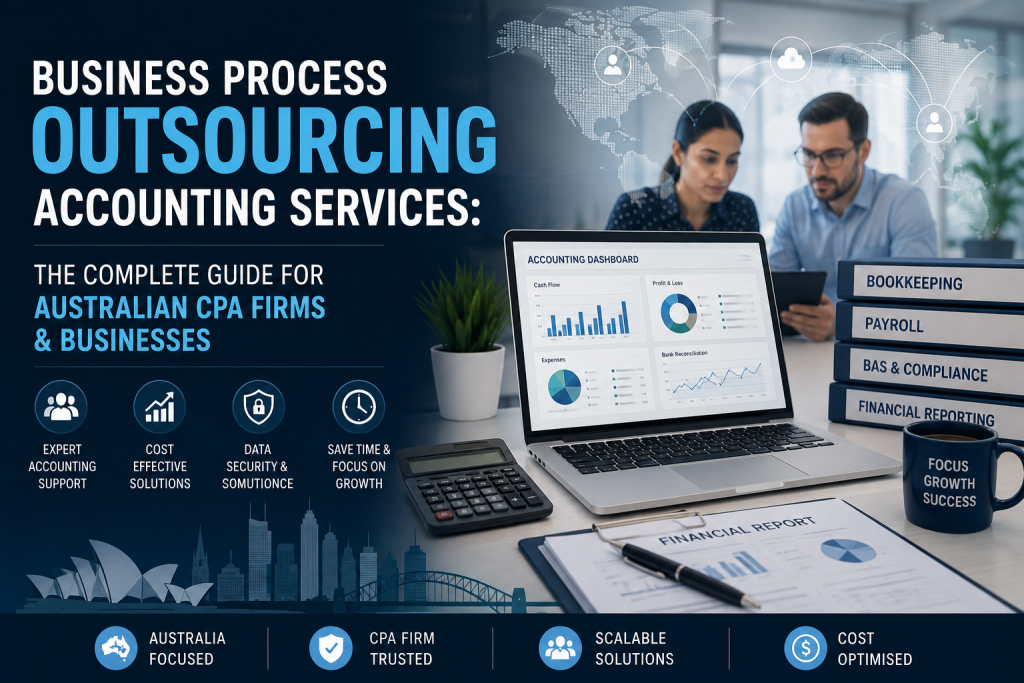
What Are Business Process Outsourcing Accounting Services?
BPO accounting services determine the practice of financing and accounting functions of the business through a professional third-party service provider that takes care of the entire process with the help of the professionals they employ, modern technologies they have implemented, and standardised operational processes. In contrast to the usual BPO industry, accounting BPO services provide more focused attention to the financial matters of business.
Commonly referred to as finance and accounting outsourcing, this model allows businesses to utilise expertise, boost accuracy of reporting, enhance compliance, and scale finance operations efficiently. This model has gained popularity among Australian businesses and CPA firms, which want to relieve employees from tedious working processes and make use of modern accounting technology.
Why Business Process Outsourcing Accounting Services Are Growing in Australia
BPO accounting services are increasing in demand amid a thirst for cost-effective, scalable, and tech-based finance solutions among Australian businesses. The rising compliance demands, increasing operational costs, and lack of correctly skilled accounting professionals are encouraging organisations to outsource financial functions while ensuring accuracy and staying within the legal framework.
The uprising in the use of cloud accounting platforms like QBO, MYOB, and Xero, combined with AI-based automation, has increased this transition. As per the National AI Centre, in Australia, 44% of Australian SMEs used AI in February 2026, which highlights the growing importance of digital technologies in modern financial operations and business decisions.
How Accounting BPO Works
Although finance and accounting business process outsourcing service providers have their own methodology and follow their own unique approach, the majority of accounting BPO projects have similar workflow patterns.
Step 1: Discovery
The provider assesses a business’s current accounting systems, reporting expectations, software architecture, and compliance responsibilities.
Step 2: Process Mapping
Current workflows are documented, and the possibilities for automation and standardisation are established.
Step 3: SOP Creation
Standard Operating Procedures (SOPs) are created to provide uniformity in any repetitive accounting processes.
Step 4: Team Allocation
Dedicated accountants, bookkeepers, coordinators and account managers are assigned to projects depending on the requirements.
Step 5: Cloud Software Setup
All required setup and integration of accounting software, DMS, payroll software and workflow software is carried out.
Step 6: Daily Processing
Regular tasks in accounting are carried out on the basis of previously established service levels.
Step 7: Quality Assurance
The reports are reviewed by senior accountants before being sent to customers.
Step 8: Client Review
Businesses are provided with continuous financial information, business insights and reports on compliance.
Step 9: Continuous Improvement
The processes are refined through automation, enhancements in reporting and workflow optimisation.
Which Accounting Processes Can Be Outsourced?
One of the greatest benefits of business process outsourcing Australia is the range of accounting services that can be outsourced. Here we have mentioned accounting processes that can be outsourced in Australia:
| Accounting Function | Can Be Outsourced? | What It Includes | Business Benefit |
| Bookkeeping | ✔ | Recording daily transactions, maintaining ledgers, expense categorisation, and updating financial records. | Accurate financial records and real-time financial visibility. |
| Accounts Payable | ✔ | Invoice processing, supplier payments, approval workflows, and vendor management. | Faster invoice processing and stronger supplier relationships. |
| Accounts Receivable | ✔ | Customer invoicing, payment tracking, collections, and overdue follow-ups. | Improved collections and healthier cash flow. |
| Payroll Processing | ✔ | Payroll calculations, PAYG withholding, superannuation, leave management, and payroll reporting. | Reduced payroll errors and compliance with employment regulations. |
| BAS Preparation | ✔ | Preparing and lodging Business Activity Statements, including GST and PAYG obligations. | Compliance with ATO requirements and timely lodgements. |
| GST Reporting | ✔ | GST calculations, reconciliation, and tax reporting. | Accurate tax reporting and reduced compliance risks. |
| Bank Reconciliation | ✔ | Matching bank transactions with accounting records and resolving discrepancies. | Better cash visibility and improved financial accuracy. |
| Tax Preparation | ✔ | Preparing business tax returns, supporting schedules, and tax documentation. | Reduced compliance risks and streamlined tax filing. |
| SMSF Accounting | ✔ | Financial statements, transaction recording, and compliance support for self-managed super funds. | Specialist superannuation expertise and regulatory compliance. |
| Financial Reporting | ✔ | Profit & loss statements, balance sheets, cash flow statements, and management reports. | Better decision-making through timely financial insights. |
| CFO Reporting | ✔ | KPI dashboards, board reports, financial analysis, and strategic recommendations. | Strategic business insights for sustainable growth. |
| Cash Flow Management | ✔ | Monitoring cash inflows and outflows, liquidity planning, and working capital analysis. | Improved liquidity planning and stronger financial stability. |
| Budgeting | ✔ | Preparing operational and annual budgets with cost allocation. | Better financial control and resource allocation. |
| Forecasting | ✔ | Revenue projections, expense forecasting, and scenario planning. | Smarter business planning and informed decision-making. |
| Compliance Reporting | ✔ | Regulatory reporting, audit support, and statutory documentation. | Reduced regulatory risk and improved governance. |
| Year-End Accounts | ✔ | Year-end reconciliations, financial statements, audit preparation, and closing the books. | Efficient financial close and audit readiness. |
Most modern service providers tailor their service packages depending on the size, industry, and complexity of operations of their clients.
Benefits of Accounting BPO
The development of accounting BPO has surpassed the simple cost-effectiveness of labour. Rather, it plays a crucial role in creating strong financial systems that enable firms to grow.
Scalability
BPO accounting services can scale up their finance processes according to their current workload without incurring any fixed expenses. This flexibility allows for successful adaptation to the seasonal changes in business volume or business expansion and changing accounting regulations.
Access to Specialists
Rather than relying solely on their in-house accountants, businesses can take advantage of entire teams of specialists in such areas as bookkeeping, payroll, taxation, compliance, etc.
Operational Resilience
An entire dedicated team ensures that the burden does not fall on any one individual and that continuity of services can be maintained even in case of staff holidays or business growth.
Faster Month-End Close
Standardised processes and automated reconciliation ensure rapid delivery of month-end results.
Improved Financial Reporting
Timely reports enable management to make sounder strategic decisions.
Better Cash Flow Visibility
Routine reconciliations and reporting provide an overview of cash inflows and outflows in real time.
Standardised Processes
Written procedures allow for the uniformity of operations, perfection in execution, and compliance with regulations.
Technology Adoption
BPO providers take advantage of cloud accounting applications, technological solutions, and artificial intelligence to deliver positive results.
Reduced Compliance Risk
Expert accounting teams follow developments in Australian fiscal policies and banking systems and thus avoid costly mistakes.
Accounting BPO vs Traditional Outsourcing
| Feature | In-House Accounting | Local Outsourced Accounting | Offshore Outsourced Accounting | Accounting BPO |
| Delivery Model | Internal finance team | Local accounting firm or independent accountant | Overseas accounting provider | Dedicated outsourced finance team with structured processes |
| Primary Focus | End-to-end internal accounting | Compliance and periodic accounting support | Cost-efficient transaction processing | Comprehensive finance and accounting management |
| Scalability | Limited by hiring capacity | Moderate | High | Very high with flexible resource allocation |
| Access to Specialists | Depends on internal hiring | Limited to firm capabilities | Varies by provider | Wide access to bookkeepers, payroll specialists, tax professionals, management accountants, and CFO-level expertise |
| Technology & Automation | Business manages its own systems | Varies by provider | Often limited to requested tools | Cloud accounting, AI automation, workflow management, and real-time reporting |
| Standardised Workflows | Depends on internal processes | Limited standardisation | Varies | Documented SOPs and quality-controlled processes |
| Business Continuity | Vulnerable to employee turnover and leave | Moderate | Moderate | Dedicated teams with backup resources and continuity planning |
| Compliance Support | Managed internally | Strong local compliance expertise | May require additional oversight | Strong compliance support with documented controls and reporting standards |
| Reporting Frequency | Depends on internal resources | Usually monthly or quarterly | Typically scheduled reporting | Real-time dashboards, monthly reporting, and management insights |
| Cost Structure | High fixed staffing and overhead costs | Service-based fees | Lower operating costs | Flexible, scalable pricing with access to specialised expertise |
| Best Suited For | Large organisations with established finance departments | Small businesses needing external accounting support | Businesses focused primarily on cost savings | Startups, SMEs, CPA firms, and growing businesses seeking scalable, technology-enabled finance support |
Accounting BPO blends expert knowledge, technology, established procedures and scalability in a complete finance solution.
Industries That Benefit Most
- CPA Firms: CPA firms use outsourcing to deal with excess work during tax periods, accounting bottlenecks, and deadline pressures while their employees focus on advisory and client work.
- Professional Services: Professional services like law firms & consultancies take advantage of simplified bookkeeping, invoicing, and financial reporting without specifically employing large financial teams.
- Healthcare Sector: Healthcare organisations benefit from outsourced accounting services in regard to payroll for multiple specialists, complex billing reconciliations, and stringent regulatory reporting.
- Retail Sector: Retail companies enjoy the advantages of automated accounting and inventory reconciliation, as well as cash flow availability due to a large number of transactions made.
- Hospitality: Hotels, restaurants, and hospitality businesses rely on accounting BPO to tackle ever-changing seasonal labour costs, pay payroll for multiple sites, and make daily reconciliations of multiple transactions.
- Manufacturing: Manufacturers benefit from accurate accounting of expenses, management of accounts payable for the suppliers, and generation of the financial reports that would assist with inventory and production planning.
- Construction: Construction businesses utilise outsourced accounting for job costing, invoicing, and payments to subcontractors as well as for adhering to the reporting requirements of the industry.
- Real Estate: Real estate agencies and property management firms utilise BPO service providers for the reconciliation of their trust accounts, tracking of commissions and timely reporting on their operations with multiple properties.
- Startups: Startups leverage BPO for accounting services, as it helps them access the same level of services as offered by CFOs without the difficult task of putting together the internal team from the outset.
- E-commerce: E-commerce businesses use outsourced accounting services to streamline their transactions, keep sales across different platforms accurate, comply with GST requirements, and track cash flows.
In all these fields, accounting BPO brings the freedom to either enlarge or decrease the scope of the finance operations, benefit from expert knowledge and ensure compliance while eliminating the burden of having extra expenses related to the formation of the internal finance team.
AI and Automation in Accounting BPO
Automation accounts for a lot in contemporary accounting BPO, as it accelerates processes, improves accuracy, and increases scalability within finance activities.
- OCR: This component extracts data from receipts and invoices electronically while minimising manual entry.
- Bank Feeds: It helps connect a bank account to cloud accounting systems like QBO, MYOB, and Xero, updating transactions in real-time.
- AI Categorisation: This technology is capable of learning from previous transactions to effectively classify the various types of expenses and revenue.
- Automated Reconciliations: It is aimed at decreasing the time necessary to match transactions of the bank with accounting records while flagging inconsistencies along the way.
- Approval Workflows: This enables the movement of receipts and expenses through the process of digital approval to strengthen control and auditing.
- Expense Automation: This allows the capturing of receipts while applying rules of expenses.
- Reporting Automation: It enables the generation of real-time dashboards and financial reports based on actual data.
All of these instruments help increase efficiency in accounting processes due to the time and effort saved from processing information manually.
Software Used in Modern Accounting BPO
The top business process outsourcing accounting services providers in accounting and finance are now preferring cloud accounting solutions instead of independent applications.
Common platforms include:
| Software | Primary Purpose | How Integration Improves Efficiency |
| Xero | Cloud accounting | Acts as the central ledger that receives data automatically from Dext, Hubdoc, and ApprovalMax, eliminating manual entry and keeping records real-time. |
| MYOB | Australian accounting and payroll | Syncs payroll, GST, and compliance data with connected apps, reducing duplicate entry and keeping statutory reporting accurate and up to date. |
| QuickBooks | SME accounting | Connects with capture and approval tools so transactions flow straight into the ledger, speeding up bookkeeping for smaller businesses. |
| Dext | Receipt capture and expense automation | Pushes OCR-extracted invoice and receipt data directly into Xero, MYOB, and QBO, removing manual data entry and reducing transcription errors. |
| Hubdoc | Document collection | Automatically fetches bills and statements and feeds them into the accounting platform, ensuring no source documents are missed or entered late. |
| ApprovalMax | Invoice approval workflows | Links approval decisions directly to the accounting platform, so only authorised transactions post to the books — no manual chasing or re-entry. |
| FYI Docs | Document management | Keeps client files and correspondence linked to the relevant job or ledger entry, cutting time spent searching across inboxes and folders. |
| Karbon | Practice management and workflow | Pulls status updates from connected tools into one workflow view, giving teams visibility into deadlines and job progress across all systems. |
Security and Compliance
Businesses require sound measures from any third party they hire to handle their financial information. Consequently, finance and accounting business process outsourcing service providers are required to comply with set standards and enforce precautionary measures against security breaches.
- ISO Practices: Providers are known to comply with ISO 27001 certification, which enables confirmation that they have set systematic measures to safeguard data.
- NDAs: An agreement is signed between the client and the accountants in which the former entrusts the latter with secret financial information.
- RBAC: Access to systems and client information is limited based on work roles; hence, employees only get to view what they need to do their work.
- MFA: More than just a password is needed to log in to a system, which prevents unwanted access by unauthorised persons even if given login credentials are compromised.
- Encryption: Both data in transit and data at rest are encrypted, thereby preventing access to confidential financial information.
- Privacy Act of 1988: Service providers who work with customers in Australia are expected to conform to the requirements of the Privacy Act of 1988. As per this Act, management of private and financial information needs to consider how the data is being collected, processed, stored, and shared.
- Australian Data Protection Considerations: Businesses must have an idea where their data is stored or processed, particularly because of overseas teams in their operations, and should have certain agreements in place with them about data handling and residency.
- Audit Trails: Accounting systems keep track of the people who have accessed, edited, or approved the data, thus making it easy to check compliance.
It is through these technologies that it is possible for companies in Australia to outsource finance operations without risking their data security.
In-house vs Offshore vs Local Accounting BPO
Selecting a service provider for business process outsourcing Australia, Australian businesses typically have the choice of using a local (onshore) or offshore service provider. Each of these options presents its own unique considerations in terms of cost, compliance knowledge, and communication.
| Accounting Model | Pros | Cons |
| In-House Accounting | • Full control over accounting processes, data, and workflows• Direct communication with internal teams and management• Strong understanding of the business, its operations, and financial goals• Greater control over sensitive financial information and compliance | • Higher costs for salaries, benefits, training, and accounting software• Recruiting and retaining skilled accounting professionals can be challenging• Limited scalability when transaction volumes increase• Internal teams may spend significant time on repetitive accounting tasks |
| Local Accounting BPO | • Strong knowledge of Australian taxation laws, the Privacy Act 1988, and ATO directives• Easier real-time communication due to a common time zone and language• Simpler due diligence for data residency and compliance• Better suited to complex or judgement-based activities, such as CFO reporting and tax strategy | • Higher hourly rates compared with offshore options• Talent shortages may limit access to skilled accounting professionals• Limited scalability for high-volume, repetitive transactions |
| Offshore Accounting BPO | • Significant labour-cost savings for high-volume, labour-intensive tasks• Access to large talent pools for bookkeeping, data entry, and transaction processing• High scalability as transaction volumes increase• Extended working hours can support faster completion of routine tasks | • Time-zone differences can make real-time collaboration more difficult• Requires strong oversight to ensure compliance with Australian standards, including the Privacy Act 1988• Potential communication and cultural gaps• Greater due diligence may be required when data is stored or processed overseas |
When Each Model Is Appropriate
In-House Accounting tends to suit:
- Businesses that need complete control over their accounting processes, financial data, and internal workflows.
- Companies handling sensitive or highly confidential financial information that prefer to keep accounting functions within the organisation.
- Businesses with stable transaction volumes and sufficient resources to hire and retain a dedicated accounting team.
- Organisations where finance teams are closely involved in strategic decision-making and management reporting.
Local BPO tends to suit:
- Businesses that require ongoing collaboration with their finance team
- Works that deals with an understanding of Australian law — like SMSF accounting, taxation, and compliance reports
- Midsize companies prefer ease of use over affordability
Offshore BPO tends to suit:
- Businesses that carry out considerable amounts of repetitive transactional work such as bookkeeping, accounts payable & receivable, and data entry.
- Cost-effective businesses like start-ups and SMEs that seek to expand operations without incurring huge fixed costs.
- Businesses that have well-established internal systems but need only execution capability.
How to Choose the Right Accounting BPO Provider
When choosing an accounting BPO provider, you must consider the impacts on financial accuracy, compliance, and business continuity. Use this checklist when choosing your accounting BPO partner.
- Industry Knowledge: Have they deployed sufficient industry knowledge to understand your requirements? Are they familiar with trust accounting, job costing, or payroll handling across different locations?
- Software Skills: Are they skilled in handling software such as Xero, MYOB, QuickBooks, and automation software like Dext and ApprovalMax?
- Security: Is there any certification from their side in the area of security, such as ISO 27001? Do they follow important security standards like RBAC access control or MFA?
- SLA: What is the turnaround time or the level of accuracy mentioned in their agreement with you?
- Communication: Will there be a dedicated account manager for you?
- References: Can they connect you with people you can work with in your industry who are of your size?
- Compliance Knowledge: Do they know the law of Privacy Act 1988, ATO requirements, GST, and payroll regulations?
- Scalability: Can they increase the resources right away during busy times like EOFY and tax season?
- Reporting Cadence: How often do you get reports, something like P&L, cash flow, and BAS?
- Pricing Transparency: Are the charges well defined? Are there any hidden costs such as training costs and software scaling?
Why Australian CPA Firms Choose Aone Outsourcing
Team Expertise
Aone Outsourcing has a team of more than 450+ professionals with comprehensive experience in complying with Australian regulations, ATO rules, and ASIC requirements. We have been in the industry for 11 years and served 2500+ businesses.
Focus on Australian Accounting
Aone Outsourcing provides various services based on Australian compliance obligations, such as STP Phase 2, payroll tax, and others. We work across all Australian states.
Software Used
We use software like Xero, QuickBooks Online, MYOB, and Hubdoc, but also master FreshBooks, KeyPay, and Deputy and can also provide migration help for clients with other platforms.
Quality Assurance
At Aone Outsourcing, deliverables undergo a quality assessment before being presented to the client as part of a defined onboarding-to-delivery process.
Communication Model
Each client is assigned an individual contact who provides periodic updates about the progress, unlike the system, in which a varying group performs various tasks.
Security Practices
Aone has achieved ISO 27001 certification, and the processes laid down for the handling of the data are described as enterprise-level solutions compliant with the ATO.
Dedicated Teams
Every client is allocated a dedicated team instead of sharing access to a talent pool with other clients. The same people are appointed for each new assignment and are familiar with the client’s business practices.
Final Thoughts
As businesses in Australia are adopting cloud accounting solutions, automated systems, and AI technologies in their accounting practices, the use of business process outsourcing accounting services has gained huge importance in the modern business environment by enhancing efficiency, cutting compliance costs, and getting access to the best financial specialists. The services of accounting BPO range from bookkeeping and payroll to reports generated by CFOs as well as financial forecasting, allowing clients to get the most flexible and effective solutions.
It is critical to find the outsourcing firm that combines qualified people, effective technologies and a good understanding of accounting laws in Australia. In this regard, businesses should make sure that finance and accounting business process outsourcing service providers meet their business goals when choosing to cooperate with a particular provider.
FAQs
What are business process outsourcing accounting services?
Business process outsourcing accounting services involve outsourcing accounts and finance functions to a third-party provider that manages them using professional teams, technology and standardised processes.
What accounting tasks can be outsourced?
Bookkeeping, accounting payables & receivables, payroll, BAS, GST reporting, bank reconciliation, tax preparation, financial reporting, budgeting, forecasting and compliance reporting can all be outsourced.
Is accounting BPO secure?
Reputable accounting BPO services use security measures like ISO27001 practices, NDAs, role-based access control, MFA, encryption and audit trails to protect the financial data.
What is the difference between accounting BPO and bookkeeping?
Bookkeeping mainly covers recording and maintaining financial transactions, while accounting BPO can provide broader end-to-end financial services, including payroll, reporting, compliance, forecasting and CFO support.
How much does accounting BPO cost?
Accounting BPO costs vary depending on services required, business size, transaction volume, complexity and whether the provider is local or offshore.
Is offshore accounting suitable for Australian CPA firms?
Yes, offshore accounting can suit CPA firms for high-volume repetitive tasks such as bookkeeping and transaction processing, provided strong Australian compliance, data protection and quality control are in place.
Which software is commonly used in accounting BPO?
Usually Xero, MYOB, QuickBooks Online, Dext, Hubdoc, ApprovalMax, FYI Docs and Karbon.
Can small businesses use accounting BPO?
Yes, small businesses and startups can use accounting BPO to access specialist financial support, improve scalability and reduce the need for a large in-house accounting team.