
 Australia
 USA
USA Canada
 UK
UK Ireland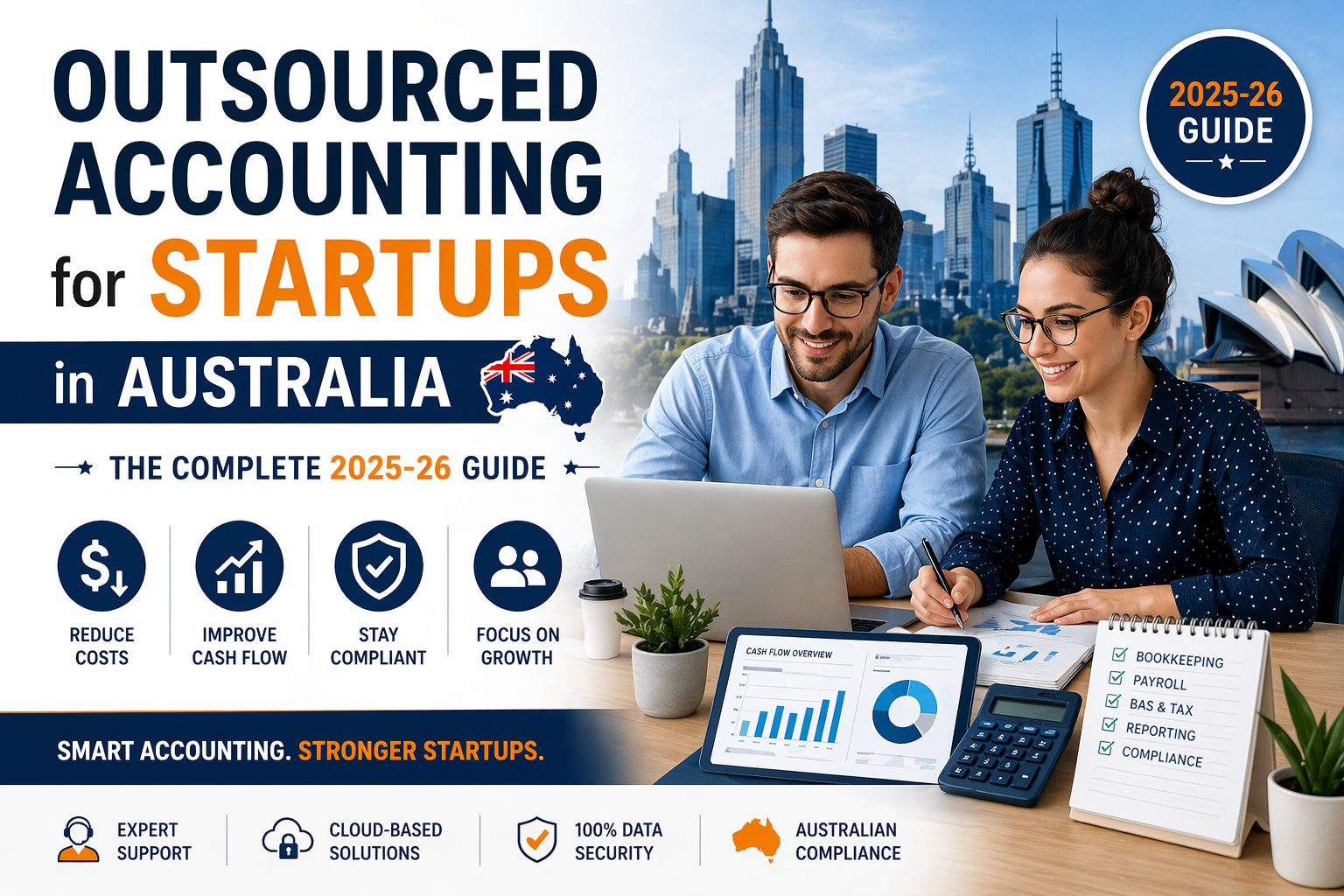
Australia’s startup ecosystem is one of the most dynamic in the Asia-Pacific region. With over 4,500 active tech startups and billions in venture funding flowing through the market each year, founders are under immense pressure to move fast — and stay compliant. But behind every growth story is a financial foundation that has to be rock-solid from day one.
That’s where outsourced accounting for startups comes in. Accounting outsourcing for startups has quickly become the preferred model for Australian founders who need expert compliance without the overhead of an in-house hire.
What Is Outsourced Accounting for Startups?
Outsourced accounting for startups in Australia is the practice of engaging an external accounting firm or specialist team to manage your financial operations — including bookkeeping, BAS lodgement, payroll, superannuation, and ATO compliance — instead of building an in-house finance function.
Rather than spending months recruiting, training, and retaining a dedicated accountant, Australian founders delegate their entire financial back office to a team that already lives and breathes the local regulatory environment. The outcome is expert-level compliance, cleaner books, and much more time to focus on establishing the actual business.
The Australian startup ecosystem is rapidly developing and is currently among the fastest-growing in Asia-Pacific, with thousands of active tech, SaaS, and e-commerce startups in Sydney, Melbourne, Brisbane, and beyond. However, one of the most overlooked issues when starting a business is financial compliance – especially in a regulatory landscape filled with requirements of the ATO, Fair Work Act, and Superannuation Guarantee requirements, which arise the instant you recruit your first staff member or pass the GST threshold.
Getting your accounting infrastructure right from the start not only ensures compliance but also helps you feel more in control of your startup’s growth and funding prospects, reducing uncertainty about costs and timing.
What Services Are Included in Outsourced Accounting for Startups?
Startup accounting services cover every financial function your business needs, delivered as a fully managed package to keep you compliant and investor-ready in Australia. Startup accounting services typically cover bookkeeping, BAS lodgement, payroll, and tax compliance. Here is what that typically includes:
Bookkeeping (Xero, MYOB, QuickBooks)
A healthy startup company’s accounting is supported by day-to-day bookkeeping. The providers outsourced employees to cloud-based systems such as Xero, MYOB, and QuickBooks to document income and expenses and reconcile bank transactions in real time. This provides you with an accurate and always-up-to-date picture of your financial status – essential when you have to report to your investors or seek financing.
BAS and GST Lodgement
One of the most significant compliance requirements for Australian startups, and the one most inadequately handled, is Business Activity Statement (BAS) lodgement. After you set up GST, you are required to submit your BAS to the ATO monthly or quarterly. Late or incorrect lodgements are subject to penalties and scrutiny by the ATO. Outsourced accountants do all of this: they compute the GST, prepare the BAS and submit them within the stipulated time through the ATO business portal.
|
Important: If your startup earns or expects to earn $75,000 or more in annual turnover, you are legally required to register for GST in Australia. Your outsourced accountant will guide you through this threshold and manage your ongoing GST obligations. |
Payroll and Superannuation Compliance
Hiring your first employee comes with a series of responsibilities under the Fair Work Act and the Superannuation Guarantee. Outsourced payroll services will ensure that your staff are paid the correct amount, PAYG withholding is calculated and paid to the Australian taxation office, and super contributions are submitted on time via a compliant clearing house. Any mistake in payroll or missed super payments would place your startup at risk of heavy fines.
Tax Returns and ATO Compliance
End-to-end processing is done with annual company tax returns, PAYG instalments and fringe benefits tax (FBT) reporting. Your outsourced team keeps up to date with changes at the ATO, so you do not need to, and they can also be your representative if the ATO requires clarification.
Financial Reporting
Clean financial statements are desired by investors, lenders, and grant bodies in Australia. The monthly Profit and Loss statements, Balance Sheets, and Cash Flow reports prepared by outsourced accountants are accurate, in a professional format, and ready to share.
Virtual CFO Services
Some providers of Virtual CFO (vCFO) services are available to startups that have raised their Series A or are fast scaling. A vCFO offers strategic financial advice – budgeting, forecasting, financial modelling, investor readiness and board-level reporting – at a fraction of the price of a full-time CFO. It is particularly useful to Australian startups that are undergoing ESIC (Early Stage Innovation Company) status, R&D Tax Incentive claims, or export grant applications.
How Outsourced Accounting Works: Step by Step
The onboarding process with a professional outsourced provider usually takes less time than a recruitment process, providing a clear timeline so founders can align this with their startup’s growth milestones. Here is the typical journey:
Step 1: Business Assessment. Your provider reviews your business structure, current turnover, industry, GST registration status, and any existing payroll obligations. They identify compliance gaps — including any historical BAS lodgements that may need attention — and establish a clear picture of what needs to be set up and managed going forward.
Step 2: Accounting Software Setup. Xero, MYOB, or QuickBooks is configured with the correct chart of accounts, GST tax codes, and integrations for your specific business — whether that is a Shopify store, a SaaS subscription billing platform, or a multi-currency payment gateway.
Step 3: Data Migration. Historical financial data is migrated cleanly into the new system, ensuring your books are complete and audit-ready from the start of your engagement.
Step 4: Ongoing Bookkeeping and BAS Preparation. Transactions are recorded and reconciled on a regular cycle. BAS is prepared and submitted to the ATO ahead of every quarterly or monthly deadline, with no need for founder involvement beyond providing access to relevant accounts.
Step 5: Monthly Financial Reporting. You receive structured monthly reports covering your profit and loss, cash position, and key business metrics. These are formatted consistently so they are ready to share with investors or board members the moment they are delivered.
Step 6: ATO Compliance and Annual Filing. Company tax returns, PAYG summaries, superannuation reconciliations, and any required ATO correspondence are managed on your behalf throughout the financial year.
Why Australian Startups Choose Outsourced Accounting
There are several compelling reasons why accounting outsourcing for startups has become the go-to model for founders who need compliance without the overhead across Sydney, Melbourne, Brisbane, and beyond, rather than hiring in-house. Here are the most significant benefits specific to the Australian context:
Lower Operational Cost Without Sacrificing Quality
A qualified accountant in Australia earns between $65,000 and $95,000 a year – and that is before you take into consideration any mandatory superannuation (11.5 per cent of regular earnings), entitlement to leave and sick leave, office space, computer licences and the cost of time in recruitment. By outsourcing your accounting services, you can reduce these overheads by 40% to 60% and access a whole team of experts instead of a single generalist employee.
Deep Expertise in ATO Regulations
The needs of the Australian Taxation Office change periodically – not only Single Touch Payroll (STP) updates but also changes to the R&D Tax Incentive scheme. Having an outsourced accounting team focused solely on startups ensures the company stays up to date with all ATO updates and remains continuously compliant, with no need for constant training.
Accurate GST and BAS Reporting
One of the most frequent and most costly errors for startups in Australia is incorrect GST coding or late BAS submission. Outsourced experts ensure that your GST tax codes are properly established initially and submit all BAS on time to avoid penalties or interest imposed by the ATO.
Scalability That Matches Your Growth
Your accounting requirements will be radically different whether you are a pre-revenue start-up or are about to raise a Series B. Outsourced accounting can grow with you, adding payroll services as you add staff, preparing investor-ready financial statements as you raise capital, and moving to vCFO services, as your needs become more complicated, without the hassle of recruiting and retaining.
Immediate Access to Cloud Accounting Tools
Xero Certified, MYOB Partners or QuickBooks ProAdvisors are outsourced providers. They configure and streamline your cloud accounting environment to enable you to see your financial position in real-time on mobile dashboards, automated bank feeds and live reporting without having to become an accounting software specialist yourself.
In-House vs. Outsourced Accounting: The Australia Comparison
The decision between hiring in-house and outsourcing your accounting comes down to cost, capability, and compliance. Here is an honest comparison for Australian startups:
|
Factor |
In-House Accountant (Australia) |
Outsourced Accounting |
|
Cost |
High salary from $65,000–$95,000+ AUD/yr plus super |
Significantly lower — typically 40%–60% less than in-house |
|
ATO Compliance |
Depends entirely on hire quality |
Expert-level, up-to-date ATO knowledge |
|
BAS & GST |
May need ongoing upskilling |
Handled by specialists as standard practice |
|
Superannuation |
Must be managed internally |
Fully managed and compliant |
|
Scalability |
Limited — headcount increase required |
Highly flexible — scales with your startup |
|
Cloud Tools |
Varies by individual hire |
Xero, MYOB, QuickBooks as standard |
|
Reporting |
Depends on in-house capability |
Regular, structured financial reporting |
|
Setup Time |
Weeks to recruit and onboard |
Fast onboarding, typically within days |
For most Australian startups — particularly those with fewer than 20 employees or under $5 million in annual revenue — the outsourced model delivers greater capability at a lower cost than hiring a dedicated accountant. Rather than relying on a single in-house accountant for startups, outsourcing gives you an entire specialist team.
What Does Outsourced Accounting Cost for an Australian Startup?
While pricing varies by provider and scope, the most useful frame is not the absolute cost of outsourcing — it is how it compares to the alternatives.
An experienced accountant in Australia who is not a partner earns between $65,000 and $95,000 per annum. Add the 11.5% Superannuation Guarantee, annual and sick leave, payroll taxes, software license, and the cost of hiring, and the total employer cost of a single accounting employee is between $110,000 and $130,000 annually. The equivalent outsourced function would normally cost 40% – 60% less and provide a complete team of specialists, rather than a simple generalist.
Within the outsourced model, the cost of your engagement is shaped by several factors specific to your startup:
- The volume of monthly transactions and the number of bank accounts to reconcile
- Whether you are registered for GST and how complex your GST coding requirements are
- The number of employees on payroll and your superannuation obligations
- Any industry-specific compliance requirements — such as GST treatment for imported digital goods in e-commerce
- The scope of services required, from basic outsourced bookkeeping through to full vCFO support
Requesting a customised quote based on your specific situation will give you the most accurate picture. A quality provider will always be transparent about scope and pricing from your first conversation.
When Should an Australian Startup Outsource Its Accounting?
The short answer is: as early as possible. The longer answer is that there are specific moments in a startup’s journey when outsourcing stops being a smart option and becomes a practical necessity.
When you register for GST, the line in the sand is the $75,000 AUD threshold. When crossed, you must file monthly or quarterly BAS returns, complete GST coding, and provide continuous reporting to the ATO. Proper setup at the time of registration helps avoid costly mistakes that can accrue over time.
When you lodge your first BAS, when you are making your BAS without the advice of specialists, the chances of making mistakes are great. One lodgement with incorrect GST calculations can be time- and effort-consuming to rectify and may attract the attention of the ATO.
When you first hire an employee. Payroll, PAYG withholding, superannuation, and STP reporting commence simultaneously. The Fair Work Ombudsman and the ATO are proactive in investigating payroll compliance matters, and the repercussions of making a mistake are grave.
When you raise investment, investors perform due diligence on your financials. Professionally prepared accounts that are clean, i.e. with an easily understandable audit trail and no unaccountable transactions, are the minimum requirement. Scattered books at this point can slow down or even kill a funding round.
When you expand operations, new states, new product lines, international sales – every one of them creates additional accounting complexity, which is better handled by a specialist team initially.
When you apply for grants or the R&D Tax Incentive, the R&D Tax Incentive in Australia is a refundable tax credit equal to 43.5% of an eligible start-up’s qualifying R&D expenditure. To make this benefit claim accurately, they must have careful financial records, particular expenditure classification, and professional knowledge of the eligibility requirements. A hired accountant who understands the incentive will ensure your startup receives all the dollars it is owed.
Common Accounting Challenges Australian Startups Face
Understanding what can go wrong is just as important as knowing what to do right. These are the most common accounting problems that Australian startup founders encounter — and how outsourcing addresses them:
Incorrect GST Reporting
Use of an incorrect GST tax code on transactions, particularly SaaS subscriptions, sales in foreign markets, or mixed-use costs, results in errors in BAS that may attract an ATO audit or lead to lost input tax credits. Outsourced accountants will set up your software properly the first time and review each transaction category.
Late BAS Lodgement Penalties
The ATO levies a Failure to Lodge (FTL) penalty, imposed per day for each overdue BAS. These penalties are cumulative for startups with limited cash flow. With an outsourced provider, all BAS deadlines are handled on your behalf; you do not need any reminders.
Payroll Compliance Issues
Australian employers face the most severe compliance risks, including underpayment of wages, misinterpretation of awards, and failure to make superannuation payments. The Fair Work Ombudsman and ATO actively investigate these issues. Outsourced payroll experts ensure that the pay run is correct and the super contribution is submitted on time.
Poor Cash Flow Tracking
Lots of startups mix cash with profit. Founders will fail to detect the symptoms of waning cash flow until it is too late without regular, accurate financial reporting. You can make informed decisions with a clear, up-to-date picture of your cash position provided by your outsourced accountant monthly.
Inadequate Financial Records for Funding Rounds
One of the most frequent causes of stalling the startup funding round during due diligence is disorganised or incomplete accounts. With an outsourced accounting department, your books are always audit-ready: so when an investor requests 24 months of financials, you can provide them on the same day.
Is Outsourced Accounting Safe for Australian Startups?
Security and confidentiality are legitimate concerns when sharing financial data with an external team. Here is how reputable providers protect your business:
Secure cloud platforms. Xero, MYOB, and QuickBooks all use bank-grade 256-bit encryption for data in transit and at rest. Access is managed through role-based permissions, meaning your provider sees only what they need to do their job.
Data privacy compliance. Reputable providers working with Australian clients adhere to the Privacy Act 1988 and the Australian Privacy Principles (APPs). If your provider operates offshore, confirm that data handling agreements are in place and that equivalent standards bind them.
Tax Practitioners Board registration. Any provider lodging documents with the ATO on your behalf — BAS, tax returns, or any other ATO correspondence — must be a registered tax agent under the Tax Practitioners Board (TPB). Always verify your provider’s TPB registration number before engaging them. This is non-negotiable.
Audit trails and version control. Cloud accounting platforms maintain a complete, immutable audit trail of every transaction entry and modification. You have full visibility into your financial records at all times, and every change is timestamped and attributed to the user who made it.
Confidentiality agreements. Confidentiality clauses govern professional accounting engagements, and providers operating under CPA Australia or Chartered Accountants ANZ membership are bound by professional codes of conduct that include strict client confidentiality obligations.
Who Should Use Outsourced Accounting in Australia?
Rather than hiring a traditional accountant for startups, outsourcing gives you access to an entire specialist team. Outsourced accounting suits a wide range of Australian startups at different stages of maturity:
Early-Stage Startups
There are no better cases than pre-revenue and bootstrapped startups, which should at least get their compliance foundation right at the start, before the habits of making costly errors have a chance to develop. Proper establishment of GST, clean bookkeeping, and having a BAS process in place on day one is much cheaper than picking up the mess a few months later.
SaaS Startups
Software-as-a-Service companies often have a complex GST treatment: subscriptions charged to Australian and foreign clients, exemptions for digital products, recognition of deferred revenue, and multi-currency transactions all add to accounting complexity that generalist bookkeepers struggle to manage. Outsourced accountants with experience in the SaaS model appropriately recognise revenue and ensure that GST is correctly applied across all transaction types.
E-Commerce Startups
Online stores require accurate GST tracking of various products, platforms (Shopify, WooCommerce, Amazon Australia) and payment gateways (Stripe, PayPal, Afterpay). E-commerce businesses have outsourced bookkeepers who directly connect to your selling stack and handle the proper recording and taxation of sales, returns, and fees.
Funded Startups
After raising capital, your investors will expect you to compile monthly professional reports, prepare board packs, and provide a clear understanding of how capital is being utilised. Outsourced accounting, especially with a vCFO overlay, can fulfil those expectations without you having to develop a finance team that your startup might not yet warrant.
How to Choose the Right Outsourced Accounting Partner in Australia
Not every accounting provider understands the specific needs of startups. And not every offshore provider understands the Australian regulatory environment. Use this checklist when evaluating potential partners:
- Demonstrated experience working with Australian startups specifically — not just SMEs in general
- Proven knowledge of ATO requirements, BAS lodgement cycles, GST coding, and Superannuation Guarantee obligations
- Xero Certified Adviser, MYOB Partner, or QuickBooks ProAdvisor accreditation
- Tax Practitioners Board (TPB) registration — essential for any provider lodging with the ATO on your behalf
- Transparent engagement terms with clearly defined scope, turnaround times, and escalation processes
- A regular communication cadence that includes monthly reporting, proactive compliance reminders, and access to a real person when you have questions
- References or case studies from startups at a similar stage and in a similar industry to yours
- Clear data security policies — especially important if the team is based offshore.
- Scalable service tiers that can grow with you from bookkeeping through to vCFO as your needs evolve
Pro tip: Ask any prospective provider how they handle ATO correspondence, BAS amendments, and payroll compliance queries — and what their standard turnaround time is for month-end reporting. The quality and specificity of the answers will tell you a great deal about how they operate day to day.
Final Thoughts
Australia’s startup ecosystem rewards founders who move fast. But the ATO rewards those who stay compliant. Outsourced accounting gives you both the operational agility to focus on building your business and the assurance that your financial obligations are being handled by specialists who understand the Australian regulatory environment inside out.
Whether you are a solo founder approaching the GST threshold for the first time, a funded startup preparing investor-ready financials every month, or a scaling SaaS business navigating the complexities of international revenue and Australian tax law, the right accounting services for startups deliver expert-level financial management at a cost structure that makes sense for where you are right now.
The startups that get this right early are not just more compliant. They are more fundable, more scalable, and better positioned to make the decisions that actually grow the business.
Frequently Asked Questions
What is outsourced accounting in Australia?
Outsourced accounting in Australia implies hiring an external company or a team of specialists to handle your startup’s financial operations, such as bookkeeping, BAS and GST filings, payroll, superannuation and ATO tax compliance instead of the employment of a full-time accountant. It provides start-ups with expert-level financial management at a much lower price than developing an internal service.
Can startups outsource bookkeeping only?
Yes. Bookkeeping-only services are available to startups with many outsourced providers who do not do their tax returns or have an existing part-time tax adviser. This will allow you to maintain your books tidy and up to date in Xero or MYOB without incurring expenses for services you are not yet required to use.
Is outsourced accounting compliant with ATO requirements?
Yes – as long as you have a registered Tax Agent with the Tax Practitioners Board (TPB). TPB-registered agents have the legal authority to file BAS, tax returns, and other documents with the ATO on your behalf. Make sure that your provider is registered before you hire them.
When should an Australian startup start outsourcing its accounting?
Ideally, from the moment you register your company, or as soon as you approach the $75,000 GST threshold. The sooner you have clean, compliant financial records, the smoother all the next steps, payroll, funding, tax returns, grant applications, etc.
What accounting services does an Australian startup typically need?
At least: bookkeeping, lodging of BAS and GST and annual company tax returns. After recruiting employees, you will need to undertake payroll and superannuation compliance. The value of monthly financial reporting and virtual CFO services increases as you grow and raise funds.
Does my Australian startup need to register for GST?
You are legally required to register for GST once your current or projected annual turnover reaches $75,000 AUD (or $150,000 for non-profit organisations). Alternatively, you can be registered voluntarily below this threshold, which can be advantageous if you have substantial business expenditures and wish to claim input tax credits.
Can I use Xero and still outsource my accounting?
Absolutely. The majority of outsourced accounting engagements in Australia are on Xero. A Xero Certified Adviser usually sets up your account, controls access rights, and works directly in your Xero file, providing complete visibility as they do the technical work.
Is it safe to outsource startup accounting to an offshore team from Australia?
Yes, and with an appropriate service provider. The offshore companies listed below are reputable, work with Australian startups under TPB registration (or through an agent registered in Australia), use Xero or MYOB, comply with the Australian Privacy Principles, and have strong data security policies. Always ensure that credentials are verified, seek references from Australian clients, and read the engagement agreement thoroughly before signing.
What is a Virtual CFO, and does my startup need one?
A Virtual CFO (vCFO) is a part-time or retainer-based outsourced top-level financial professional who offers strategic financial advice (budgeting, forecasting, investor reporting and board-level advice) to a business. The vCFO usually helps Australian startups to raise a large financing round, grow quickly or become acquisition-ready. It offers the ability of a CFO at a fraction of the expense of a full-time executive.