
 Australia
 USA
USA Canada
 UK
UK Ireland
A BAS (Business Activity Statement) is a tax form submitted by GST-registered businesses in Australia to report and pay GST, PAYG withholding, PAYG instalments, and other obligations to the ATO. BAS filing is mandatory for every GST-registered business — and missing your BAS dates carries financial penalties.
For most Australian small businesses, quarterly BAS is due on the 28th of the month following each quarter’s end. Whether you’re asking when is Q2 BAS due, when is Q3 BAS due, or what the December quarter BAS due date is — this guide has every date, every BAS period, and everything you need before lodgement.

Whether you run a sole trade, a startup or a growing enterprise, tracking your BAS due dates is what stands between you and unnecessary penalties or a cash flow scramble.
The Australian Taxation Office (ATO) expects most GST-registered businesses to submit a BAS monthly, quarterly, or annually, based on the business turnover and reporting requirements. In most cases, the BAS submission due dates are quarterly, but whenever you miss even one of them, it will lead to extra costs and hardship.
Whether you prepare your lodgement internally or delegate it to a registered BAS agent, this guide will assist you in always being prepared and never stressed – at least, not about BAS compliance – at the last minute.
What is a BAS Statement
A BAS statement (Business Activity Statement) is a form lodged with the Australian Taxation Office by businesses registered for GST. It is employed to submit and pay various tax returns in a single location.
A standard BAS statement consolidates your key business tax obligations — including GST, PAYG Withholding, PAYG Instalments, and, where applicable, FBT Instalments, Wine Equalisation Tax and Luxury Car Tax — into a single lodgement. A detailed breakdown of each component is covered in Point 1 below.
BAS lodgment is required even if your business had no activity in a given period — a nil BAS must still be submitted by the due date.
Things To Consider Before Filing Your BAS
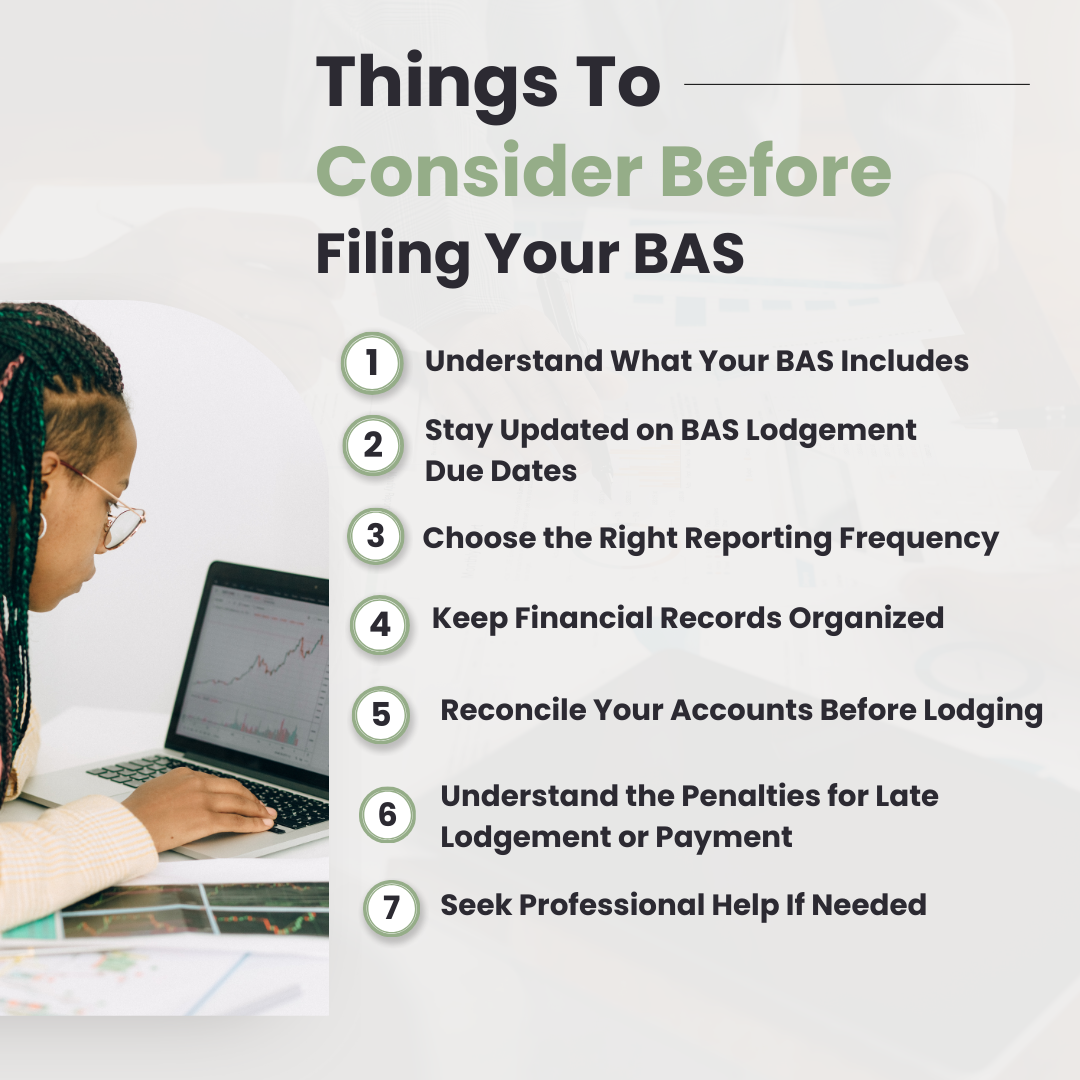
Here are the things before filing your BAS lodgements:
1. Understand What Your BAS Includes
First of all, one must be very clear as to what should be included in BAS. It typically includes:
Goods and Services Tax (GST)
Pay As You Go is a method of withholding tax whereby amounts are deducted at the source to the tax office, with the remaining to be paid to the employee.
PAYG instalments
Fringe Benefits Tax (FBT) instalments
Wine Equalisation Tax (WET) and Luxury Car Tax (LCT), if applicable
It is worth noting that each BAS submission differs depending on the business type and size. If any of these elements are misreported or omitted, it leads to discrepancies with the ATO’s records — and often a penalty. The BAS needs to be lodged, and it is only effective when the information to be submitted is well understood and prepared.
2. Stay Updated on BAS Lodgement Due Dates
Penalties and interest costs may also be incurred for failing to meet BAS lodgements, while the company’s reputation suffers with the Australian Taxation Office (ATO). a) Below are the ATO’s recent quarterly BAS due dates for the financial year 2026-27 2024-2025:
| Quarter | BAS Periods | Standard Due Date | With Tax BAS/Agent |
| Q1 | 1 July – 30 September | 28 October | 25 November |
| Q2 | 1 October – 31 December | 28 February | 28 February |
| Q3 | 1 January – 31 March | 28 April | 26 May |
| Q4 | 1 April – 30 June | 28 July | 25 August |
| 28 February 2027 falls on a Sunday, so the standard due date shifts to Monday 1 March. | |||
If you lodge quarterly BAS online through Online services for business, myGov, or SBR-enabled software (Xero, MYOB), you may be eligible for an extra two weeks to lodge and pay — the Q2 concession doesn’t apply, since its 28 February date already includes a built-in one-month buffer.
Such BAS payment due dates for BAS apply whether you lodge manually, electronically or through an agent. However, it is pertinent to mention the fact that engaging a BAS or tax agent is likely to enable you to get an extended deadline, which is always useful when you are conducting a business.
GST Due Dates in Australia
GST due dates follow the same schedule as your BAS lodgment dates above — there’s no separate GST calendar to track if you’re already diarising your quarterly BAS dates.
| Quarter | BAS Period | GST Payment Due |
| Q1 | July – September | 28-Oct |
| Q2 | October – December | 28-Feb |
| Q3 | January – March | 28-Apr |
| Q4 | April – June | 28-Jul |
For monthly BAS lodgers, GST is due on the 21st of each following month. For annual lodgers, the GST payment is due 31 October.
When Is Your BAS Due?
When is quarterly BAS due?
Quarterly BAS is due on the 28th of the month following the end of each quarter — unless lodging through a BAS agent, which may provide an extended deadline.
When is Q2 BAS due?
The Q2 BAS due date is 28 February. This covers the October–December (December quarter) BAS period. No agent extension applies — both self and agent lodgers share this deadline.
When is Q3 BAS due?
The Q3 BAS due date is 28 April for standard lodgers, or 26 May through a registered BAS agent. This covers the January–March BAS period.
When is March BAS due?
The March quarter BAS (Q3) is due 28 April for self-lodgers, or 26 May if using a BAS agent.
When is BAS due for the last quarter?
The Q4 BAS (April–June) is due 28 July for standard lodgers, or 25 August through a BAS agent.
What is the December quarter BAS due date?
The December quarter BAS due date is 28 February — with no agent extension for this quarter.
3. Choose the Right Reporting Frequency
BAS can also be filed monthly, quarterly, or annually, depending on your business’s GST turnover.
Monthly: For businesses with GST turnover of $20 million or more
Quarterly: Most small businesses fall under this category
Annually: If voluntarily registered for GST and turnover is under $75,000
It is equally important to understand your correct reporting frequency so as not to select the wrong frequency, which may cause you to have mismatched BAS statement due dates or to submit the wrong tax return.
4. Keep Financial Records Organized
The following entries should be incorporated into your records in order to file BAS returns accurately, especially in terms of the dates;
All tax invoices
Payroll summaries and PAYG records
Bank statements
Expense receipts
Cloud accounting software (Xero, MYOB, QuickBooks) can track these records automatically and send BAS deadline reminders as your lodgement date approaches. Bookkeeping also shows that when it is time to file, one will not be searching for documents at the last minute.
5. Reconcile Your Accounts Before Lodging
Before preparing your BAS, clear your GST and PAYG accounts. This process step will increase the chances that the figures in your return align with the records held by the ATO and avoid any adjustments or complications arising during an audit.
BAS is filed based on lodgement due dates, and reconciling beforehand avoids entering figures in the wrong account or leaving out something important in the final computation of tax that must be paid to the government.
6. Understand the Penalties for Late Lodgement or Payment
The ATO also has penalty units for late BAS payment due dates or statements. These penalties translate to higher operating costs for small businesses, especially if they often pay in arrears or understate taxes due to underestimations. To remain compliant with the BAS and prevent receiving a bill for some audited BAS, it is beneficial to outsource your BAS to a registered BAS agent.
7. Seek Professional Help If Needed
If the BAS process above feels like a lot to manage on top of running your business, that’s a common reason owners bring in outside help. More and more business owners in Australia have contracted professional help for BAS preparation to relieve stress and meet all the BAS lodgement submission deadlines. BAS professional arrangements guarantee that BAS is lodged correctly, is lodged when it should be lodged and meets ATO requirements.
BAS in Australia — At a Glance:
- GST-registered businesses must lodge a BAS monthly, quarterly, or annually
- Most small businesses lodge quarterly, due on the 28th of the following month
- Q2 (December quarter) BAS is due 28 February — no agent extension
- Q3 (March quarter) BAS is due 28 April, or 26 May with a BAS agent
- Missing a BAS date triggers ATO penalties starting at $364 per 28-day period
- A nil BAS must still be lodged even with zero business activity
Frequently Asked Questions (FAQs)
1. What are the quarterly BAS due dates for 2025 and 2026?
BAS due dates follow a consistent pattern: the 28th of the month after each quarter ends. For the current FY2026-27 cycle: the July–September 2026 quarter is due 28 October 2026, October–December 2026 is due 1 March 2027 (28 February falls on a Sunday), January–March 2027 is due 28 April 2027, and April–June 2027 is due 28 July 2027. Registered BAS or tax agents can secure extended dates for Q1, Q3 and Q4 — see the table above.
2. What if I miss a BAS lodgement deadline in 2025 or 2026?
The ATO, however, may apply late lodgement penalties if the BAS has not been lodged on time as indicated below. This can also have an impact on the records of your taxes and your compliance. It’s always advisable to submit BAS before the due dates of the BAS statement, and in the event that one has a tendency to miss the deadline, one should consult with the BAS agent or the ATO for an extension.
3. When are BAS payment due dates in 2025 and 2026?
The BAS payment deadlines follow its lodgement deadlines, which are usually on the 28th of the subsequent month, on the particular financial year’s quarter end. Many of the companies make payments to their suppliers or for their services from the vendors, and these payments should be made within the required time to avoid the extra interest cost. To minimize the chances of missing the BAS deadline, you should allow for direct debit, BPAY or use the ATO online services.
4. Do I still need to lodge if my business had no activity during the quarter?
Yes. Even if you did not have any income or expense in the relevant period, it is mandatory that you file the nil BAS for your business. This helps you submit your BAS on time and within the legal requirements of the Australian tax law. This may result in automatic reminders, non-lodgement notices, or penalties may be imposed by the ATO.
5. What’s the best way to stay on top of BAS lodgement and payment deadlines?
To ensure you do not miss your BAS lodgement dates or due dates for BAS payments, you can make use of the online business rather than go for a registered BAS agent. Some of the accounting software also has features that include reminders and calendars, which you need to use to assist when it comes to remembering various BAS quarterly dates for the submissions.
6. What are the BAS quarters in Australia?
Australia has four BAS quarters: Q1 (July–September), Q2 (October–December), Q3 (January–March), and Q4 (April–June). Each quarter has a standard BAS due date of the 28th of the following month. Most quarters may have a longer deadline for businesses that are lodged through a registered BAS agent.
7. When is Q3 BAS due?
Q3 BAS is the period between January and March and is due 28 April to typical lodgers. When you lodge via a registered BAS agent, the deadline is extended to 26 May. Another term used to refer to this quarter is the March quarter BAS.
8. When is March BAS due?
The March quarter BAS (Q3) is due 28 April for businesses lodging directly. The users of a registered BAS agent have until 26 May. It is always good to have your records reconciled by the end of January, through to March, to prevent last-minute mistakes or late payments.
9. When is BAS due for the last quarter?
The final quarter BAS (Q4) covers April–June and is due 28 July for standard lodgers. Businesses that book via a registered BAS agent have a deadline that is extended to 25 August. This is the last BAS lodgment of the Australian financial year.
10. What happens if I miss a BAS lodgment deadline?
The ATO applies a Failure to Lodge penalty of one penalty unit ($313 in 2024–25) for every 28-day period your BAS remains outstanding, up to five penalty units. General Interest Charges are charged on any outstanding amounts. The sooner the lodging is done, the less the penalty will be.