
 Australia
 USA
 Canada
 UK
 Ireland




The Australian financial year runs from 1 July to 30 June. The current financial year is FY2026–27 (FY27), beginning Wednesday, 1 July 2026 and ending Wednesday, 30 June 2027. In October 2026, Australia is in Q2 (1 October–31 December 2026). The financial year is also commonly called the fiscal year, income year or tax year, although some tax obligations use a different reporting period.
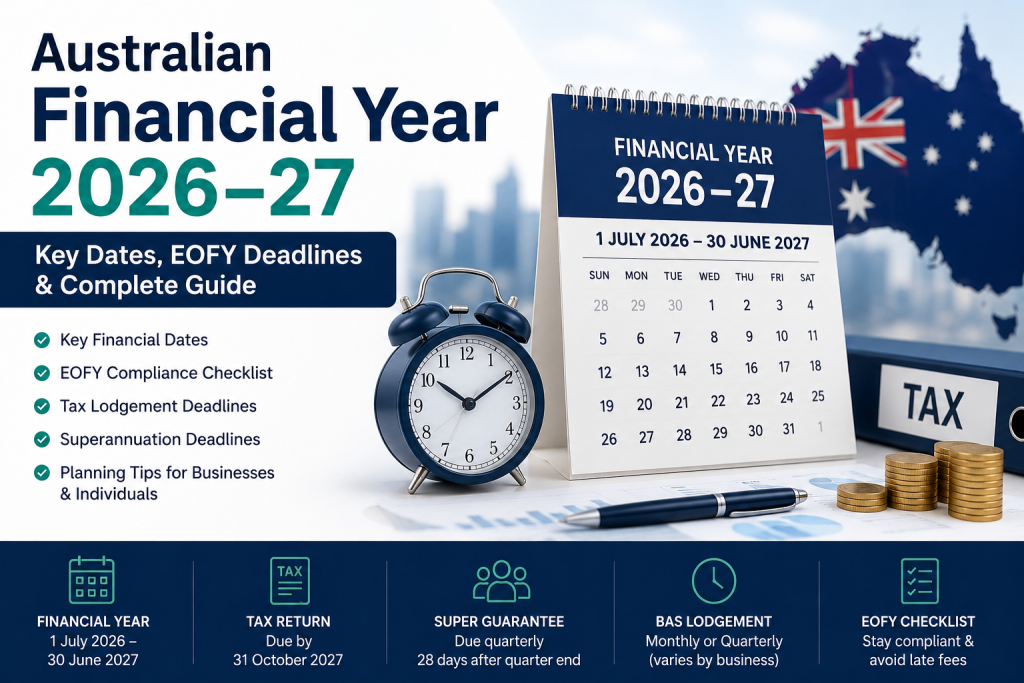
For most individuals lodging their own FY2025–26 income tax returns, the usual calendar deadline is 31 October 2026. Since this falls on a Saturday, the next-business-day rule generally means Monday, 2 November 2026. Different dates may apply to registered tax-agent clients and specific circumstances.
What Is the Australian Financial Year?
The Australian financial year is the 12-month period running from 1 July to 30 June of the following year. It provides the main reporting period for individual income tax and many business accounts, budgets and annual financial statements. FY2026–27 is also written as FY27, 2026/27 or 26/27.
| At a glance | FY2026–27 |
| Starts | 1 July 2026 |
| Ends | 30 June 2027 |
| Current quarter in October 2026 | Q2: October–December |
| Previous financial year | FY2025–26 (FY26) |
Quick date answer: In Australia, the financial year starts on 1 July and finishes on 30 June. For October 2026, the current financial year is 2026–27, also written FY27. The previous or last financial year was 2025–26 (FY26); the next financial year will be 2027–28 (FY28).
What Financial Year Are We In? FY26 or FY27?
Australia is currently in FY2026–27, commonly called FY27. Australian financial years are named after the calendar year in which they end. FY27 began on 1 July 2026 and ends on 30 June 2027.
The Australian financial year does not follow the calendar year. January to June 2027 remains part of FY2026–27.
| Financial year | Period covered | October 2026 status |
| FY25 | 1 July 2024 – 30 June 2025 | Ended |
| FY26 | 1 July 2025 – 30 June 2026 | Ended |
| FY27 | 1 July 2026 – 30 June 2027 | Current |
| FY28 | 1 July 2027 – 30 June 2028 | Upcoming |
You may also see the current financial year written as 2026–27, 2026/27 or 26/27. When a document only says FY26 or FY27, check the accompanying dates to avoid confusion.
If you are checking “what financial year are we in Australia?” or “what FY are we in?”, the answer is FY27 as at October 2026. FY26 refers to the 12 months from 1 July 2025 to 30 June 2026, not the calendar year 2026.
When Does the Australian Financial Year Start and End?
The Australian financial year starts on 1 July and ends on 30 June the following year. The final day is known as the end of financial year (EOFY).
- First day of FY2026–27: Wednesday, 1 July 2026
- Last day (EOFY): Wednesday, 30 June 2027
- First day of FY2027–28: Thursday, 1 July 2027
The calendar year, by contrast, runs from 1 January to 31 December. This difference matters for tax returns, financial reporting, GST and budgeting.
For anyone checking last financial year dates or the 25–26 financial year, FY2025–26 began on 1 July 2025 and ended on 30 June 2026. The next new financial year begins on 1 July 2027, after FY2026–27 ends on 30 June 2027.
Financial Year Quarters in Australia (FY2026–27)
The Australian financial year has four quarters, each covering three months. Businesses use these periods for financial reporting and, where applicable, quarterly GST and Business Activity Statement (BAS) reporting.
| Financial quarter | Dates in FY2026–27 | Calendar quarter | Also called |
| Q1 | 1 July – 30 September 2026 | Q3 2026 | September quarter |
| Q2 | 1 October – 31 December 2026 | Q4 2026 | December quarter |
| Q3 | 1 January – 31 March 2027 | Q1 2027 | March quarter |
| Q4 | 1 April – 30 June 2027 | Q2 2027 | June quarter |
The financial-year quarters and calendar-year quarters use different numbering because the Australian financial year starts in July rather than January.
FY2025–26 Financial Year Quarters
The previous Australian financial year, FY2025–26, ran from 1 July 2025 to 30 June 2026.
| Financial quarter | Dates in FY2025–26 | Also called |
| Q1 | 1 July – 30 September 2025 | September quarter |
| Q2 | 1 October – 31 December 2025 | December quarter |
| Q3 | 1 January – 31 March 2026 | March quarter |
| Q4 | 1 April – 30 June 2026 | June quarter |
Which financial quarter are we in? In October 2026, Australia is in the second financial quarter (Q2) of FY2026–27. Unlike calendar-year quarters, Australian financial quarters begin in July: Q1 is July–September, Q2 is October–December, Q3 is January–March and Q4 is April–June.
Quarterly BAS Due Dates for FY2026–27
Quarterly BAS lodgment and payment dates depend on the reporting period, lodgment method and eligibility for any agent or online concessions. The dates below are a planning guide, not a substitute for the due date shown in ATO Online Services or the relevant registered-agent program.
| Reporting period | Standard BAS deadline | Common eligible registered-agent date |
| July–September 2026 (Q1) | 28 October 2026 | 25 November 2026 |
| October–December 2026 (Q2) | Sunday, 28 February 2027; next business day is Monday, 1 March 2027 | No additional standard Q2 extension |
| January–March 2027 (Q3) | 28 April 2027 | 26 May 2027 |
| April–June 2027 (Q4) | 28 July 2027 | 25 August 2027 |
Some online and registered-agent concessions apply only if their conditions are met. Confirm the operative date rather than assuming an extension is available. Searches for “financial year 2026” or “FY2026” can refer to different periods. Under the usual Australian financial-year naming convention, FY2026 means FY2025–26 (ending 30 June 2026), while FY2026–27 is FY27. Always check the start and end dates rather than relying on the abbreviated label alone.
Australian Financial Year Dates: FY2019–20 to FY2027–28
Australian financial years always run from 1 July to 30 June. The table below provides a year-by-year reference for past, current and upcoming financial years.
| Financial year | Short name | Start date | End date | Days |
| 2019–20 | FY20 | 1 July 2019 | 30 June 2020 | 366 |
| 2020–21 | FY21 | 1 July 2020 | 30 June 2021 | 365 |
| 2021–22 | FY22 | 1 July 2021 | 30 June 2022 | 365 |
| 2022–23 | FY23 | 1 July 2022 | 30 June 2023 | 365 |
| 2023–24 | FY24 | 1 July 2023 | 30 June 2024 | 366 |
| 2024–25 | FY25 | 1 July 2024 | 30 June 2025 | 365 |
| 2025–26 | FY26 | 1 July 2025 | 30 June 2026 | 365 |
| 2026–27 | FY27 | 1 July 2026 | 30 June 2027 | 365 |
| 2027–28 | FY28 | 1 July 2027 | 30 June 2028 | 366 |
A financial year has 365 days in a standard year and 366 days when it includes 29 February. A financial year date is not necessarily a tax return due date. The Australian tax year generally follows 1 July to 30 June, but the date a return must be lodged depends on the taxpayer and applicable lodgment arrangements.
When Are Australian Individual Tax Returns Due?
The usual calendar date for individuals lodging their own Australian tax returns is 31 October after the end of the income year. Eligible clients using a registered tax agent may qualify for a later deadline under the ATO’s lodgment program.
The 15 May date is a common deadline for eligible registered-agent clients, not a universal date. Some taxpayers must lodge earlier, depending on their circumstances and lodgment history.
| Income year | Usual self-lodgment date | Common registered-agent date for eligible clients |
| FY2024–25 | Friday, 31 October 2025 | Friday, 15 May 2026 |
| FY2025–26 | Saturday, 31 October 2026 | Saturday, 15 May 2027 |
| FY2026–27 | Sunday, 31 October 2027 | Monday, 15 May 2028 |
Where a due date falls on a weekend or public holiday, the ATO generally allows lodgment on the next business day. Verify your actual due date in ATO Online Services or with your registered tax agent.
Special Registered-Agent Tax Return Deadlines
The ATO’s registered-agent lodgment program uses different dates based on taxpayer category, lodgment history and other conditions. Important dates for FY2025–26 returns may include 31 October, 31 March 2027 and 15 May 2027. A 5 June concession may be available in certain circumstances; this is a conditional concession, not a universal replacement due date.
Do not assume you qualify for a later date simply because you use a tax agent. Check the official current-year agent program and your individual ATO account.
Is the Tax Year the Same as the Financial Year in Australia?
For most Australian individuals and businesses, the income year used for income tax follows the same dates as the financial year: 1 July to 30 June. The ATO generally refers to this period as the income year.
For example, an FY2026–27 tax return covers relevant income, deductions and other reportable information for the period from 1 July 2026 to 30 June 2027.
There are important distinctions:
- Income tax year: Generally 1 July to 30 June.
- Fringe benefits tax (FBT) year: 1 April to 31 March.
- Substituted accounting period: Some eligible entities may receive ATO approval to use an alternative accounting period.
- Overseas tax years: Other countries may use different reporting periods.
Businesses with overseas operations or alternative reporting arrangements should confirm which period applies to each tax and accounting obligation.
FY2026–27 Key Dates and Deadlines
The following dates are general planning references. Legislative changes, lodgment concessions, entity circumstances and weekend rules can affect the applicable deadline. Confirm compliance dates with the ATO.
| Date | Key event or deadline | Status as of 12 October 2026 |
| Wednesday, 1 July 2026 | FY2026–27 begins. Payday Super commences. | Passed |
| Tuesday, 14 July 2026 | General STP finalisation deadline for FY2025–26. | Passed |
| Tuesday, 28 July 2026 | Q4 BAS deadline for April–June 2026 and final quarterly super guarantee payment deadline under the previous payment cycle. | Passed |
| Friday, 28 August 2026 | TPAR deadline for relevant contractor payments made during FY2025–26. | Passed |
| Friday, 28 August 2026 | General SGC statement and payment deadline for employers that missed the final quarterly super payment deadline for April–June 2026. | Passed |
| Wednesday, 28 October 2026 | Standard Q1 BAS deadline for July–September 2026. Eligible businesses may qualify for a later deadline. | Upcoming |
| Saturday, 31 October 2026 | Usual calendar date for self-lodging FY2025–26 individual tax returns. The next business day is Monday, 2 November. | Upcoming |
| Thursday, 31 December 2026 | Q2 of FY2026–27 ends. | Upcoming |
| Sunday, 28 February 2027 | Q2 BAS calendar due date. The next business day is Monday, 1 March 2027. | Upcoming |
| Wednesday, 31 March 2027 | Common registered-agent deadline for certain individuals and trusts whose latest lodged return resulted in a tax liability of $20,000 or more, subject to the applicable program. | Upcoming |
| Wednesday, 28 April 2027 | Standard Q3 BAS deadline for January–March 2027. | Upcoming |
| Saturday, 15 May 2027 | Common registered-agent program date for eligible FY2025–26 individual tax returns. The next business day is Monday, 17 May. | Upcoming |
| Saturday, 5 June 2027 | Potential concessional date for eligible individuals and trusts with a 15 May deadline, provided the applicable conditions are met. | Upcoming |
| Wednesday, 30 June 2027 | FY2026–27 ends. Businesses should review year-end accounts, payroll and tax records. | Upcoming |
| Wednesday, 14 July 2027 | General STP finalisation deadline for FY2026–27. | Upcoming |
| Wednesday, 28 July 2027 | Standard Q4 BAS deadline for April–June 2027. | Upcoming |
| Saturday, 28 August 2027 | Usual TPAR deadline for relevant contractor payments made during FY2026–27. | Upcoming |
| Sunday, 31 October 2027 | Usual calendar date for self-lodging FY2026–27 individual tax returns. The next business day is Monday, 1 November. | Upcoming |
Registered tax agent dates do not apply automatically to every taxpayer. They depend on being on the agent’s client list in time and on your lodgment history. Some clients must lodge earlier because prior-year returns are outstanding or other program conditions apply.
The ATO’s guidance on BAS deadlines, taxable payments reporting, STP finalisation, super guarantee charge and registered-agent lodgment program explains the relevant obligations.
Official ATO Resources
Use these resources to check applicable requirements and deadlines:
- BAS due dates — standard quarterly deadlines and the online-lodgment concession.
- Penalty units — check the applicable Commonwealth penalty-unit value and legislation.
- Failure-to-lodge penalties — how late lodgment penalties work.
- Work-related expense deductions — eligibility and record-keeping guidance.
- Registered-agent lodgment program — agent dates, eligibility and concessions.
- Payday Super — changes to super payment timing from 1 July 2026.
- Super guarantee rates — applicable super guarantee rates.
- Taxable payments reporting system — TPAR requirements and annual reporting.
What Changed From 1 July 2026?
The 2026–27 financial year includes changes to superannuation payments and individual income tax. The status of each measure matters: a measure that has been announced is not necessarily law.
Payday Super
The 2026–27 year introduces Payday Super payment timing changes. Employers should review payroll configuration, payment processes, employee super details and reconciliations against the ATO’s current Payday Super guidance. Detailed exceptions and statutory timing should be checked with an appropriately qualified adviser.
Super Guarantee Rate
The super guarantee rate for FY2026–27 is 12%. Employers must calculate contributions in accordance with the applicable rules and the relevant earnings base.
Personal Income Tax Rates
For FY2026–27, the marginal tax rate for Australian resident taxpayers on the portion of taxable income above $18,200 and up to $45,000 is 15%, down from 16% in FY2025–26.
The rate applies to the relevant portion of taxable income, not to all income. Individual tax liability also depends on other applicable rates, offsets, levies and circumstances.
$1,000 Standard Deduction for Work-Related Expenses
EDITORIAL VERIFICATION REQUIRED BEFORE PUBLICATION: The supplied 12 October review states the $1,000 standard deduction has commenced for eligible taxpayers in 2026–27; older indexed ATO material still describes it as proposed. Confirm the enacted status, eligibility rules and treatment of other work-related claims directly with the current ATO guidance before replacing the live paragraph. Do not publish a definitive entitlement claim without that verification.
What Happens If You Miss an ATO Deadline?
Missing a required lodgment or payment deadline can lead to failure-to-lodge penalties, interest or other ATO action. The amount depends on the obligation, the entity and relevant law. Late lodgment and late payment are separate issues.
For documents due on or after 1 July 2026, the page currently cites a $364 penalty-unit value. Reconfirm that value and the applicable small, medium and large entity multipliers against current ATO guidance before publishing.
| Situation | Possible consequence |
| Late tax return, BAS or other required document | Failure-to-lodge penalty |
| Late payment of tax | General interest charge (GIC) |
| Unpaid or late super guarantee contributions | Super Guarantee Charge and related obligations |
| Repeated or serious non-compliance | Further ATO compliance action |
Late lodgment and late payment are separate issues. Both penalties and interest can apply to the same outstanding obligation. Contact the ATO or a registered tax agent promptly if you expect to miss a deadline. Penalty remission may be available in eligible circumstances, but it is not guaranteed.
For further details, read the ATO’s failure-to-lodge penalty guidance and check the current penalty-unit rules.
How the Financial Year Affects Individuals and Businesses
The financial year determines the period used for many Australian tax and business reporting activities. The exact obligations depend on whether you are an employee, sole trader, company, trust or other entity.
For Individuals
Individuals may need to:
- Report employment, investment and other relevant income.
- Gather records for eligible deductions and offsets.
- Check pre-filled income information before lodging.
- Lodge their tax return by the applicable deadline.
- Keep supporting records as required.
For Businesses
Businesses may need to:
- Reconcile bank accounts, receivables and payables.
- Prepare and lodge BAS and other required reports.
- Review GST and PAYG withholding obligations.
- Reconcile payroll and complete STP finalisation.
- Meet applicable Payday Super and contractor-reporting obligations.
- Prepare year-end financial statements and tax information.
Accurate records throughout the year make year-end reporting easier and help businesses identify discrepancies before deadlines approach.
Aone Outsourcing supports Australian businesses and accounting firms with outsourced bookkeeping, BAS accounting, payroll services and tax preparation support. The appropriate service depends on your requirements, internal resources and existing accounting workflow.
EOFY Checklist for Australian Individuals and Businesses
Use this checklist to prepare for 30 June and reduce last-minute reconciliation work.
Individual EOFY Checklist
- Review income statements and other income records.
- Organise receipts and records for potentially eligible deductions.
- Check investment income and capital gains information.
- Review super contributions and relevant supporting records.
- Confirm the tax return deadline that applies to you.
Business EOFY Checklist
- Reconcile all bank accounts and business credit cards.
- Review outstanding customer invoices and supplier bills.
- Reconcile GST, PAYG withholding and BAS records.
- Check payroll records and prepare STP finalisation.
- Review Payday Super processes and outstanding contributions.
- Review contractor payments and TPAR reporting requirements.
- Check inventory records and complete a stocktake where applicable.
- Review fixed assets, depreciation and supporting documents.
- Prepare year-end financial reports and tax information.
- Confirm company, trust and other lodgment dates with the ATO or a registered tax agent.
NEW PRACTICAL STEP: Assign an owner and review date to each EOFY task. Record unresolved discrepancies and supporting evidence before handing the file to an accountant or registered tax practitioner.
Why Does Australia’s Financial Year Run From July to June?
Australia’s July-to-June financial year has historical roots in its colonial administrative arrangements and was retained as the country’s national accounting system developed. Today, the period provides a common reporting framework for government budgets, income tax and many business accounting processes.
Using a consistent annual cycle helps organisations compare financial performance, prepare tax returns, plan budgets and manage reporting obligations. Australia’s financial year is distinct from the calendar year, which runs from January to December.
How Australia’s Financial Year Compares With Other Countries
Financial and tax years vary internationally. These differences matter for businesses with overseas operations, international employees or cross-border income.
| Country | Common financial or tax year | Important distinction |
| Australia | 1 July – 30 June | Standard income year for most taxpayers |
| New Zealand | 1 April – 31 March | Standard tax year for many taxpayers |
| United Kingdom | 6 April – 5 April | Personal tax year; company accounting periods can differ |
| India | 1 April – 31 March | Standard financial year |
| United States | 1 January – 31 December for most individuals | Federal government fiscal year runs from 1 October to 30 September |
| Canada | 1 January – 31 December for most individuals | Federal government fiscal year runs from 1 April to 31 March |
These are general comparisons. Special rules may apply to businesses, trusts, government bodies and people with international tax obligations.
Australian states and territories generally follow the same 1 July–30 June financial year for standard tax and financial reporting purposes.
Can a Business Use a Different Financial Year-End?
Yes. Some businesses can use a substituted accounting period (SAP) if they obtain the required ATO approval. This arrangement may be useful when an Australian entity needs to align its reporting period with an overseas parent company or another qualifying business arrangement.
An alternative year-end should not be adopted without confirming eligibility and obtaining the necessary approval. Most Australian businesses use the standard 1 July–30 June financial year.
Need Help With Australian Bookkeeping and BAS Reporting?
Accurate year-round bookkeeping makes EOFY easier. Aone Outsourcing supports Australian businesses and accounting firms with bookkeeping, BAS preparation support, payroll processing and tax-preparation workflows, subject to the engagement scope and applicable professional responsibilities.
Explore Aone Outsourcing bookkeeping, BAS accounting and payroll service, or contact the team to discuss which parts of your accounting workflow can be outsourced.
The following short answers cover common searches about current, previous and next financial years, Australian tax year dates, EOFY dates and financial quarters.
Frequently Asked Questions
1. What financial year are we in?
Australia is in FY2026–27 (FY27), which runs from 1 July 2026 to 30 June 2027.
2. Are we in FY26 or FY27?
Australia is in FY27. FY2025–26 ended on 30 June 2026, and FY2026–27 began on 1 July 2026.
3. When does the Australian financial year start and end?
The Australian financial year starts on 1 July and ends on 30 June the following year. FY2026–27 runs from 1 July 2026 to 30 June 2027.
4. What quarter of the financial year are we in?
From 1 October to 31 December 2026, Australia is in Q2 of FY2026–27. Q3 starts on 1 January 2027, and Q4 starts on 1 April 2027.
5. What are the Australian financial year quarters?
Q1 runs from July to September, Q2 from October to December, Q3 from January to March, and Q4 from April to June. These are also known as the September, December, March and June quarters, respectively.
6. What do FY26, FY27 and FY28 mean?
FY26 refers to 1 July 2025 to 30 June 2026. FY27 covers 1 July 2026 to 30 June 2027, while FY28 covers 1 July 2027 to 30 June 2028.
7. When does the 2026–27 financial year end?
FY2026–27 ends on Wednesday, 30 June 2027. The next financial year begins on Thursday, 1 July 2027.
8. Is the tax year the same as the financial year in Australia?
For most Australian individuals and businesses, the income tax year runs from 1 July to 30 June. The fringe benefits tax year runs from 1 April to 31 March.
9. When is my FY2025–26 tax return due?
The usual self-lodgment date is Saturday, 31 October 2026. You can generally lodge on the next business day, Monday, 2 November 2026, without a failure-to-lodge penalty. Eligible registered-agent clients may have a later deadline, depending on their circumstances and the ATO’s lodgment program.
10. How many days are in FY2026–27?
FY2026–27 has 365 days, equal to 52 weeks and one day. FY2027–28 has 366 days because it includes 29 February 2028.
11. Can I be penalised for missing a tax return deadline?
Potentially. The ATO may impose failure-to-lodge penalties and interest depending on the obligation and circumstances. Check your actual due date and seek registered-agent advice where needed.
12. Does the $1,000 work-related expense deduction apply in FY2026–27?
The eligibility and legal status of this measure must be confirmed against the latest ATO guidance before claims are made. It does not apply to FY2025–26 returns.
13. How does Payday Super affect FY2026–27?
Employers should review when contributions must reach employees’ funds and update payroll controls under the rules applicable from 1 July 2026.
14. Why does Australia use a July-to-June financial year?
The convention has historical administrative origins and remains the standard period for government budgets and most income-tax reporting.
15. Can a business use a different year-end?
Some entities may be eligible for an approved substituted accounting period; confirm eligibility and ATO approval requirements.
16. What is the 5 June tax agent concession?
It is a conditional concession for certain eligible clients, not a universal due date. Check the current ATO registered-agent lodgment program.
17. What were the dates of the last financial year?
The last completed Australian financial year was FY2025–26 (FY26), from 1 July 2025 to 30 June 2026.
18. When does the next financial year start in Australia?
The next financial year, FY2027–28 (FY28), starts on 1 July 2027 and finishes on 30 June 2028.
19. Is the end of the financial year always 30 June in Australia?
The standard Australian end-of-financial-year date is 30 June. Some eligible entities may use an approved substituted accounting period, so their accounting year-end can differ.