
 Australia
 USA
USA Canada
 UK
UK Ireland




Even though the End of Financial Year (EOFY) may still be months away, innovative Australian businesses know that preparation shouldn’t start in June — it starts now. When you are running a start-up or are in charge of a big company, you have a great chance when you set time aside to sort out your financials long before the end of the year.
A systematic End of Financial Year checklist is your financial checklist, as it enables you to remain within the Australian Taxation Office (ATO) regulations whilst discovering ways to utilise tax deductions better and improve cash flow. Rather than a minute scramble, now you would find it easy to go to June confident in the knowledge that you have your bills, payroll, and records sorted out.
This is a step-by-step EOFY guide that is aimed at Australian businesses. You will know how to make your financials one step at a time, automate your accounting systems—everything you need to make your next year-end a hassle-free and strategically sound plan.
Why You Need a Financial Year-End Checklist?
The task of keeping finances in order is not merely a compliance issue but also a control issue in the Australian fast-moving business environment. The financial year-end checklist provides you with that control, transforming the rather intricate accounting operations into an easily understandable action plan.
A financial checklist will keep your business ATO compliant every year without facing a single beat. It maintains the accuracy of your financial records, maximises your tax deductions, and your reporting. Through a process of review of accounts, payroll, and expenses, you will never face a last-minute shock, and you will present the actual financial position of your business in your records.
Financial strategy is also enhanced with a year-end financial review checklist. It assists in identifying areas for growth, uncovering inefficient processes, and preparing for a potential audit with confidence.
More to the point, it will make you a forward-thinking person, enabling you to anticipate, allocate resources efficiently, and make sound business decisions as early as next year.
Pro Tip: Do not wait until June to start looking at your finances. A mini annual end check at the end of every quarter to ensure that you are compliant, audit-ready, and not stressed when EOFY comes.
Financial Year-End Checklist for Australian Businesses (2025 Update)
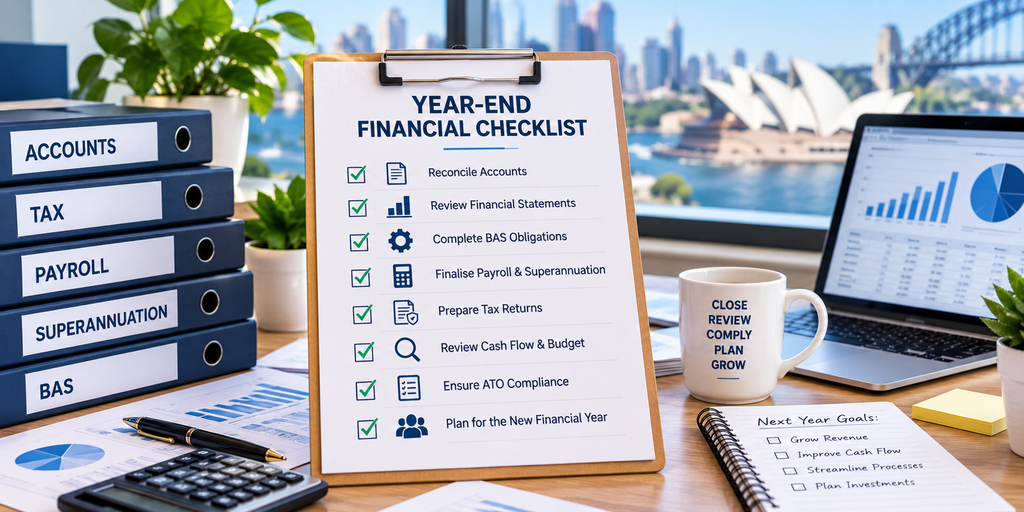
An Australian business should prepare well in advance of the End of the Financial Year (EOFY). Rather than hastily completing reconciliation and tax calculations in June, an accountable accounting checklist at the end of the year will ensure accuracy, compliance, and peace of mind.
The following are the key points to follow to sort out your books effectively by the 2025 financial close. Whether you are handling your accounts yourself or using a professional accountant, by following this accounting checklist, your end-of-year review will be smoother and more efficient.
1. Prepare Your Financial Paperwork
Any year-end accounting checklist must begin with clean, reconciled financial records. To start, balance all bank accounts, credit cards, and petty cash so that all transactions are correct in your accounts.
Then you can add all invoices, bills, and receipts to your accounting software, such as Xero, MYOB, or QuickBooks. This will ensure that all the incomes and expenses are reported accurately.
Consider all the expense categories and ensure that they are placed in the proper categories, since misplacing expenses can incur an impact on your taxable income as well as the accuracy with which this information is represented. Lastly, make sure you check your loan statements and interest payments to confirm that the numbers match your balance sheet.
2. Review Accounts Payable and Receivable
This is because it is a healthy cash flow, which is determined by how you manage what you are owed and what you owe. One of your end-of-year checklists in accounts is to review accounts receivable, update outstanding invoices, send reminders, and close old accounts that will not be collected.
If some debts cannot be recovered, they are reported as bad-debt write-offs to maintain high accuracy and reflect real profitability. On the payable ledger, all supplier invoices should be entered, and all payments made on time, so that suppliers can maintain good relations with them.
It is also prudent to check the GST requirements for payables and receivables, ensuring they align with your Business Activity Statement (BAS). Being consistent in this case helps to minimize errors and keep your EOFY checklist audit-ready.
3. Carry out Stocktake (if applicable)
In a product-based business, a stocktake is an imperative before year-end closure. It is more than a mere paper whack, as it makes sure that your records of inventory reflect accurate, real physical quantities. Compare the available inventory with your inventory management system, record the difference, and identify the cause: inventory, theft, or a data entry mistake.
Determine old, damaged, and expired inventory and modify values as needed. Such modifications may affect your Cost of Goods Sold (COGS) and, eventually, your taxable income.
According to ATO requirements, all companies with inventory must provide the correct closing value of stock at the close of the financial year. This helps ensure compliance and provides insights into purchasing and sales performance.
4. Audit Assets and Depreciation
Your assets there speak volumes about the business’s expansion, but only if they are used correctly. The first thing you should do is review your fixed asset register to ensure all your assets are registered. Assess the depreciation schedules for each item against the ATO guidelines.
If you bought new equipment, vehicles, or office equipment in FY 2024-25, it is essential to add these items and depreciate them. Equally, eliminate old or scrap assets that do not add value.
It is also an opportune moment to evaluate your suitability for temporary full expensing or other ATO small business depreciation. By utilizing these tax breaks, you can minimize your taxable income and improve your cash flow.
When this is finished, you need to update your asset register with an accurate value and situation at the start of the next financial year.
5. Check Payroll, STP, and Super Obligations
One of the most frequent EOFY issues is payroll errors—and these can be prepared in advance. Balance your Single Touch Payroll (STP) reports with your internal payroll data so that wages, tax, and super contributions for employees are perfectly synchronized.
Check that the superannuation payments are completed and on time; keep this in mind, as payments made before 30 June are deductible in the same year. PAYG withholding obligations are correctly reported and lodged with the ATO.
Use this to check the stock of leave and employee records to ensure that they comply with the requirements of the Fair Work. After all checks are complete, send employees and their income statements through myGov, as paper group certificates have been abandoned.
To ensure a silky, compliant payroll process, look out for Payroll Outsourcing Services – Aone Outsourcing.
6. Plan Tax Deduction and Concession
EOFY planning does not rely solely on compliance but also on strategy. The last thing you should check in your year-end accounting audit is tax deductions and government concessions, which may be helpful to your business.
Assess the deductible costs, including office rent, utilities, insurance, travel, software, and professional fees. Take into account the possibility of paying in advance some expenses, such as the insurance or rent, so that you can claim deductions sooner.
Upon eligibility, utilize instant asset write-offs and research and development tax credits to lower the taxable income. Simplified depreciation options and tax offsets should also be considered to increase the chances of savings for small businesses.
With forethought, you can recognize plausible deductions, and you will not miss out on benefits that directly enhance your bottom line.
EOFY Checklist for Individuals and Sole Traders
Even though the EOFY is generally seen as a business issue, individuals and sole traders also have their respective end-of-year obligations. Your own and business finances are your concern, unlike in a large business, and it is all the more important to have a clear financial year-end checklist.
First, list all your income sources, including your regular job, freelance work, and side gigs. Regardless of how you make your money online, in contract form, or through a regular employer, you want to ensure that all the sources of income are recorded before you set a single tax form in your hands.
Second, document every allowable expenditure. For sole traders, these may include home office expenses, internet charges, software fees, professional dues, or acquisitions. These allowances can be deducted to a large extent, provided proper receipts and records support them.
Don’t overlook your superannuation payments —particularly when you are self-employed. Voluntary contributions may not only help you accumulate your retirement funds but also benefit significantly in terms of tax incentives. And in a similar vein, you should also check whether your HECS/HELP repayments are up-to-date, and your private health insurance information is up-to-date, as these may have an impact on your tax liability or surcharge.
Lastly, submit your tax return on time either by myTax or a registered tax agent. The sooner you file, the more likely you are to receive refunds without penalty. Having a proactive mindset and an EOFY checklist to follow will help an individual meet yearly compliance requirements and build financial preparedness going forward.
Wrapping Up!
EOFY doesn’t have to be daunting —unless you think about it in advance and make yourself organised. An effective End of Financial Year checklist will ensure that the finances remain transparent, compliant, and poised for new opportunities.
As a business owner, freelancer, or personal taxpayer, this is one structured solution that will help you avoid stressing out late in the year, meet ATO requirements, and make smarter financial choices next fiscal year.
At Aone Outsourcing, our team of professionals has expertise in assisting Australian firms and individuals with their accounting, bookkeeping, and taxation needs. With reconciliations and strategic, visionary tax planning, we guarantee you’ll be one step ahead at EOFY.
FAQs
What is a financial year end checklist Australia?
A financial year-end checklist helps businesspeople and individuals ensure that all accounting, payroll, and tax-related processes are completed by the end of the financial year, which in Australia is June 30.
Why is a financial year end checklist Australia important?
It also guarantees you receive ATO compliance, maximum tax efficiency, and that your financial records are prepared for an audit or performance review.
What are the key tasks in a financial year end checklist Australia?
The primary operations, such as account reconstruction, superannuation and payroll checking, stocktake, updating asset depreciation, and next year’s tax planning, are among the core tasks.
When should I start using a financial year end checklist Australia?
The sooner (2-3 months before June 30) the better, as it will allow collecting the paperwork, eliminating mistakes, planning the deductions effectively, and so on.
Can I download a financial year end checklist Australia template?
Yes! Aone Outsourcing will offer a free EOFY checklist PDF for download to businesses and individuals in Australia, in a bid to make compliance simple.
Is a financial year end checklist Australia different for small businesses and individuals?
Absolutely. Whereas businesses handle payroll, GST, and asset management, individuals handle personal income, deductions, and tax returns.
How can a financial year end checklist in Australia help me reduce my taxes?
A properly prepared EOFY checklist reflects all eligible deductions, expenses are scheduled in advance, and all documents are properly maintained – all of which contribute to a reduction in taxable income.