
 Australia
 USA
USA Canada
 UK
UK Ireland



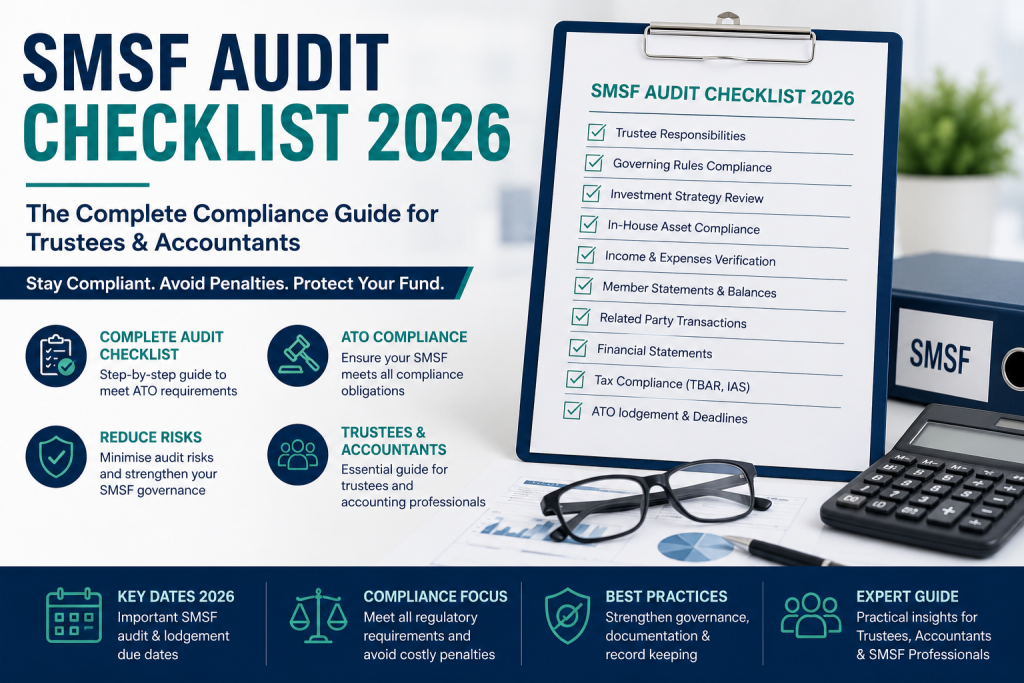
Every Self-Managed Super Fund (SMSF) in Australia must undergo an annual independent audit under the Superannuation Industry (Supervision) Act 1993. Working from a clear checklist helps trustees and accountants prepare documentation early, avoiding common compliance issues and unnecessary lodgement delays.
Managing a Self-Managed Super Fund requires ensuring its funds comply with the Australian Taxation Office. Financial and regulatory compliance requires an annual audit per legal requirements. Online SMSF audit services provide a quick and secure way to meet all ATO requirements. Trustees and accountants who utilise professional online SMSF audit services achieve faster, more efficient processes that reduce errors and ensure accurate compliance. The ultimate SMSF audit checklist of 2026-27 contains all necessary steps to enable the smooth and accurate conduct of ATO-approved audits.
Why an Online SMSF Audit Matters
The audit process conducted using paper documents often faces challenges, which are excessively slow and complex. Paper-based audits are notoriously slow, usually bogged down by missing files or version control confusion between trustees, accountants, and auditors. Moving to a digital workflow gives everyone real-time access to the same secure document store. It drastically cuts turnaround times, simplifies tracking, and ensures your records stay audit-ready for the ATO.
Trustees who choose a trustworthy online SMSF audit service maintain their fund’s ATO guidelines compliance while avoiding the prolonged duration of necessary processes. Leading audit preparation becomes more efficient through secure remote document storage because it reduces the chance of missing important details and facilitates smoother auditing.
Online SMSF Audit Checklist 2026
Here is a good SMSF audit checklist for you to stay away from all the complications:
| S.No | Compliance Area | What the Auditor Reviews |
| 1 | Fund Setup & Legal | Valid Trust Deed, active ABN/TFN, signed Trustee Declarations. |
| 2 | Financial Statements | Balance Sheet, P&L, general ledger, trial balance, bank reconciliations. |
| 3 | Contributions & Rollovers | Member contributions against ATO caps, valid rollover documentation. |
| 4 | Investments & Valuations | Investment strategy, sole purpose test, market valuations at 30 June, 5% in-house asset limit. |
| 5 | Tax & Regulatory | SMSF Annual Return, 15% concessional tax, franking credits, NALI rules. |
1. Fund Setup and Legal Compliance
Before auditing financial activity, your auditor will confirm the fund is legally established. They will inspect:
- An updated Trust Deed aligned with current super legislation.
- Active ABN and TFN registrations.
- Signed Trustee Declarations (required within 21 days of any new trustee appointment).
2. Financial Statements and Reconciliations
Accurate bookkeeping prevents the majority of audit delays. Ensure you provide:
- Full financial statements (Balance Sheet and Profit & Loss).
- Up-to-date general ledger and trial balance.
- Complete bank reconciliations matching year-end statements for every fund account.
3. Contributions and Rollovers
Auditors test all fund deposits against ATO limits:
- Concessional (pre-tax) Cap: $32,500 per member for FY2026–27.
- Non-Concessional (after-tax) Cap: $130,000 per member for FY2026–27 (up to $390,000 under bring-forward rules).
- Rollovers: Transfer balance documentation proving funds originated from a compliant super entity.
4. Investment Compliance and Asset Valuations
Fund investments must serve one goal: providing retirement benefits to members (the Sole Purpose Test).
- Investment Strategy: Must be documented, regularly reviewed, and reflect actual fund asset allocation.
- Market Valuations: All assets must be valued at fair market value as of 30 June.
- In-House Assets: Related-party loans, leases, or investments cannot exceed 5% of total fund value.
- Separation of Assets: SMSF assets must remain completely separate from personal or business assets.
5. Tax and Regulatory Obligations
Auditors verify that tax obligations have been calculated correctly prior to lodging the SMSF Annual Return (SAR):
- Application of the 15% concessional tax rate on eligible contributions and income.
- Proper documentation for franking credits and tax offsets.
- Compliance with Non-Arm’s Length Income (NALI) rules to ensure all income and expenses reflect genuine market rates.
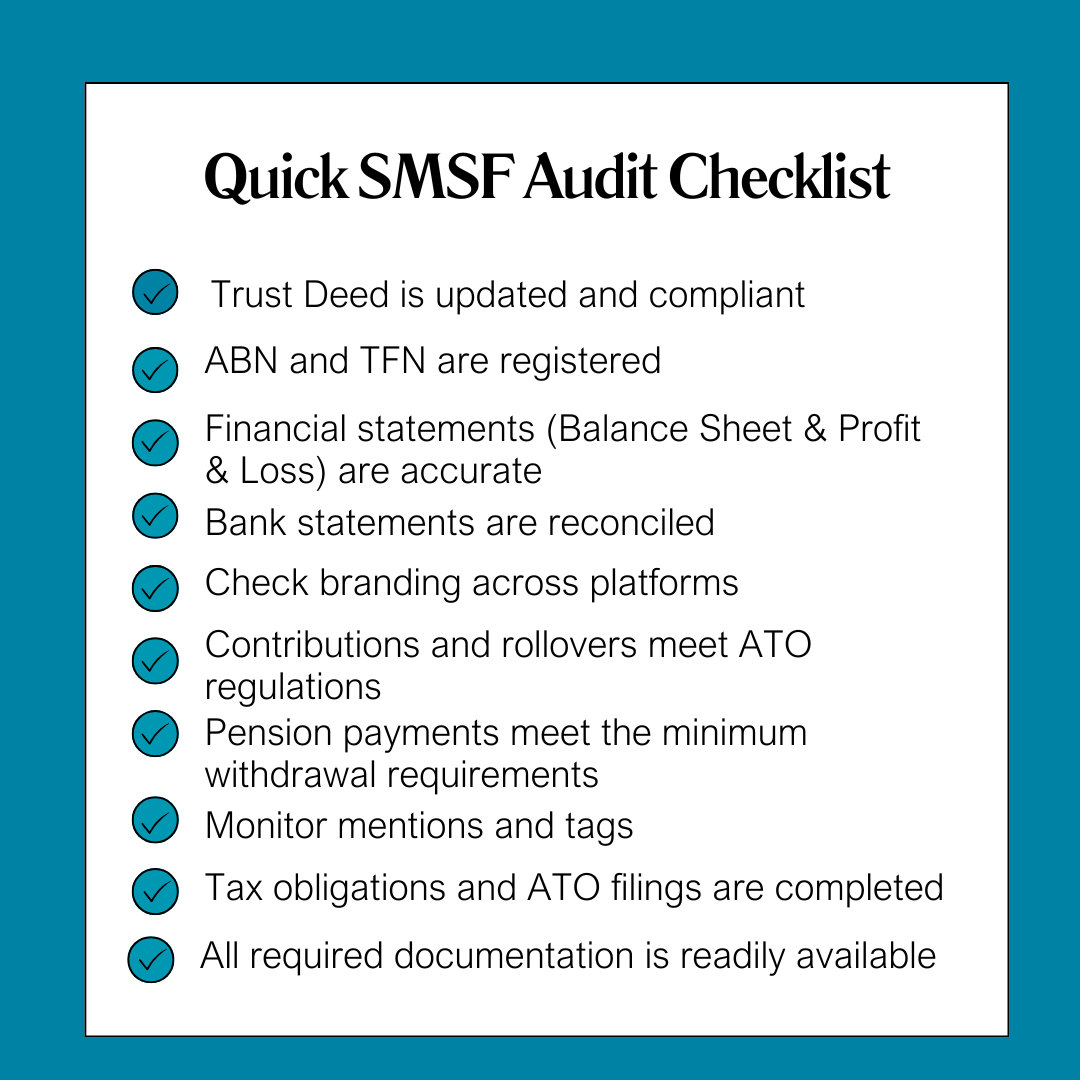
Quick SMSF Audit Checklist
SMSF Audit Requirements: What Auditors Actually Look For
An SMSF audit isn’t just a financial sanity check—it has two distinct parts required by law:
- Financial Audit: Evaluates whether the fund’s financial statements accurately reflect its financial position.
- Compliance Audit: Verifies whether the fund complied with the Superannuation Industry (Supervision) Act 1993 and related regulations throughout the financial year.
Under Australian law, the audit must be completed by an independent ASIC-registered SMSF auditor before you can lodge your SMSF Annual Return. If material breaches occur, the auditor is required to report them directly to the ATO via an Auditor Contravention Report (ACR).
Choose a Reliable Online SMSF Audit Service
A proper selection of an SMSF audit Australia provider is essential for both compliance requirements and the avoidance of delayed submissions. To ensure reliable SMSF audits, trustees need to search for ATO-registered SMSF auditors who demonstrate experience in performing smooth audits. An optimal SMSF audit service via the internet must provide trustees with a secure platform to store documents through cloud storage and simple document access operations. To prevent penalties from late submissions, it is vital to receive prompt responses during the audit process, together with clear communication and fast service deliveries.
A reputable industry profile combined with straightforward fees without surprise expenses must influence your selection of a service provider. Aone Outsourcing Solutions is an experienced online SMSF audit service provider, leading to stress-free audits that follow all required compliance standards.
Wrapping Up
The annual audit of SMSFs is a critical element enabling fund compliance with ATO rules. This online SMSF audit checklist helps trustees along with accountants, to prepare for their audits effectively and decrease compliance risks while creating an efficient audit process. The process of regulatory evolution requires SMSF trustees to remain informed about ATO guidelines while using professional audit services to preserve their fund’s integrity.
Looking for SMSF audit services requires partnering with an expert provider like Aone Outsourcing Solutions to make the auditing process smooth while maintaining absolute compliance standards. Don’t hesitate to contact us for a hassle-free SMSF audit process.
Frequently Asked Questions
1. What is an SMSF audit, and why is it mandatory?
The independent review of Self-Managed Super Funds’ financial records and compliance documents by Australian Taxation Office (ATO) regulations constitutes an SMSF audit. Every SMSF must perform annual audits according to law to protect itself from penalties while following superannuation regulations.
2. What are the key changes in SMSF audits for 2026?
Some key updates for 2026 include:
Stricter documentation requirements for contributions and rollovers
Enhanced digital verification processes for investment valuations
More stringent rules around non-arm’s length income (NALI)
Increased scrutiny on pension withdrawals to meet minimum drawdown requirements.
3. How do I ensure my SMSF investment strategy meets compliance?
Your SMSF investment strategy needs to match your fund’s goals and follow all ATO requirements, which include satisfying the Sole Purpose Test. The proper valuation of investments should occur on June 30, 202,5, while personal funds must remain independent from fund assets.
4. What documents are required for an online SMSF audit in 2026?
You will need your updated Trust Deed, ABN/TFN proof, full financial statements (Balance Sheet and P&L), bank reconciliations, contribution/rollover records, asset valuation evidence as of 30 June, and your written investment strategy.
5. How can I get started with an online SMSF audit?
The SMSF audit process begins by collecting financial data and compliance documents after selecting an experienced online audit provider for submission of your audit records. Services like Aone Outsourcing Solutions offer expert online SMSF audits with secure and hassle-free processing.
6. When is the deadline to complete an SMSF audit?
Your audit must be finalized before lodging your SMSF Annual Return. For self-lodging funds, the deadline is generally 28 February following the end of the financial year. Funds lodging through a registered tax agent typically have extended deadlines (often May 15).
7. What documents do I need to prepare for an online SMSF audit?
You will need your updated Trust Deed, ABN/TFN proof, full financial statements (Balance Sheet and P&L), bank reconciliations, contribution/rollover records, asset valuation evidence as of 30 June, and your written investment strategy.
8. What are the key contribution limits for the FY2026–27 audit cycle?
For FY2026–27, the concessional contribution cap is $32,500 per member, and the non-concessional cap is $130,000 (with a bring-forward limit of up to $390,000 depending on total super balance).