
 Australia
 USA
 Canada
 UK
 Ireland




Most growing businesses reach a point where the books are up to date, and the tax returns are filed, yet the owner still feels like they are steering blind. Revenue is rising, but cash feels tight. Key business decisions, such as hiring and pricing decisions, are being made on gut feel. The question that usually follows is “Do we need a CFO?”
That is the wrong place to start. Many businesses that ask it have a gap in their accounting, not in their strategy. Others have good accounting but poor strategic thinking. Telling these two problems apart determines whether you need outsourced accounting services, outsourced CFO services, one of them, or both.
The problem is large. As of 30 June 2026, Australia had 2,814,778 active businesses, including 996,203 with employees, the Australian Bureau of Statistics reports. Cash flow adds pressure on top of that. Xero data shows Australian small businesses took an average of 6.9 days longer than expected to receive payments in the September 2026 quarter.
This guide explains the difference between the two services. It shows you how to check which part of your finance function is failing, so you can decide what support to add next.
The Real Question Is Not “Do You Need a CFO?” but “Where Is Your Finance Function Breaking Down?”
The key issue is identifying which part of your finance function is failing. A business doesn’t need a CFO because it is big or because the owner feels stressed. It needs one when a specific layer of finance is not doing its job.
Consider a small service company with 20 employees. Its bookkeeping is current, and it files tax returns on time. But when the owner wants to know whether to open a second office, nobody can answer. The problem is not that the company lacks an accountant. The problem is a lack of people who can use accounting information for forecasting.
This is why a title-based question leads to poor decisions. Hiring a CFO when you have three months of unrecorded transactions wastes money. Hiring more bookkeepers without a strategic plan is a waste of money too. You need to know which layer is weak before you spend anything.
For many owners, CFO services for small business sounds like a single product. In practice, it is a set of functions that sit on top of solid accounting. The rest of this guide walks through those functions, one layer at a time.
Outsourced Accounting vs CFO Services: What Is the Difference?
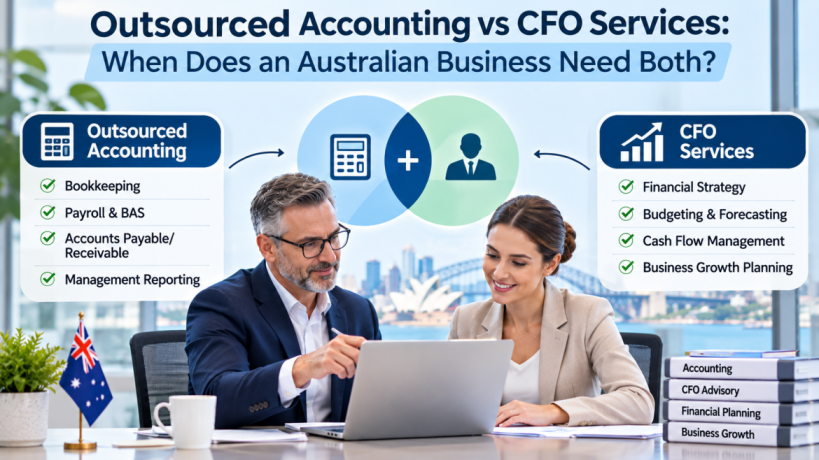
Outsourced accounting keeps your financial records accurate and on time. Outsourced CFO services use those records to explain results, plan ahead, and guide decisions. Accounting mostly covers processing and visibility. CFO-level support mostly covers interpretation and direction.
| Factors | Outsourced accounting | Outsourced CFO-level support |
| Main question | What happened, and is it recorded correctly? | What does it mean, and what should we do next? |
| Typical outputs | Reconciled ledgers, management accounts, BAS and payroll records | Forecasts, scenario models, variance explanations, decision support |
| Layers | Processing and visibility | Interpretation and direction |
| Typical rhythm | Monthly close | Monthly or quarterly review |
| Depends on | Complete source records and a working system | Reliable accounting data |
The 4-Layer Business Finance Model
This is Aone’s four-layer finance function framework. Every finance function has four layers: processing, visibility, interpretation, and direction. All four exist in every business at the same time, even if only one or two are working well.
This is a model of ownership, where all four layers exist at the same time and are not a sequence. You are not supposed to graduate from one layer to the next. Instead, ask who owns each layer and how well they are doing it.
Many owners think of financial management services as one service. Segmenting the work can help owners see gaps in their services and determine who will provide the missing services.
Layer 1: Financial Processing
Processing is an accounting layer. Every other layer depends on processing. Transactions are recorded, bank accounts are reconciled, payroll runs, and bills and invoices are tracked. Data errors in processing will make every report built on top of it wrong, too.
Good processing is boring, and that is the point. Good processing is routine and carried out consistently every month with few surprises. A close that runs well past your agreed close calendar is an early sign of weak processing.
Layer 2: Financial Visibility
Visibility means having up-to-date information about where the business stands, accurately and on time. Monthly management accounts, a clear profit and loss statement, and an up-to-date balance sheet all belong here.
Many business owners believe that having good accounting information is enough. It is necessary, but it does not tell you what to do next. A report that arrives three weeks late is also a problem, because decisions have already been made without that accounting information.
Layer 3: Financial Interpretation
Interpretation turns numbers into meaning. This is where you ask why margins fell, which product lines earn the most, or why cash moved the way it did. It means comparing this month to last month and explaining the gap.
This is where CFO-level thinking starts. Someone has to look at the numbers and say, “This is what happened, and this is why it matters.”
Layer 4: Financial Direction
Direction is the strategic planning function. It covers cash flow forecasting, scenario planning, and the big business decisions about hiring, pricing, expansion, borrowing, and raising capital.
Without a plan, a business is likely to make important decisions without relevant information. A CFO often leads direction, though owners, boards, and advisers may also contribute.
When Outsourced Accounting Alone May Be Enough
Outsourced accounting services are appropriate if Layers 1 and 2 are the real gap and the company does not need financial planning and forecasting services.
This is common for small businesses with steady clients, stable margins, and an owner who makes decisions informally. Some stable smaller businesses may not yet need formal CFO-led forecasting, though basic cash-flow planning stays useful. They need good recordkeeping and reports delivered on time.
You may be in this position if:
- Your books are overdue by a month or longer.
- Your Bank reconciliations do not match, and nobody has time to prepare them.
- Your reports come to recipients late or in an unreadable format.
- Your decisions are not urgent, and the business has enough resources to wait for your decision.
If these describe your business, outsourced accounting services can help solve these problems. Once your accounting and reporting systems have improved, you can review whether you need more.
Be careful with this stage. Many business owners stay in this phase because it feels safe, even when the business has outgrown informal decisions. The test is simple: when you make a big decision, do you have a forecast to back it up? If not, the gap is probably in interpretation and direction, not in bookkeeping.
When CFO-Level Support Becomes Necessary
Outsourced CFO services become useful when Layers 1 and 2 work well, but Layers 3 and 4 are missing. Accounting and other financial information are available. The gap is strategic.
You will often see this scenario with companies that have grown past the owner’s ability to manage them. The company uses an accountant who does good, accurate work. But nobody is explaining what the numbers mean or building a forecast the owner can use.
Look for these signs:
- The owner cannot explain the differences in profits from one quarter to the next.
- Cash planning is done week to week, with no forward view.
- Key business decisions such as hiring and setting prices are often made without modelling the outcome.
- The business has a plan, but no monitoring system in place to check actual results against it.
This is the point where outsourced CFO services become useful. A CFO service provider can offer analysis and other services alongside the accounting services you already receive. You don’t have to choose between a bookkeeper and a CFO service provider, because the bookkeeper’s work makes the CFO’s analysis possible.
The Signs a Business Needs Both Outsourced Accounting and CFO Services
You need Outsourced Accounting and CFO Services if the foundation and strategy elements are missing in the business at the same time. The business does not just lack CFO input. Its accounting isn’t reliable enough to support strategic planning.
This situation is harder to spot because the symptoms overlap. Owners often blame strategy rather than inaccuracies in their numbers.
Common signs include:
- Month-end closes take weeks, and reports are often corrected after they’re sent.
- The owner has a vision, but the numbers supporting it don’t reconcile.
- Cash problems keep appearing without warning, even though the business is profitable on paper.
- Staff devote time to gathering information rather than putting it to use.
- A forecast was prepared once, but nobody updates it.
When you see several of these at once, adding a CFO before fixing the books will not help. A new strategist will simply build plans on shaky numbers. The right order is to fix the financial problems and then hire a strategist. In many cases, it may be best to start both services at the same time, with clear ownership from the first month.
Where Does a Financial Controller or Head of Finance Fit?
Many finance teams have a middle layer between day-to-day accounting and CFO strategy. A financial controller or head of finance usually owns the monthly close, the quality of management reports, and the first explanation of any big variances. They can work inside the business, through an outsourced provider, or as a shared role.
In the four-layer model, a controller mostly sits at the intersection of visibility and interpretation. Sometimes the honest answer to “Do we need a CFO?” is “We need someone to own the numbers first.” A controller can turn clean records into reliable reports, and then a CFO can use those reports for forecasting.
Ask yourself three questions. Who signs off on the monthly close? Who reviews the management accounts before the owner sees them? Who explains the variances? If the answer to all three is no one, you may need a controller-level role before you need a CFO.
The Cost of Solving Strategic Problems With More Accounting Capacity
Adding bookkeeping hours won’t solve strategic issues. More accounting capacity gives you more accurate records of the past. It doesn’t help you make better decisions about the future.
Here’s a classic example. Consider a company that notices falling profits. Management blames the bookkeeper and hires an additional bookkeeper. After six months, the company’s books are in good shape, but profits remain low. Nobody has analysed which products or customers are losing money, and nobody has modelled what a price change would do.
The business paid for excess capacity and still has the problem it started with. The bookkeeper did exactly what was asked. What the company lacked was analysis.
This is why the question “Do we need more help?” needs a second question: “What kind of help?” Capacity can answer the first question. Strategy can answer the second.
The Cost of Building Strategy on Unreliable Financial Data
Strategies built on messy data can look precise but still be wrong. This is the mirror image of the previous problem, and it is just as expensive.
Imagine a business that hires a consultant to advise on the future when its own accounting records are incomplete. The consultant prepares projections using last year’s data, but the company’s records contain errors about when it recorded certain large invoices. The consultant’s projections show significant growth prospects. The owner signs a lease for a larger office. Three months later, the company faces a cash shortfall because actual results differ from the consultant’s projections.
Cash flow is often where the damage shows up first. Xero Small Business Insights data shows that Australian small businesses were paid an average of 6.9 days after the due date in the September 2026 quarter. Separately, A March 2026 Xero survey reports that Australian small businesses lost an average of $15,257 in the previous financial year because of late payments. When receivables are not tracked properly, the forecast cannot see the problem coming.
Earlier Xero research, from 2022 and using 2021 data, found that almost half of all invoices were paid late, with one in ten paid more than a month late. It also found that small businesses that received most payments late experienced 17% more cash flow crunches than those paid on time. Late payments are not just an accounting annoyance. Beyond accounting problems, late payments can create other difficulties for businesses, including planning challenges.
Clean records come first. Predictions are only as reliable as the data behind them.
The Integrated Finance Function Model
An integrated finance function means that all four layers have clear owners and clear handoffs between them. Accounting feeds the CFO. The CFO provides input to the accounting function to help shape its future activities. Nothing falls between the two teams.
In practice, an integrated model runs on a schedule. Here is what that usually includes:
- A fixed monthly close. Financial records close each month on a set day. This lets the CFO plan around when financial data will be available.
- A standard management accounts pack. The same format each month allows users to track and compare information.
- A weekly cash check. Review bank balance, payables, and receivables together to spot cash issues.
- A joint review point. The accounting team and the CFO meet to walk through variances and agree on what needs explaining.
- A monthly forecast update. The forecast is refreshed with actuals, so decisions are based on current data.
The most important part is the handoff and communication between departments. If accounting delivers reports late, the CFO’s analysis is always out of date. If the CFO asks for information in a new format every month, the accounting team cannot keep up. Write down the dates and formats for each handoff before work begins.
One Provider or Two Specialists: Which Model Fits?
One provider can simplify handoffs because accounting and CFO-level staff work from the same data and calendar. Two specialists can also work well, as long as ownership, data access, and reporting formats are agreed in writing. Neither option is automatically better or cheaper. The right choice depends on how much handoff effort you can manage, how deep the specialist knowledge needs to be, and how much coordination your team has time for.
| Factor | One provider | Two specialists |
| Handoffs | Fewer parties, shared data and calendar | More handoffs, so written rules are needed |
| Depth of specialism | Varies by provider | Can match a specialist to each layer |
| Accountability | One party for the whole function | Split, so ownership must be clear |
| Coordination by your team | Usually lower | Usually higher |
| Flexibility to change | Changing affects both layers | Each layer can change separately |
A Practical “Do We Need Both?” Decision Framework
Check each layer with three yes-or-no questions. The answers to the three questions can help you determine the support needed for each layer and the order.
Layer 1: Processing
- Is there a set window for the monthly close?
- Do bank reconciliations match without manual fixes each month?
- Are the invoice and bill recognition dates correct?
Layer 2: Visibility
- Are monthly management accounts issued on a fixed date?
- Can the owner read the reports without needing a translator?
- Are the reports verified to match the bank and the ledger?
Layer 3: Interpretation
- Can someone explain the change in margin or cash during the last quarter?
- Are variances between budget and actuals explained each month?
- Do you know which products, services, or customers are the most profitable?
Layer 4: Direction
- Is there a forecast that is updated at least every quarter?
- Do you use modelling for big decisions like hiring and pricing decisions?
- Does someone evaluate the result against the plan?
Now read your answers:
A layer passes when all three of its questions are answered yes.
| Layers 1 and 2 | Layers 3 and 4 | What it suggests |
| Pass | Pass | No new support needed now. Review again in six months. |
| Pass | Fail | Add CFO-level support on top of existing accounting. |
| Fail | Pass | Fix accounting first. Strategy likely rests on unreliable numbers. |
| Fail | Fail | Stabilise accounting first, then add CFO-level support. Agree ownership in writing. |
This framework offers general guidance. You should not rely on it as a substitute for expert business advice from a qualified adviser. Even if all four layers pass, a funding round, an acquisition, rapid growth, multi-entity complexity, or a leadership gap may justify extra support.
Metrics That Show Whether Accounting and CFO Work Are Connected
Five metrics to evaluate the effectiveness of your accounting processes and whether CFO-level decisions are built on them. Track them monthly to catch problems earlier.
- Month-end close time: Number of business days required to complete the monthly close. A falling number means processing is becoming more reliable.
- Reporting turnaround: Number of days from month-end to owner delivery of management accounts. Long delays could slow management decision-making.
- Forecast accuracy: Comparison of forecast and actual results, usually measured as a percentage gap. Significant discrepancies between forecast and actual results may indicate issues with the forecasting process or data.
- Days sales outstanding: The average number of days it takes customers to pay. Rising days sales outstanding may show collection problems affecting cash flow.
- Cash runway: How many months the business can cover its costs at the current cash burn. This is the number the owner should be able to answer at any time.
Read these metrics together. If close time is falling but forecast accuracy stays poor, processing is improving while the forecast assumptions are not. If days sales outstanding and report preparation times are increasing, you may not see collection problems until they become serious.
Five Business Scenarios Where Both Services Can Work Together
Both services work together in five situations. These examples show a range of circumstances in which a business may need both accounting and CFO services.
A Business Preparing for Sale or Acquisition
Buyers look closely at financial records before they make an offer. They check whether the accounts are clean, whether the numbers are repeatable, and whether the forecast is credible. A business in this position needs reliable processing and a clear story about future earnings. An accountant may help sellers build an audit trail. The company’s CFO assists sellers in the forecast and explains the numbers to buyers.
A Multi-Entity Group
A group of companies and trusts has more handoffs, more intercompany transactions, and more places for errors to hide. The group needs to maintain separate accounting records for its entities, but the owner needs one view of the whole group. Accounting personnel provide accounting information about the entities. The group’s CFO provides information to the owner about matters related to financing and investing in the group.
A Fast-Scaling E-Commerce Brand
Online sales grow quickly, and so do the transactions. Payment gateways, marketplaces, and inventory systems all create data that needs to be reconciled. The accounting team keeps the records accurate every day. The CFO watches margin per product, the cost of returns, and cash tied up in stock, and models how growth will change the cash position.
A Service Firm Opening a Second Location
Opening a second site at a new location creates accounting issues. Costs, staff, and revenue need to be tracked by location, and the owner needs to know whether the new site will pay off. Accounting information helps management understand the activities at each location. A CFO creates a business plan for a new location before signing a lease and compares actual results from the new location to the plan.
A Business Outgrowing Its Owner’s Spreadsheet
Many businesses start with one person performing all accounting functions in a spreadsheet. As the business grows, that spreadsheet becomes a bottleneck, and mistakes creep in. The business needs accounting software and a team to use it to make decisions, and it needs someone to turn the output into decisions. Both services are needed to move from a personal system to a managed finance function.
What Should the Accounting Team Own and What Should the CFO Own?
The accounting department manages Layers 1 and 2, and the CFO owns Layers 3 and 4. The coordination procedures between them decide whether the combined service works.
The following table shows who owns each layer, defines what failure looks like, and what the handoff should contain. Use the table to identify gaps in your current process.
| Layer | Failure signal you will see | Primary owner | Handoff to the other team |
| 1. Processing | Month-end takes longer than it should, and bank reconciliations fall behind | Accounting team | Closed monthly ledger, delivered by a fixed date |
| 2. Visibility | Reports arrive late, or do not match the bank | Accounting team | Standard management accounts pack, same format each month |
| 3. Interpretation | The owner cannot explain why margin or cash changed | Accounting prepares the data, CFO explains it | Variance notes that link each number to a cause |
| 4. Direction | Hiring, pricing, or expansion decisions are made without a forecast | CFO | Updated cash flow forecasting and scenarios, reviewed with the owner each month. |
The main benefit of this table is the failure signal column. You can troubleshoot business issues by looking at the failure signals, then check the owner and the handoff. This turns a vague feeling that “finance is not working” into a specific question you can act on.
Be clear about the handoff in writing. Agree on the date the ledger closes, the format of the reports, and who calls the review meeting. Many problems in shared projects arise during the transition, not inside either team.
What Does an Integrated Finance Function Cost?
Cost depends on four parts, not one fee. The first is set-up or clean-up work to bring your records to a reliable state. The second is ongoing accounting, which covers processing, reconciliations, payroll, and reporting. The third is the CFO-level rhythm, which includes reviews, forecast updates, and decision support. The fourth is your own management time and any extra tools you need.
The main cost drivers are the number of entities, transaction volume, the systems you use, how complex the reporting is, how often reviews happen, and how clean your records are at the start. Compare written scopes, deliverables, and exclusions, not just the monthly fee. For details on CFO pricing, see our dedicated cost guide.
How to Know if Your Business Is Ready for an Integrated Finance Model
Before scaling from accounting to CFO support, evaluate your data quality, process, budget, and leadership commitment. Use this readiness check before you start:
- Data quality: Are books reconciled and closed on time for at least three consecutive months?
- Process: Do you have a monthly close schedule and a standardised reporting system?
- Budget: Are there sufficient funds available in the company budget to pay for accounting and strategic services for at least one year?
- Leadership buy-in: Will the owner attend reviews and act on what they learn?
How to Transition From Accounting Support to Integrated Finance Support
If you pass the above-listed checks, the transition itself is usually straightforward. Stabilise the current accounting workflow first, unless there is a documented reason to change systems, then add the interpretation layer. Finally, install the new forecasting system once you’ve confirmed the numbers are accurate.
For an existing accounting client, a phase-by-phase transition process is advised. First, make sure processing and visibility are stable. Second, add a monthly meeting between the business owner and CFO to discuss accounting issues. Third, build the first forecast and compare it with actual results over the next quarter. The phased approach lets you test each phase before moving to the next.
When Should a Business Bring Finance Capability In-House?
Outsourcing does not have to be permanent. Consider bringing finance in-house when decisions need someone on site every day, when the business has complex structures or capital events, when board or confidential work needs a full-time owner, or when managing handoffs costs more than the outside team saves.
Many businesses do not switch completely. A common setup is an in-house finance lead or controller who works alongside outsourced accounting or CFO-level support for specific layers. For guidance on which model fits your business size, see our fractional CFO guide.
Common Mistakes Businesses Make When Building Their Finance Function
Several mistakes come up again and again:
- Hiring in-house too early. A full-time CFO is expensive, and many small businesses do not have enough finance work to keep one busy. Outsourced support is a more practical starting point.
- Unclear role ownership. If no one knows who owns the forecast, no one maintains it.
- Skipping the readiness check. Adding strategy to unreliable books is the most common reason a CFO engagement disappoints.
- Expecting results too quickly. You can build a first forecast early and refine it as the data improves.
- Treating the CFO as a replacement for the accountant. The accountant and CFO play different but complementary roles, and cutting one weakens the other.
How Aone Supports Businesses With Accounting and CFO Support
Aone provides both outsourced accounting services and outsourced CFO services. Businesses can try Aone’s outsourced accounting services to build a reliable base, and add CFO-level support when they are ready, without changing providers.
The advantage of working with one team is continuity. The people who keep your records also understand the numbers behind your decisions. It’s easier to transfer within the group. Your records and performance reviews are likely to be more consistent.
If you’re unsure which areas of your financial management need work, start with a conversation. Book a free discovery call with the Aone team, and we will help you work out whether you need accounting, CFO support, or both.
Diagnose the Finance Gap Before Choosing a Service
Not sure which layer of your finance function is failing? Our four-layer diagnostic asks three yes-or-no questions for each layer. It gives you a pass or fail for each layer and a plain recommendation on what to fix first.
Book a discovery call, and the Aone team will help you decide whether you need accounting, CFO-level support, or both.
CTA: Get the Finance Function Gap Assessment
Frequently Asked Questions
Can one provider deliver both outsourced accounting and CFO services, or do I need two?
One provider can deliver both, which is more convenient. Accounting and CFO staff will work with the same data, so handoffs are cleaner, and there is less duplicated effort. Multiple vendors are an option, but you’ll need to work with those vendors to manage the handoff yourself.
Is it more expensive to run accounting and CFO support together than separately?
Not necessarily. Cost depends on scope, business size, and how much strategic input you need. Compare written scopes line by line. Try to negotiate an agreed-upon service level commensurate with your scope of work to keep costs down.
Do I need to fix my bookkeeping before adding CFO-level support?
Yes, in most cases. CFO-level analysis depends on reliable records, and a forecast built on wrong numbers will mislead you. Take steps to improve data processes and communication before implementing measures to offer guidance to the CFO.
How do outsourced accounting and CFO teams communicate with each other in practice?
They usually agree on a schedule, such as a specific day each month to close and report on the books and a monthly meeting to review business matters. Between those points, they share updates on anything unusual, such as a large unexpected invoice or a change in payment terms.
Can I start with accounting only and add CFO support later?
Yes, this is a common path. Consider hiring outsourced accounting services to confirm your books’ accuracy, and add CFO-level support when the business needs forecasts and strategic analysis. It may be beneficial for you to retain the same service provider.
What size business typically needs both services at once?
There is no fixed size. Businesses that need Outsourced Accounting and CFO Services at the same time usually have unreliable records and a growing number of decisions that need modelling. This can happen in a small business that is growing quickly, or in a larger one with complex structures.
Does adding CFO support replace my accountant or bookkeeper?
No. CFO services do not replace accounting services. An accountant or bookkeeper still records transactions, prepares statements, and handles compliance. The CFO uses that work to explain results and plan.
How long does it take to set up an integrated finance function?
It depends on how clean your records are when you start. If your accounting records are sound, you can establish an accounting integration rhythm in a few months. If the records need cleaning, expect it to take longer, because you can’t trust the forecast until the numbers are right.
When should a business bring finance in-house instead of outsourcing?
Bring finance in-house when decisions need a daily presence, when the business has complex structures or capital events, or when handoff effort costs more than the outside team saves. Many businesses keep outsourced support and add an in-house finance lead for the layers that need it most.
Where does a financial controller fit when I use outsourced accounting and CFO services?
A financial controller usually sits between day-to-day accounting and CFO-level strategy. They own the monthly close, the quality of management reports, and the first explanation of variances. The role can be in-house, outsourced, or shared. If nobody in your business is doing those jobs, a controller may be the gap to fill before a CFO.