
 Australia
 USA
USA Canada
 UK
UK Ireland



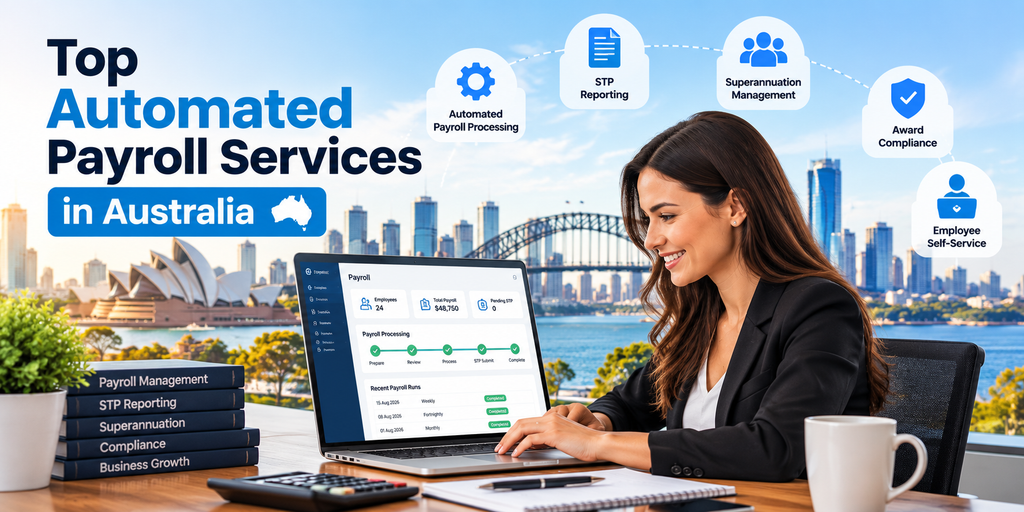
Honestly speaking, payroll is not the reason anybody gets into business. But for many Australian companies, it silently becomes one of the most significant sources of stress. Failure to pay on time, miscalculation of awards, super errors, or ATO compliance issues can soon deplete time, money, and trust.
To Gen Z founders, digital-first startups, and Millennials growing businesses, manual payroll just does not fit into the modern team workflow. The need for remote workers, flexible working hours, gig work, and rapid development requires more intelligent systems. Automated payroll services fall into that — they are offered to facilitate payments, minimize mistakes, and ensure the business complies without micromanagement.
With increased scrutiny from the Fair Work Ombudsman and tighter digital reporting obligations from the Australian Taxation Office, businesses in 2026 are under greater pressure to ensure payroll accuracy, transparency, and audit readiness. Automated payroll services provide a structured, compliance-ready framework that reduces regulatory exposure while improving operational efficiency.
This guide will cover automated payroll in Australia, its nature, functionality, advantages, the most appropriate software, and the role of outsourcing payroll automation in helping businesses avoid losing focus in the business setting due to spreadsheets.
What Are Automated Payroll Services?
Automated payroll services are technology-intensive services that control payroll operations electronically rather than manually, eliminating the need for computation and data entry resources. Unlike spreadsheets or separate systems, an automated payroll system enables a business to calculate wages, taxes, and entitlements in accordance with predetermined rules, using real-time employee data.
Salaries, PAYG withholding, superannuation contributions, overtime, allowances, and leave balances are automatically processed for these services. Payslips are produced in digital form, and single touch payroll (STP) systems directly report payroll data to the ATO, ensuring accuracy and compliance.
Current automated payroll processing is also combined with accounting, HR, and time tracking. This creates a centralized payroll process in which modifications, such as adding new employees, adjusting pay rates, or granting leave, are reflected in payroll operations immediately.
It is possible to combine automation and professional payroll supervision: a business may use payroll software for automation or outsource automated payroll services to a provider specializing in them.
Why Australian Businesses Need Automated Payroll?
Over time, payroll in Australia has become increasingly complex due to constant changes in regulatory frameworks, evolving workforce structures, and tightening compliance requirements. Automated payroll is no longer a nice-to-have; it is a must to ensure operational stability.
Increasing Compliance and Regulation Pressure
Fair work awards, interpretation of modern awards, superannuation guarantee legislation, PAYG legislation, and STP Phase 2 are the various compliance requirements that Australian businesses need to adhere to. Automated payroll systems embed these conditions into the workflow, significantly reducing compliance risk and exposure to fines.
Organizational Workforce Structures
Now with casual workers, contractors, hybrid teams, and remote workers, manual payroll is unable to keep up with this trend. Automated payroll and time-and-shift payments of various types are calculated accurately without manual intervention.
Payroll Risk and Underpayment
Payroll errors may negatively affect employee confidence and lead to litigation. Automated payroll mitigates human error by applying consistent rules and system-based checks to all pay cycles.
Ineffectiveness of Time and Cost
Manual payroll consumer business time every pay period. Intuitive payroll software eliminates tedious tasks for internal teams, enabling any business to focus on development, planning, and workforce engagement.
In recent years, payroll underpayment cases and compliance investigations across Australia have highlighted the financial and reputational risks of manual payroll errors. Automated payroll processing helps businesses build defensible compliance records and maintain clear digital audit trails.
Key Features of Automated Payroll Services
Automated payroll services provide a compliance-ready framework, unlike discontinuous payroll processes.
ATO & STP Phase 2 Compliance
STP Phase 2 of automated payroll systems is designed to deliver greater accuracy in reporting income, tax, and superannuation to the ATO with minimal manual intervention.
Automated Wages and Award Calculations
The system includes wage calculations based on Fair Work awards and enterprise agreements, as well as overtime calculations, penalties, allowances, and deductions, making it effective in determining pay under different pay structures.
Superannuation Processing
Superannuation contributions are calculated to minimize the risk of late payments and non-compliance penalties.
Entitlement Management & Leave
Annual leave, sick leave, extended service leave, and public holidays are automatically tracked, and the required entitlements are provided to employees.
Employee Self-Service Portals
Employees can safely view payslips, update personal information, and submit leave requests, thereby reducing payroll administration workload.
Real-Time Payroll Reporting
Businesses can have immediate access to payroll expenses, taxes, and workforce information, enabling them to make sound financial decisions.
Benefits of Automated Payroll Services for Small Businesses
For small businesses, payroll errors can be costly and disruptive. Payroll automation services are a reliable way to avoid hiring in-house payroll experts.
Less Administrative Cumbersomeness
Automation will eliminate redundant payroll processes, allowing business owners to focus on generating revenue rather than managing compliance.
Better Accuracy and Consistency
Calculations within the systems ensure wages, superannuation, and tax are calculated each cycle, minimizing the risk of underpaying or of it being contested.
Conformity and Not a Complexity
ABA developed an inbuilt Australian payroll rules framework to be self-critical of these requirements in light of changes in laws set by the Fair Work and ATO.
Economical Payroll Administration
Automated and outsourced payroll services are more cost-effective for the organization than paying internal payroll staff in the long term.
Automated Payroll Services vs Manual Payroll
Before automating, one should understand the differences between automated and manual payroll systems.
|
Feature |
Automated Payroll Services |
Manual Payroll |
|
Accuracy |
System-driven calculations minimise errors |
High risk of manual mistakes |
|
Compliance |
Built-in ATO & Fair Work rules |
Requires constant manual monitoring |
|
Processing Time |
Fast, repeatable payroll cycles |
Time-consuming for each pay period |
|
Scalability |
Easily supports business growth |
Becomes unmanageable as teams grow |
|
Reporting |
Real-time payroll and tax insights |
Limited reporting visibility |
|
Cost Efficiency |
Lower long-term operational cost |
Higher admin and correction costs |
How Outsourced Payroll Services Enhance Automated Payroll
This is a combination of a pre-prepared payroll system and outsourced payroll partners, which is commonplace in Australian CPA firms and businesses as they seek to enhance accuracy, compliance, and operational control. Whereas calculations and reporting are handled by automation, the outsourced experts ensure the system operates properly and remains compliant with Australian regulations.
Outsourced payroll services assist in:
- Set up the payroll automation systems correctly – It is important to have the right setup during the initial configuration of employee classifications, pay rates, superannuation, and tax settings.
- Ensure current compliance with STP and the Australian Taxation Office, including monitoring, reporting requirements, and regulatory updates to mitigate compliance risk.
- Check and payroll audits: Automated outputs are reviewed to highlight any discrepancies before they become expensive issues.
- Process intricate payroll demands: Benefiting businesses with numerous awards, subcontractors, distant companies, or a multi-organizational setup.
- Conserve company time and reduce operational costs – Enable internal units to focus on advisory and finance strategy and on business development rather than payroll administration.
With the automation and outsourcing of payroll and skills, CPA firms can expand the scope of payroll services with confidence, enhance reporting consistency, and invest in strategic development rather than manual payroll services.
Best Automated Payroll Software in Australia
The selection of the appropriate payroll software is a very crucial factor in effective payroll automation. Some of the most popular ones in Australia are listed below.
The following automated payroll software solutions are widely used in Australia and support STP reporting and local compliance requirements. However, software effectiveness depends on correct configuration, award interpretation, and ongoing compliance monitoring.
Xero Payroll

|
Best For |
Small to mid-sized Australian businesses using Xero Accounting |
|
Key Features |
STP reporting, automated superannuation, employee self-service, pay runs |
|
ATO Compliance |
Fully compliant with STP Phase 2 requirements |
|
Compatibility |
Integrates seamlessly with Xero Accounting and third-party apps |
|
Ease of Use |
Very user-friendly interface, ideal for non-payroll experts |
|
Scalability |
Suitable for growing teams but limited for very complex payroll |
Xero Payroll and Xero Accounting go hand in hand, making it the perfect match for small- to mid-sized businesses. It facilitates STP reporting, automated superannuation, and employee self-service, providing an easy payroll experience with high compliance.
MYOB Teams Plus Payroll

|
Best For |
Businesses with complex awards and compliance requirements |
|
Key Features |
Advanced award interpretation, compliance tools, payroll reporting |
|
ATO Compliance |
STP Phase 2 and Fair Work compliant |
|
Compatibility |
Integrates with MYOB accounting and workforce tools |
|
Ease of Use |
Moderate learning curve due to advanced features |
|
Scalability |
Strong scalability for medium to large organisations |
MYOB Teams Plus Payroll is used among companies with complicated reward programs. It offers robust compliance solutions, correct award interpretation, and scalable payroll management to the expanding Australian businesses.
QuickBooks Payroll
|
Best For |
Small businesses using QuickBooks Accounting |
|
Key Features |
Automated tax calculations, payslip generation, payroll summaries |
|
ATO Compliance |
Supports STP reporting and PAYG requirements |
|
Compatibility |
Best used with the QuickBooks ecosystem |
|
Ease of Use |
Simple and intuitive payroll setup |
|
Scalability |
Suitable for small teams with straightforward payroll needs |
QuickBooks Payroll automates tax calculations, optimizes payroll reporting, and integrates with QuickBooks accounting programs. It is convenient with small companies that want ease and efficiency.
Employment Hero

|
Best For |
Businesses seeking combined HR and payroll automation |
|
Key Features |
Payroll automation, HR management, onboarding, and compliance tools |
|
ATO Compliance |
STP Phase 2 compliant |
|
Compatibility |
Integrates payroll with HR and workforce management |
|
Ease of Use |
User-friendly with a modern interface |
|
Scalability |
Ideal for growing businesses with expanding HR needs |
Employment Hero is an end-to-end workforce management solution for payroll automation and HR management. It is best suited to companies that prefer onboarding, compliance, payroll, and employee engagement portfolios.
Payroller
|
Best For |
SMEs seeking affordable payroll automation |
|
Key Features |
Cloud-based payroll, STP reporting, leave tracking |
|
ATO Compliance |
Fully compliant with Australian payroll regulations |
|
Compatibility |
Works independently or with select accounting tools |
|
Ease of Use |
Simple setup and easy payroll runs |
|
Scalability |
Suitable for small to medium-sized teams |
Payroller is a cloud-based payroll application designed for small and medium-sized Australian enterprises. It is highly convenient, compliant, and budget-friendly, making it mainly used by growing businesses.
KeyPay

|
Best For |
Businesses with complex or multi-location payroll |
|
Key Features |
Advanced automation, award interpretation, and detailed reporting |
|
ATO Compliance |
STP Phase 2 and Fair Work compliant |
|
Compatibility |
Integrates with multiple accounting and HR platforms |
|
Ease of Use |
Powerful but requires payroll knowledge |
|
Scalability |
Excellent for large and fast-growing businesses |
KeyPay is an effective payroll engine for businesses with complex payroll needs, international operations, or large workforces. It has a high order of automation, compliance control, and reporting.
PayCat

|
Best For |
Businesses planning long-term payroll scalability |
|
Key Features |
Automated payroll, compliance tracking, and custom reporting |
|
ATO Compliance |
Designed to meet Australian payroll requirements |
|
Compatibility |
Integrates with selected accounting and workforce tools |
|
Ease of Use |
Moderate learning curve |
|
Scalability |
Strong support for expanding organisations |
PayCat offers scalable auto-payroll services with robust compliance monitoring and custom reporting capabilities. It is appropriate for businesses with long-term scalability and payroll efficiency plans.
How Outsourced Automated Payroll Services Work?
Automated payroll services are provided through outsourcing, combining payroll software with professional management to ensure accuracy and compliance.
Step 1: Payroll Set-Up and Configuration
An automated payroll system is set up with employee information, compensation regulations, reward schemes, and compliance.
Step 2: Automated Payroll Processing
Payroll is also processed on a pay cycle basis, with wages, deductions, tax, and superannuation automatically computed.
Step 3: STP & ATO Reporting
The STP ensures compliance and transparency by submitting real-time payroll data directly to the ATO.
Step 4: Superannuation and Tax Management
Super contributions are calculated, reviewed, and managed correctly. PAYG obligations are calculated, reviewed, and managed correctly.
Step 5: Continuous Compliance and Support
Payroll specialists monitor regulatory developments, answer payroll questions, and provide ongoing support.
For businesses operating in highly regulated industries or managing complex award structures, outsourced automated payroll services provide an additional layer of oversight. Payroll specialists review automated outputs, monitor legislative updates, and ensure reporting accuracy beyond what software alone can deliver.
How to Choose the Right Automated Payroll Provider?
Selecting the appropriate provider is an essential step toward the success of payroll automation. The priority for Australian businesses should be providers who have demonstrated compliance with local payroll regulations and STP requirements.
A trusted automated payroll service provider must have secure, cloud-based systems that can be integrated with accounting and human resources systems. It must be scalable so that your payroll solution can expand with your employees without affecting performance.
Human support is also essential. The most efficient providers can provide a combination of automation and dedicated payroll specialists, who will process exceptions, compliance-related changes, and payroll situations that are complicated- they provide efficiency, as well as a sense of order.
The Bottom Line!
International businesses grappling with current workforce needs and the rising compliance burden no longer see automated payroll as an option. By automating payroll with intelligent automation, companies can achieve precision, uniformity, and reliability.
Payroll automation reduces operational risk, saves time, and ensures employees receive accurate payments on time, whether through an automated payroll service provider or in-house. Strategically using a computerized payroll service and the company that will be used, with businesses in mind for growth, ensuring payroll within the company is up to date, legal, and secure.
As payroll regulations continue evolving in Australia, businesses that rely solely on manual processes face increasing compliance exposure. Investing in automated payroll services in 2026 is not just about efficiency — it is about risk management, audit preparedness, and long-term operational stability.
FAQs
What is an automated payroll service?
Automated payroll services use software to calculate wages, taxation, and superannuation, and ensure ATO-compliant reporting.
Is automated payroll safe and accurate?
Yes. The use of modernized automated payroll systems has ensured data accuracy and protection through secure cloud technology and embedded compliance rules.
How much does payroll automation cost in Australia?
Prices depend on the size of the business and the complexity of payroll, yet in the long run, automation is likely to be cheaper than manual payroll.
Does automated payroll meet ATO requirements?
Yes. Proven automated payroll products are intended to comply with ATO regulations, such as STP Phase 2.
Can small businesses use automated payroll?
Absolutely. Automated payroll is the best option for a small business interested in compliance, efficiency, and scalability.