
 Australia
 USA
USA Canada
 UK
UK Ireland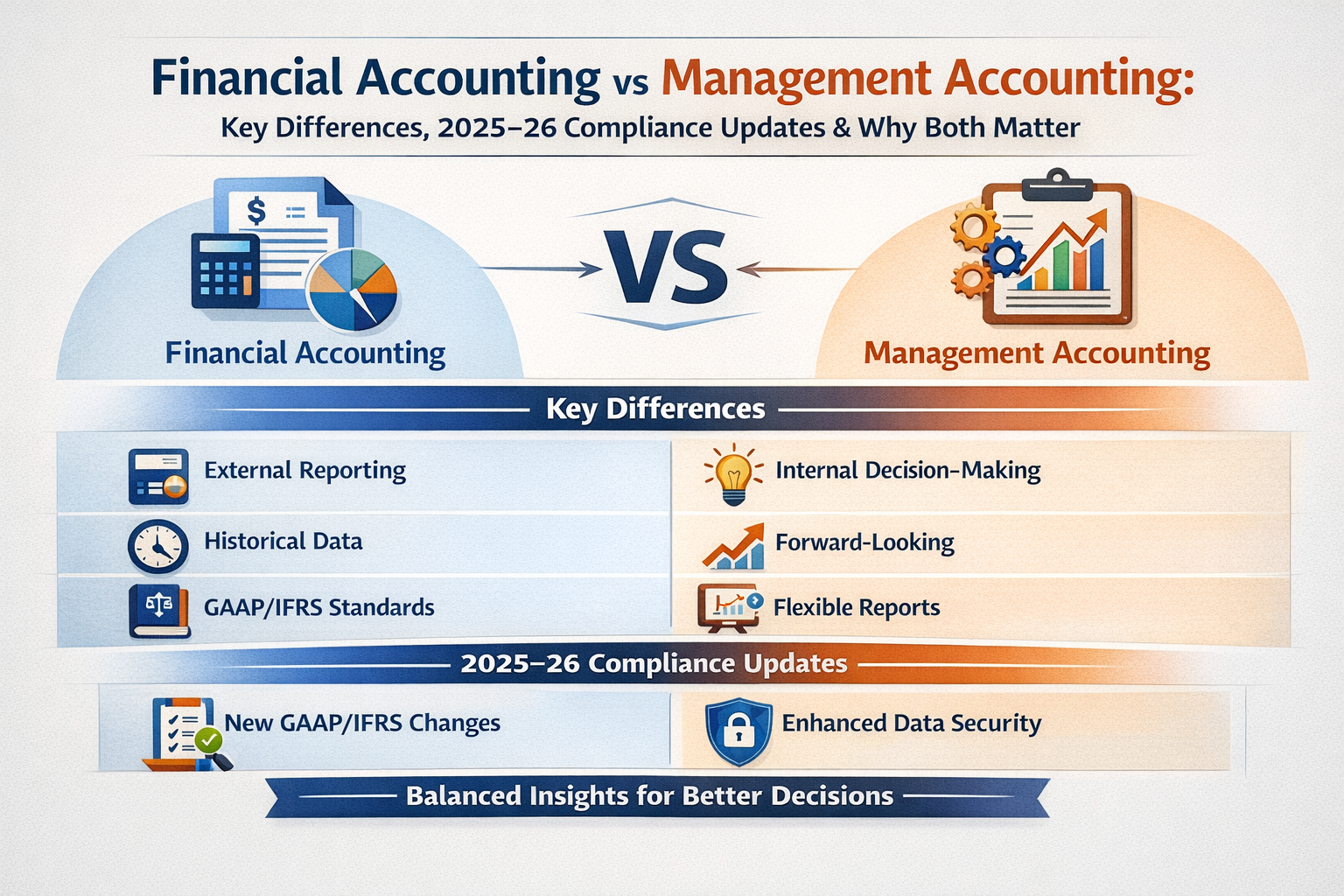
Financial accounting records and reports your business’s past financial performance for external stakeholders — auditors, investors, and the ATO. Management accounting uses the same data internally to plan budgets, control costs, and drive strategic decisions. Most Australian businesses need both. In 2025–26, integrated cloud platforms like Xero and MYOB make running both systems simultaneously easier and more affordable than ever.
In today’s dynamic business world, financial literacy is no longer a luxury but a competitive requirement. As a small business, startup, or financial expert, the ability to read and utilize accounting information could be the difference between your prosperous expansion and business continuity.
A good financial strategy must be based on two fundamental fields: financial accounting and management accounting. Whilst financial accounting focuses on external accuracy, i.e., recording, summarizing, and presenting your company’s performance to investors, regulators, and lenders, management accounting provides internal clarity, which gives leadership the analysis required to make informed decisions.
What is a Financial Accountant?
A financial accountant is responsible for maintaining the economic record of an organization to support the company’s financial integrity through meticulous record-keeping and reporting. Financial accounting is a process that involves recording, summarizing, and reporting a company’s financial transactions to project a clear image of its profitability and position.
These accountants ensure compliance with the regulations of the Australian Accounting Standards Board (AASB) and International Financial Reporting Standards (IFRS), and their output includes formal documents such as the Profit and Loss Statement, Balance Sheet, and Cash Flow Statement. The main users of these reports are external stakeholders, including investors, government agencies, creditors, and financial institutions, who require accurate data to assess a business’s stability and performance.
Technology improves accuracy and efficiency. In 2025, 92% of Australian SMEs are using cloud-based accounting systems to comply with statutory accounting records, according to the MYOB SME Survey. The practical case in point is the end-of-year financial state of a company, as reported to ASIC, which indicates its adherence, accountability, and willingness to gain trust among those interested in investing in the firm. With the ATO’s expansion of real-time data matching in 2025–26, having clean, audit-ready financial records is no longer just best practice — it’s essential protection against compliance risk.
What is a Management Accountant?
A management accountant, sometimes referred to as a managerial or cost accountant, is an accountant who concentrates on changing raw financial data into strategic management information helpful in making decisions within the organization. Management accounting, as opposed to financial accounting, is prospective; it offers business plans, budgets, and performance analysis as a basis for the business planning procedure.
The management accounting role incorporates cost control, resource optimization, variance analysis, and the construction of performance dashboards, enabling managers to identify trends and areas of improvement. These accountants play a crucial role in determining how effectively a company allocates its time, talent, and capital to achieve sustainable growth.
In 2026, AI-powered forecasting tools embedded in platforms like Xero Analytics and MYOB Insights are enabling even small businesses to access predictive cash flow modelling that was once reserved for enterprise finance teams. An illustration is that a management accountant can create monthly KPI reports and cash flow forecasts, thereby enabling leadership teams to make proactive decisions rather than reactive ones.
Difference Between Financial Accounting and Management Accounting
Financial accounting and management accounting are critical yet distinct factors in the current competitive market. Financial accounting ensures accuracy and compliance, whereas management accounting focuses on internal efficiency and future planning. Their differences can be used to show the business owners how to be more strategic in the use of financial data.
|
Factor |
Financial Accounting |
Management Accounting |
|
Primary Purpose |
To provide accurate financial information for external reporting and statutory compliance. |
To deliver actionable insights that support internal management decisions and future planning. |
|
Main Objective |
Show the company’s financial position and performance over a specific period. |
Help management make informed operational, tactical, and strategic decisions. |
|
Users / Audience |
External stakeholders — investors, regulators, creditors, tax authorities, and financial institutions. |
Internal users — managers, executives, department heads, and business owners. |
|
Frequency of Reporting |
Prepared quarterly, biannually, or annually based on statutory requirements. |
Generated weekly, monthly, or even daily for ongoing performance tracking. |
|
Standards and Frameworks |
Must comply with AASB (Australian Accounting Standards Board) and IFRS (International Financial Reporting Standards). |
No mandatory framework; tailored to the organization’s internal goals and policies. |
|
Focus Period |
Historical — records what has already happened in the business. |
Future-oriented — analyzes trends to predict what could happen next. |
|
Data Type Used |
Quantitative and financial data such as revenues, expenses, assets, and liabilities. |
Both quantitative and qualitative data, including KPIs, performance metrics, and customer insights. |
|
Tools & Techniques |
Ledgers, journals, trial balance, financial statements (P&L, Balance Sheet, Cash Flow). |
Budgets, forecasts, variance analysis, dashboards, break-even analysis, and cost-benefit models. |
|
Nature of Reports |
Summarized, formal, and standardized for external publication. |
Detailed, dynamic, and customized for internal management review. |
|
Time Orientation |
Looks backward to evaluate past financial performance. |
Looks forward to setting targets and improving future outcomes. |
|
Confidentiality Level |
Public — information is shared with external parties. |
Confidential — restricted within the organization. |
|
Decision Type Supported |
Investment and compliance-related decisions. |
Operational, pricing, production, and performance-related decisions. |
In simple terms, financial accounting is accountancy that tells us what has happened, and management accountancy answers the question of why it happened and what the next step is.
This gap is expected to become less pronounced by 2025-2026. As AI-based analytics and cloud-based enterprise resource planning become more common, the integration of the two functions is seen in relation to overall businesses, namely, combining accuracy and real-time data with long-term forecasting. This integrated strategy enables decision-makers to remain adaptable, lawful, and growth-capable.
Which One Matters More for Small Business Owners?
In 2025–26, the answer is clearer than ever: you need both.To owners of small businesses, the two types of accounting are invaluable. Financial accounting is precise, valid, and trustworthy. It ensures the audit, investment relations, and tax submission of the financial statements. Otherwise, regulatory fines and funding risks may occur.
Management accounting, on the contrary, injects odd clarity as well as focus. It helps business owners understand their actual cost structure, cash flow position, and future growth potential. However, despite its value, it is not adopted extensively. The Australian Bureau of Statistics (2024) argues that although this country has over 35% of its GDP borne by SMEs, only 42% of these companies actively apply management accounting tools to make decisions.
Luckily, with low-entry-level cloud-based software, even small businesses can now assume high-level budgeting and forecasting that was only enjoyed by large corporations. Such programs as MYOB, QuickBooks, and Xero enable the owners to track the performance indicators daily as well as financial compliance reports- all under a single roof.
The takeaway? Financial accounting makes your business ethical, because its accounting is legal; management accounting makes it profitable. Intelligent business persons rely on the two to stay ahead in an uncertain marketplace.
Key Roles of Financial & Management Accounting
Financial and management accounting play a crucial role in supporting the economic well-being of a business and informing its long-term strategy. Their goals may not be similar, but they complement one another.
Financial Accounting Roles
Tax compliance & reporting: Ensures proper submission of BAS, GST, and annual financial statements.
Profit and loss tracking: Establishes the performance of the business and the areas that require efficiency.
Investor transparency: Establishes credibility by reporting fine, standardized financial information that is consistent with AASB and IFRS standards.
Management Accounting Roles
Budget planning and forecasting: Establishes goals and predicts future resource requirements.
Operational decision support: Provides managers with insights into where to make pricing, cost control, and investment decisions.
Cost-control variance analysis: Tracks the differences between planned and actual performance as a way of reducing wastage.
As noted in the Deloitte SME Performance Study 2024, businesses utilizing both disciplines have a 23% higher profitability rate than those using financial accounting only. Such a synergy not only guarantees compliance with decisions but also informs them, turning financial information into an engine of innovation and growth.
Your Multi-Purpose Accounting Tool
The modern-day digitalised business environment has seen the use of cloud-stored accounting software such as Xero, MYOB, and QuickBooks online change the nature of co-operation between financial and management accounting. Such platforms allow smooth integration of financial reporting and management dashboards to enable real-time reporting of compliance and strategy planning.
With the help of automation and AI, these tools have the potential to automatically classify expenses, create cash flow predictions, and even predict future performance trends. This eliminates manual errors and provides a single source of truth – a single platform where your financial statements, KPIs, and forecasts all align effectively.
In the case of small and medium-sized enterprises, this digital integration is not only a convenience issue, but it also enables making more intelligent decisions. Immediate updates are guaranteed on one platform, ensuring your accountant, bookkeeper, and manager view the exact updated numbers, which leads to quicker reporting and more certain planning.
How to Integrate Financial & Management Accounting in Practice?
To bridge the gap between financial accounting and management accounting, businesses must align their people, processes, and technology accordingly. The following programs are a road map that can help it come to pass:
1. Switch to cloud accounting systems: Select software such as MYOB or Xero, which will enable financial statements and management reports to be integrated automatically.
2. Match your chart of accounts: Be sure that both systems use the same cost centres, departments, and generate revenue using the same data.
3. Automate report generation: Implement AI-based templates for P&L reports, budgets, and variance reports to automate report generation, thereby removing errors in their preparation.
4. Schedule monthly management dashboards: Establish monthly management reports to provide top management teams with regular updates on sales performance, costs, and cash flow.
5. Review and reconcile quarterly: Compare the cross-regulation of financial records and management projections between the two to verify the accuracy and alignment.
The Access Group (2025-2026) reports that when companies combine both functions, the reported time is reduced by 45%, and cooperation between finance and operations can be improved.
To consider a particular example, a chain of Australian cafes has recently implemented real-time dashboards to compare daily sales with monthly budgets, enabling managers to make immediate adjustments to purchasing and staffing decisions.
2025–26 Compliance Updates Every Australian Business Should Know
The Australian regulatory environment has seen meaningful changes heading into the 2025–26 financial year that directly affect how businesses approach financial accounting.
Key updates to be aware of:
Single Touch Payroll Phase 2 (STP2): Now fully implemented for all employers, STP2 mandates more detailed payroll reporting to the ATO, including country codes and income categories for workers on vacation. Companies that are not yet fully compliant risk fines.
Revised AASB Standards: For some SMEs, especially those moving to streamlined IFRS frameworks, the AASB has updated its standards for lease accounting and revenue recognition.
ATO Data Matching Expansion: Accurate financial accounting records are now non-negotiable as the ATO expands real-time data matching across property, investment income, and gig-economy earnings.
Instant Asset Write-Off Threshold: Management accountants should take this into account when planning depreciation strategies for 2025–2026. The $20,000 threshold for qualified small businesses (turnover under $10M) was extended through June 30, 2025.
Staying current with these changes is far easier when your accounting is handled by qualified professionals who track regulatory updates in real time.
Challenges, Limitations & Best Practices
The combination of financial accounting and management accounting is a strength, yet it can not always be easy. Practical barriers can significantly impede adoption and have a substantial impact on many small and medium-sized businesses in Australia. These are some of the pitfalls that can help you better understand how to get the most out of your accounting systems.
Common Challenges
Disconnected Systems: Financial and operational data often fail to communicate, primarily due to the use of outdated software or spreadsheets, which creates a data silo. This may result in errors, redundant work, and slower reporting.
Staff Resistance: Transitioning to an AI-driven cloud-based system is expected to be challenging. Workers often feel anxious about adopting new tools or losing control over familiar processes.
Finance vs Operations Misalignment: Financial accountants are concerned with accuracy and compliance, whereas managers prefer speed and insight. Without cooperation, reports may be disregarded or misconstrued.
Limited Resources: Small businesses often lack the resources to invest in new systems, training, or consulting support. But now, with the help of the latest cloud solutions, integration is cheaper than ever.
Best Practices for Success
Develop a Hybrid Accountancy Team: Pair accountants, analysts, and managers together to balance between compliance and strategic decision-making.
Automation and AI: Automate mundane tasks such as data entry, categorization of expenses, and report preparation to save time and minimize mistakes.
Upskill Your Team: 70% of CFOs will upskill their teams in data analytics by 2026, according to the report PwC Global Finance Study (2025-2026). An AI forecasting and KPI-based skills are becoming important.
Dashboards and Data Visualisation: The presence of real-time dashboards makes KPIs easy to understand, trends to be noticed, and allows managers to make quick and informed decisions.
Review Periodically: Monthly reconciliations and quarterly audits would ensure that accounting data, both financial and management accounting data, is in alignment and is accurate.
When practiced wisely, the integration of financial and management accounting will turn numbers into actionable insights. Businesses do not remain compliant; they forecast the trends, manage the costs, and make wiser decisions. Integration brings about clarity, swiftness, and confidence throughout the organization, assisting both leaders and teams to succeed in the competitive market.
Will Financial and Managerial Accounting Both Work for My Business?
The answer is the emphatic yes–financial and management accounting are like twins. Whereas financial accounting keeps your business audit-ready and compliant with the law, as well as transparent to your investors, management accounting enables you to make smarter and faster decisions because it analyzes costs, performance, and forecasts.
For instance, a manufacturing SME could integrate management accounting cost reports and budget forecasts with audited financial statements to maximize production efficiency, pricing, and investments. This combination guarantees not only compliance but also strategic agility.
The simple routine of financial accounting can be outsourced to accounting professionals who specialize in this area, allowing business owners to focus on managerial knowledge, forecasting, and expansion strategies. By leveraging the two domains, companies can maintain financial stability and propel their operations to excellence.
Why Australian Businesses Are Outsourcing Accounting in 2026
The cost and complexity of maintaining a full in-house accounting function have pushed many Australian SMEs toward outsourcing — and the trend is accelerating. According to IBISWorld (2025), the Australian accounting outsourcing market grew by 11.4% in the 2024–25 financial year, driven by rising labour costs, software complexity, and the need for real-time financial insight.
Three main benefits come from outsourcing financial and management accounting functions for small and medium-sized businesses: lower overhead (no need to hire senior accountants at salaries of $90k to $130k+), access to specialised knowledge in strategy and compliance, and a quicker turnaround for reports and forecasts.
Aone Outsourcing specialises in offering end-to-end accounting support to Australian companies, including monthly KPI reports, custom management dashboards, and ATO-compliant financial statements. Your numbers are always accurate, audit-ready, and decision-ready when you outsource your accounting, regardless of whether you’re a multi-location SME in need of consolidated reporting or a sole proprietor scaling up.
Final Thoughts!
Finally, financial and management accounting play different but interrelated functions in any business. Economic accounting provides precision and adherence to statutory reporting, fostering investor confidence, whereas management accounting offers practical insights to inform strategic decisions, optimize operations, and project future performance.
The combination of both methods has never been easier, thanks to the advent of digital transformation and integrated accounting tools, which allow businesses to merge the two methods. SMEs can keep up with compliance and enable instant generation of insights with cloud-based accounting software and AI-driven analytics, which will create a single source of truth among all decision-makers.
FAQs
What is the difference between financial accounting and managerial accounting?
Financial accounting is concerned with the reporting of the past to external parties, whereas managerial accounting utilizes the information in the internal strategy, planning, and decision-making.
Can a business use only one type?
Not ideally. Financial accounting ensures compliance, whereas managerial accounting provides insight into performance. A combination of the two is fundamental to balanced development and governance.
Which is more critical for small businesses?
Both are equally vital. Management accounting provides direction for growth, while financial accounting ensures compliance and credibility.
What are typical KPIs in management accounting?
The most common KPIs, including gross profit margin, cash conversion cycle, budget variance, and ROI, can be used to monitor performance and make decisions.
Are management accounting reports subject to audit?
No. They are internal reports that, although not legally audited, are based on accurate financial data, making them reliable.
How often should management accounting be prepared?
To have real-time information for decision-making, most businesses prepare monthly or weekly reports, enabling quicker and more informed decisions.
What changed in Australian accounting compliance for 2025–26?
Key updates include full STP2 enforcement, expanded ATO data matching across investment and gig income, revised AASB lease standards for SMEs, and the extended $20,000 instant asset write-off threshold for eligible businesses.
Can AI replace my accountant for management reporting?
AI tools can automate data collection, generate KPI dashboards, and flag anomalies — but strategic interpretation, compliance oversight, and financial decision-making still require human expertise. AI augments accountants; it doesn’t replace them.
Is management accounting tax-deductible for Australian businesses?
Yes. Fees paid for accounting services — including management consulting, bookkeeping, and financial reporting — are generally tax-deductible as business expenses under Australian tax law. Consult your tax adviser to confirm eligibility.