
 Australia
 USA
USA Canada
 UK
UK Ireland



The company tax rate is an important consideration for Australian businesses planning their tax obligations for 2026–27. While the standard rates are 25% for eligible base rate entities and 30% for other companies, determining which rate applies is not as simple as checking your annual turnover. A company with aggregated turnover below $50 million may still be subject to the 30% rate if more than 80% of its assessable income is BRE passive income. This guide explains how to determine the correct company tax rate for 2026–27, including the eligibility tests, aggregated turnover threshold and passive income requirements, so you can assess which tax rate applies to your company.
What Is the Company Tax Rate in Australia for 2026–27?
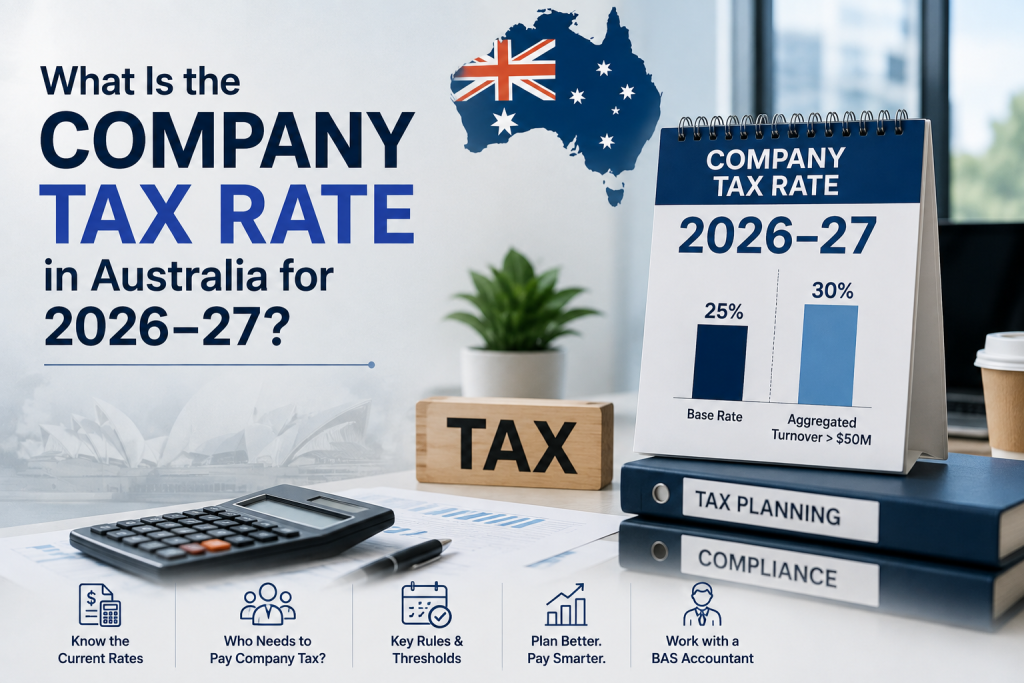
The Australian company tax rate varies based on the company’s size and type. For the financial year 2026-27, Australia has two different rates. Companies that qualify as Base Rate Entities generally pay 25%, while companies that do not qualify generally pay 30%.
25% Base Rate Entity Rate
The lower 25% rate targets small-to-medium active businesses. To secure this rate, a company must pass two annual tests concurrently:
- Turnover Test: Aggregated turnover must be less than $50 million.
- Passive Income Test: Base Rate Entity Passive Income (BREPI), such as commercial rent, dividends, capital gains, and interest, must not exceed 80% of total assessable income.
30% Standard Rate
The standard 30% full corporate rate is the default baseline. It applies automatically to larger enterprises exceeding the turnover cap. It can also apply to companies with low turnover that fail the BRE passive-income test, including companies whose assessable income consists largely of BRE passive income.
Company Tax Rate in Australia for 2026–27
| Company Category | Tax Rate for 2026–27 | Core Requirements |
| Eligible Base Rate Entity | 25% | Aggregated turnover below $50 million AUD and passive income is 80% or less |
| Other Companies | 30% | Aggregated turnover of $50 million or more, or more than 80% of assessable income is BRE passive income |
Source: Australian Taxation Office (ATO) Company Tax Rates
Who Qualifies for the 25% Company Tax Rate?
To qualify for the 25% rate, a company must satisfy the legal definition of a Base Rate Entity (BRE). Due to the fact that business situations vary, your tax rate may change from one year to the next. For instance, a company can get the tax rate of 25% in Year 1, but a sudden increase in revenue in Year 2 can lead to a 30% tax rate for the next year.
To be classified as a Base Rate Entity, a company must pass two strict tests concurrently during the relevant income year.
Aggregated Turnover Test
To qualify for the 25% company tax rate, a company’s aggregated turnover for the income year must be less than $50 million.
However, your company’s standalone revenue alone does not tell the complete story. Under Australian tax law, “aggregated turnover” is the sum of your business’s annual turnover plus the annual turnover of any entities that are “connected” with you or are your “affiliates.”
- Connected Entities: Any entity that controls, is controlled by, or is under common control with the relevant entity. For this definition, control generally means the direct or indirect ability to exercise, or otherwise control, 40% or more of the voting rights, rights to dividends, or rights to capital of an entity. Source: Entities connected with you and control relationships (ATO)
- Affiliates: Any individual or company that acts, or could reasonably be expected to act, in accordance with your directions or wishes in relation to their business affairs.
Important Insight: If your standalone company makes $5 million in sales, but it is controlled by a parent entity that generates $46 million globally, your aggregated turnover is $51 million. Because this exceeds the $50 million threshold, your small company will be taxed at 30%, despite its modest individual size.
Passive Income Test
The second qualification criterion requires that 80% or less of your company’s total assessable income consists of Base Rate Entity Passive Income (BREPI). This rule ensures that the lower tax rate is reserved for active trading businesses rather than passive investment shells or wealth-holding structures.
If more than 80% of your business income is derived from passive sources, you fail this test. Common examples of passive income include:
- Interest: Earnings from corporate bonds, term deposits, or cash accounts.
- Rent: Income derived from commercial or residential investment properties.
- Royalties: Payments received for the use of intellectual property, patents, or copyrights.
- Dividends: Certain corporate distributions and related franking credits, subject to specific exclusions such as non-portfolio dividends.
- Net Capital Gains: A net capital gain included in the company’s assessable income.
Is Base Rate Entity Status Permanent?
No, Base Rate Entity status is not permanent. Under Australian tax law, it is an annual tax test that your company must re-evaluate every financial year based on its specific financial circumstances for that period. A company can easily move in and out of BRE status from one year to the next.
How Circumstances Shift: A 3-Year Scenario
A company can easily move in and out of BRE status from one year to the next. The scenario below demonstrates how routine business shifts alter a company’s tax rate between 25% and 30%:
Year 1: Qualifies for 25%
A consultancy earns $2 million in active revenue and $100,000 in interest. With aggregated turnover below $50 million and passive income below the 80% threshold, it qualifies as a base rate entity (BRE) and pays 25% tax.
Year 2: Moves to 30%
The consultancy pauses trading and earns $50,000 in active revenue plus a $400,000 net capital gain. Although turnover remains below $50 million, passive income exceeds 80% of assessable income, so it loses BRE status and pays 30%.
Year 3: Moves to 30%
The consultancy earns $10 million in active revenue, but a connected entity has $45 million in turnover. Its aggregated turnover becomes $55 million, exceeding the $50 million threshold. It therefore does not qualify for the 25% rate and pays 30%.
Note: Don’t simply carry forward last year’s assumption. Reassess the applicable requirements for the current income year.
25% vs 30% Company Tax — Worked Example
To understand the difference between the two company tax rates, consider a simplified example based on a fictional Australian company.
Example 1: Company Qualifies for the 25% Rate
The fictional Australian company has:
- Taxable income: $100,000
- Aggregated turnover: Below the applicable threshold
- Income mix: Meets the passive income requirement
Because the company qualifies for the 25% company tax rate:
$100,000 × 25% = $25,000
If the 30% rate applied instead:
$100,000 × 30% = $30,000
Difference: $5,000
This shows why determining the correct company tax rate matters. However, this is a simplified illustration. Actual company tax calculations can involve deductions, tax adjustments, offsets and other factors that affect the final tax liability.
Example 2: Company With Substantial Passive Income
Now consider another Australian company, which has:
- Taxable income: $100,000
- Aggregated turnover: Below $50 million
- Passive income: $90,000
- Other assessable income: $10,000
Although the company’s aggregated turnover is below $50 million, 90% of its assessable income is passive income in this simplified example. This exceeds the 80% limit for the base rate entity passive income test.
Therefore, the company would generally not qualify for the 25% rate and the 30% rate may apply.
At 30%:
$100,000 × 30% = $30,000
The key point is that turnover alone does not determine eligibility. A company can be well below the $50 million threshold and still fail the base rate entity test because of the composition of its income.
What Counts as Taxable Income for Company Tax?
It is critical to differentiate between revenue, accounting profit, and taxable income in the process of figuring out the amount of corporation tax owed. The numbers in these categories do not always match up and using the wrong one could lead someone to make an error on their tax return.
- Revenue: The entire amount a firm earns via selling goods, rendering services or executing any other operations before deducting expenses.
- Accounting Profit: The profit reflected in a firm’s financial publications, which has already included relevant income and expenses following accounting principles.
- Taxable Income: The final amount after accounting for the corresponding tax rules in order to find out the taxable income.
Company tax is generally calculated based on taxable income rather than simply applying the tax rate to total sales or revenue.
For example, a company that earns $500,000 in revenues does not automatically have to pay 25% of that amount in corporate tax. After all allowable operational costs and other adjustments, the taxable income might be much less.
Therefore, the calculation should not simply be:
Revenue × 25%
Instead, the applicable company tax rate is generally applied to the company’s taxable income, subject to the relevant tax rules and circumstances.
Company Tax Rate vs Personal Tax Rate
Company and personal tax rates apply to different taxpayers. A company is a separate tax entity, while individuals are taxed on their own taxable income. Therefore, a 25% company tax rate does not mean the business owner will ultimately pay only 25% tax on the profits.
| Company | Individual |
| Separate taxpayer from its owners | Taxed on their own taxable income |
| Generally taxed at 25% or 30%, depending on eligibility | Subject to progressive marginal tax rates |
| Pays tax on its taxable income | Pays tax on personal taxable income |
| Can retain or distribute after-tax profits | Tax treatment depends on the income received |
Why the 25% Rate Does Not Tell the Whole Story
If a company retains its after-tax profits, the immediate tax outcome differs from distributing those profits as dividends. When dividends are paid, franking credits can affect the shareholder’s personal tax liability.
The overall tax outcome therefore depends on how profits are generated, retained and distributed, as well as the business structure and ownership arrangements.
Key Takeaway: A 25% company tax rate does not mean a business owner personally pays only 25% tax on business profits. The tax position should be considered at both the company and shareholder levels.
How the Company Tax Rate Affects Franking Credits
The company tax rate affects the amount of franking credits available when profits are distributed as franked dividends. These credits reflect tax already paid by the company and may reduce the shareholder’s tax liability.
For example, if a company earns $100 and pays 25% company tax, it has $75 remaining for distribution. If fully franked, the $75 dividend may carry a $25 franking credit, subject to the applicable rules.
The shareholder generally includes both amounts in their assessable income and may claim the franking credit as a tax offset. The outcome depends on the shareholder’s personal tax position.
The company tax rate affects franking credits, but the overall tax outcome also depends on how profits are distributed and the shareholder’s circumstances.
Company Tax Return Requirements for 2026–27
For the 2026–27 income year, Australian companies generally need to prepare and lodge an annual company tax return with the ATO. Preparing the return involves more than applying a tax rate to the company’s profit. The company must accurately determine its taxable income, classify its income correctly, claim eligible deductions, and apply the appropriate company tax rate based on its circumstances.
Key areas to consider include:
- Annual company tax return – reporting the company’s income, deductions, taxable income and tax payable.
- Taxable income calculation – reconciling accounting results with the relevant tax rules.
- Deductions – identifying and substantiating allowable business expenses.
- Income classification – correctly identifying different types of income, including income relevant to the base rate entity passive income test.
- Company tax rate – determining whether the company qualifies for the 25% rate or whether the 30% rate applies.
- PAYG instalments – accounting for instalments paid during the year and determining any remaining tax liability.
- Supporting records – maintaining invoices, receipts, bank records, payroll information and other documentation supporting the return.
- Year-end accounting information – ensuring financial statements, trial balances and other year-end records provide a reliable basis for the tax calculation.
The underlying accounting records, income classification, deductions and tax adjustments must also be correct. For businesses, this is where year-end accounting and tax preparation can become time-consuming, particularly when there are multiple income sources, related entities or significant transactions.
A structured year-end process can help businesses identify tax issues early, support the figures reported in the return and ensure the company’s tax position is assessed using the requirements applicable to the 2026–27 income year.
How Aone Outsourcing Can Support Company Tax Compliance
Getting the correct company tax rate is only one part of maintaining accurate tax records. Aone Outsourcing Solutions supports Australian businesses and accounting firms with the accounting work required to keep tax and compliance processes organised, including:
- Company tax return preparation support – support in preparing the accounting and tax information required for company tax returns.
- Bookkeeping and year-end accounting – maintaining accurate books and completing year-end adjustments and reconciliations.
- Income and expense classification – organising transactions correctly so income and deductible expenses can be appropriately identified.
- Tax-ready financial information – preparing clean, structured financial data for tax preparation and review.
- Reconciliation support – reconciling bank, balance sheet and other accounts to identify discrepancies before year-end reporting.
- BAS and PAYG-related accounting work – supporting BAS/GST reconciliations and related accounting processes.
- Compliance workflow support – helping manage recurring accounting and tax preparation tasks within an organised workflow.
- Accounting data preparation – bringing together the reports, records and supporting information needed for tax and compliance work.
Need support with your company’s tax and accounting workload? Talk to Aone Outsourcing about your requirements.
FAQs
What is the company tax rate in Australia for 2026–27?
The company tax rate is generally 25% for eligible Base Rate Entities (BREs) and 30% for other companies.
Is the Australian company tax rate 25% or 30%?
Australian company tax rate can be either 25% or 30%. Eligible BREs generally pay 25%, while companies that do not meet the BRE requirements generally pay 30%.
Who qualifies for the 25% company tax rate?
A company generally qualifies if its aggregated turnover is below $50 million and BRE passive income does not exceed 80% of its assessable income.
Does turnover below $50 million automatically qualify a company for the 25% rate?
No. The company must also satisfy the passive income test. More than 80% BRE passive income can result in the 30% rate.
What is a base rate entity?
A Base Rate Entity is a company that meets the requirements for the 25% company tax rate, including the aggregated turnover and passive income tests.
Does a company need to reassess its base rate entity status every year?
Yes. BRE status is determined for each income year, so a company’s tax rate can change based on its turnover and income mix.
How is company tax calculated?
Company tax is generally calculated by applying the applicable 25% or 30% rate to taxable income, not total revenue.
What is the difference between company tax and personal tax?
Company tax applies to a company’s taxable income, while personal tax applies to an individual’s taxable income using progressive marginal tax rates.
How does company tax affect franking credits?
The company tax paid affects the franking credits attached to franked dividends. Shareholders may use these credits against their personal tax liability, subject to the applicable rules.
When does a company need to lodge its tax return?
Australian companies generally need to prepare and lodge an annual company tax return with the ATO for each income year, including 2026–27.