
 Australia
 USA
USA Canada
 UK
UK Ireland



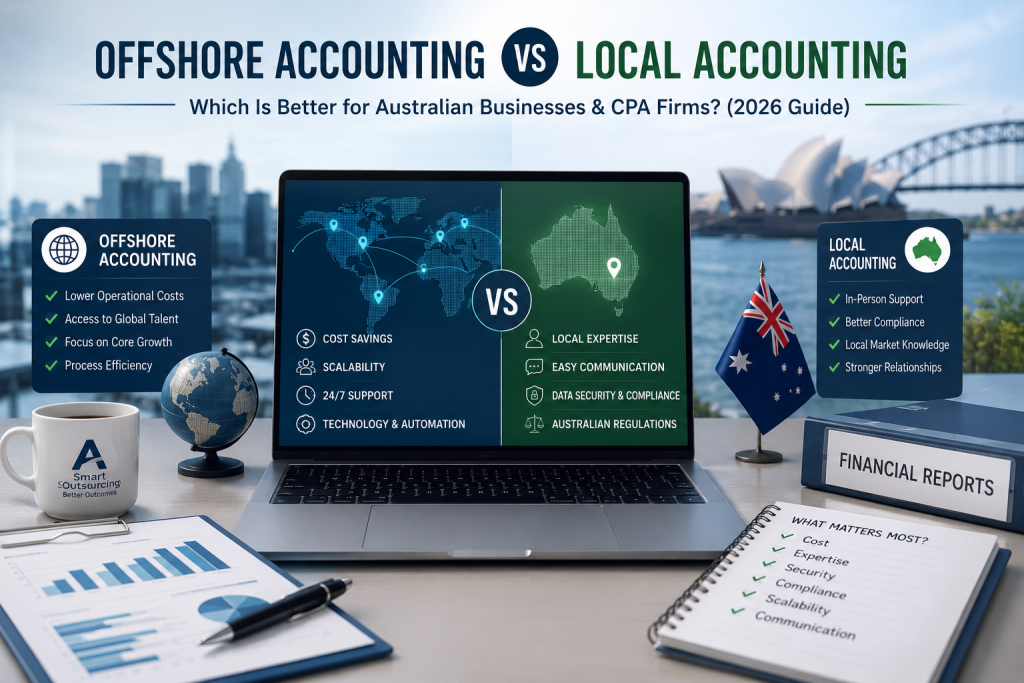
Businesses and CPA firms in Australia are currently going through a tough phase where they are facing growing pressure to control accounting costs while acquiring skilled professionals and scaling operations without compromising quality. This is where the offshore accounting vs local accounting debate becomes important. The reason why accounting costs are putting such immense pressure on Australian businesses & CPA firms is that the country is facing a shortage in the accounting profession. Vacancy fill rate for taxation accountants in the country sits near 55% according to a CA ANZ survey from January to December 2025, well below the threshold of 67% as per Jobs and Skills Australia.
The same report predicts that Australia could have a shortage of nearly 6,000 accountants by the year 2030, as it is believed that there will be a huge demand in areas of accounting, finance, and auditing roles, with around 28,000 positions by the year 2029. Issues regarding a shortage of talent, rising salaries, pressures of compliance and high client expectations are making it difficult for businesses and companies to have an in-house accounting team without going over budget.
As a result, offshore accounting has emerged as a solid alternative for organisations looking to scale up while controlling costs. Local accounting meanwhile provides benefits like proximity, direct communication, data security & compliance and greater control. For Australian businesses and CPA firms, the better choice in 2026 depends on factors such as cost, work complexity, compliance, security, technology, scalability, and specific service requirements.
This guide provides a detailed comparison of offshore accounting vs local accounting for Australian businesses and CPA firms. Instead of promoting one model, in this guide, we examine the strengths and limitations of both to help you choose the approach that is best suited for your business needs.
What Is Offshore Accounting?
Offshore accounting is the practice of hiring remote accounting professionals or third-party firms located in another country to handle a company’s financial, bookkeeping, and tax preparation tasks. Businesses use this strategy to lower labour costs, scale operations, and access specialised global talent.
The advantage of working with an offshore accounting service provider is that it can work with existing accounting software and a few client-specific processes. A common misconception about offshore accounting is that it is all about cost optimisation. But the reality is that professional offshore accounting firms provide dedicated accountants, reviewers, managers, quality controls and service-level agreements.
What Is Local Accounting?
Local accounting generally refers to financial services provided by nearby, community-based accounting firms, or accounting practices tailored to specific regional laws and municipal regulations such as ATO, GST, and BAS requirements. Local accounting services contrast with large national or remote online firms by offering face-to-face engagement and localised compliance expertise.
Typically, businesses in Australia hire a local accounting firm to assist with bookkeeping and tax compliance. CPA firms in Australia usually offer specific services such as tax planning, business consulting, financial analysis, and compliance.
Offshore Accounting vs Local Accounting: What’s the Difference?
Local accounting uses professionals based in your home country for direct communication and complex local tax advice. Offshore accounting outsources routine financial tasks like bookkeeping and tax prep to remote teams in lower-cost overseas regions, saving up to almost half of the operational expenses.
Cost, skills, availability, communication, compliance, technology, turnaround, scalability, security, reporting, consulting, capabilities, and continuity are the key points of difference between offshore and local accounting firms. There is no winner here because each depends on the quality of work required, level of supervision, your budget and growth expectations.
| Factor | Offshore Accounting | Local Accounting |
| Cost | Lower FTE cost; no direct super or leave on-cost burden for the client | Higher Australian wages, superannuation, leave, and employment on-costs |
| Expertise | Trained professionals can work to Australian accounting standards under managed processes | Strong local knowledge developed through Australian practice |
| Availability | Extended coverage can be achieved through time-zone differences | Primarily available during Australian business hours |
| Communication | Structured async communication, scheduled calls, and documented workflows | Direct communication, with in-person meetings often available |
| Compliance | Australian processes can be followed under appropriate local practitioner oversight | Direct local accountability and familiarity with Australian requirements |
| Technology | Often cloud-based, using platforms such as Xero and MYOB for remote workflows | Cloud technology is also widely used, depending on the provider |
| Turnaround | Time-zone differences can support overnight processing | Work generally follows standard Australian business cycles |
| Scalability | Teams can often be expanded or reduced more quickly | Scaling depends largely on local recruitment and staff availability |
| Data Security | Access controls, contractual safeguards, and audit trails can support secure delivery | Direct control over systems and staff within the local organisation |
| Reporting | Standardised and dashboard-driven reporting is common | Reporting can be more customised and relationship-driven |
| Advisory Capability | Well suited to accounting support, with strategic advice often retained locally | Strong option for complex, high-touch financial and business advisory |
| Business Continuity | Team-based delivery can reduce dependency on a single employee | Smaller teams may face greater key-person dependency |
Cost Comparison: Offshore Accounting vs Local Accounting
Offshore accounting Australia typically costs less; superannuation, recruitment, software, office space, training, employee benefits, and productivity are all considered. However, the actual difference depends on the volume, complexity, service scope, and level of expertise required. Local accounting can remain cost-effective for businesses that need high-touch advisory or complex work.
The main cost factors include:
- Salary: Professionals from Australia working in accounting earn significantly higher salaries when compared to overseas accountants who are performing the same process-driven tasks.
- Superannuation: In Australia, superannuation is a compulsory requirement, which local employers have to include in addition to employee wage payments, while in the case of outsourcing to other countries, the employer does not deal directly with any employment costs.
- Recruitment: Recruitment needs to be done locally, which includes advertising costs, recruitment fees, interviewing candidates, employment orientation, and replacement costs. On the other hand, the offshore service providers do all recruitment in the course of their normal work activity.
- Software: Accounting, payroll, communication, and security software might be needed for both models. Depending on the agreement, the costs of using offshore service providers may include these expenses.
- Office Costs: If your teams work from the office, you will need office space, furniture, utilities, and other necessary infrastructure. In contrast, offshore teams usually operate from the provider’s facilities.
- Training: Businesses will often need to invest time and money into training their local employees on using software, processes, and organisational policies. Managed offshore teams might have staff already trained but might still require training specific to their Australian operations.
- Employee Benefits: Local employment may provide leave benefits, insurance, allowances, and other advantages, which add to the overall expenses of the employee.
- Productivity: Rather than only hourly rates, costs should be analysed in terms of quality, delivery time, management, redoing, and the capacity to respond to changes in the workload.
Cost Model: Local Accounting Provider vs Offshore Accounting Provider
The following is an example only, not a guaranteed market price. Assume that the company located in Australia needs a full-time accountant who will be responsible for performing bookkeeping, accounting, and reporting functions, as well as accounts payable.
| Cost Component | Local Model | Offshore Model |
| Salary/service cost | $80,000 | $35,000 |
| Superannuation & employment costs | $10,000 | Included/varies |
| Software & equipment | $5,000 | Included/varies |
| Office & infrastructure | $8,000 | Included/varies |
| Recruitment & training | $5,000 | Included/varies |
| Annual cost | $108,000 | $35,000–$45,000 |
Actual costs differ considerably depending on the place of work, the contractor in charge, work experience, and workload involved. Therefore, companies should compare overall operational costs rather than only wages.
In order to compare offshore accounting vs local accounting, you should determine your current employee cost or cost per process before proceeding with an evaluation of the cost of outsourcing.
Want to see where your accounting budget could be reduced? Use a cost-comparison tool or speak to our accounting specialist at Aone Outsourcing Solutions to compare your current operating model with available alternatives.
Quality Comparison: Offshore Accounting and Local Accounting
Local and offshore accounting differ primarily in proximity and depth of context. Local accounting offers immediate face-to-face communication, deep mastery of domestic tax law, and direct regulatory accountability. Offshore accounting provides high-volume scalability with significant cost savings and scalable processing power for high-volume compliance tasks.
| Capability Pillar | Offshore Accounting | Local Accounting |
| Qualifications & Certifications | University degrees plus international certifications. Cannot sign off on local tax filings without domestic review. | Country-specific designations with active domestic tax agent board registration. Legal sign-off authority. |
| Software Proficiency | Mastery of global cloud stacks (Xero, QuickBooks, NetSuite) and high-volume data capture tools (Dext, Hubdoc). Highly adaptable to digital workflows. | Experts in the same cloud platforms, plus specialised domestic compliance software (MYOB, APS, Class, BGL) and local payroll systems. |
| Industry Expertise | Best for structured, borderless models like e-commerce and SaaS. Struggles with complex local legislation (e.g., property trusts, local farming schemes). | Deeply knowledgeable in local industry benchmarks, regional economic nuances, and domestic government grants (e.g., R&D tax incentives). |
| Standard Operating Procedures (SOPs) | Critically dependent on explicit, step-by-step, written SOPs. Processing stalls if a transaction falls outside the documented workflow. | Highly functional under broad, principles-based guidelines. Relies on internal professional judgment to navigate missing data or edge cases. |
| Quality Assurance & Review | Multi-tiered, structural review factory (Junior → Senior → Team Lead). Excellent at catching mathematical and data-entry errors. | Holistic partner-led or peer review. Focuses on strategic correctness, compliance risk, and how the data aligns with real-world business goals. |
| Continuous Training | Highly structured corporate training focusing on global accounting standards, software updates, and rigorous data security protocols. | Legally mandated Continuous Professional Development hours focusing on local annual federal budgets, tax law shifts, and domestic case law. |
Compliance and Data Security: Offshore Accounting vs Local Accounting
Choosing between offshore and local accounting involves balancing cost savings against strict data protection laws and local tax regulations. While local teams offer native legal alignment and immediate trust, outsourced accounting models provide scalable labour at lower costs. Both approaches carry distinct compliance and security realities.
Australian Regulatory Compliance
ATO Expectations & BAS/GST Lodgement
Businesses remain responsible for their tax obligations, while registered tax and BAS practitioners have professional and supervisory responsibilities for services they provide or provide on behalf of clients.
- Local: Registered BAS agents or other appropriately registered tax practitioners can provide or supervise relevant BAS services in accordance with their registration and professional obligations.
- Offshore: Offshore staff who are not registered tax practitioners can perform outsourced tax or BAS work under appropriate supervision and control. The Australian registered tax practitioner remains responsible for the quality of the work and must maintain appropriate supervisory arrangements.
Payroll & Fair Work Obligations
Australian payroll process is complex because of many complications from Superannuation Guarantee (SG) regulations, Single Touch Payroll (STP Phase II), and various modern awards.
- Local: Local accounting firms know Fair Work Ombudsman award updates, public holiday rates, and payroll tax limits of various states and understand them instantly and effortlessly.
- Offshore: Higher risk of non-compliance regarding complex award interpretations. Offshore payroll data entry requires strict, double-checked local workflows to prevent severe Fair Work underpayment penalties.
Australian Privacy Act & APPs
According to the Privacy Act 1988, information regarding financial or tax matters constitutes personal information having strong privacy and security safeguards attached to it.
- Local: Keeping data within Australia may reduce some cross-border disclosure considerations, but businesses must still apply appropriate privacy and security controls.
- Offshore: In case of using offshore providers, one needs to obtain explicit consent from customers or have a legally binding contract with them that states that the offshore provider is obliged to comply with the related authority’s standards.
Data Security & Operational Controls
Access Controls & Audit Trails
- Local: Access is managed natively through secure networks. All activities of users are recorded by cloud accounting tools, which provide an obvious and valid tracing of the history of operations within the framework of Australian legislation.
- Offshore: Outsourcing mandates strict role-based access control (RBAC). Staff working outside of the country must do so with virtual desktop infrastructure that limits the ability to download information locally.
ISO-Aligned Security Practices
- Local: Local companies typically depend on the local infrastructure of top cloud service providers as well as their local IT teams.
- Offshore: It is essential to verify offshore providers for ISO 27001 certification (Information Security Management) or SOC 2 Type II compliance in order to guarantee that their physical facilities, servers, and staff hiring procedures comply with global security standards.
Offshore Accounting vs Local Accounting: Pros and Cons
Pros of Offshore Accounting
- Cost Saving: Lowers labour costs by around 50% to 70% compared to local hiring.
- Quick and Easy Scale-Ups: Conveniently scale up or down during peak seasons like tax season without local hiring hassles.
Cons of Offshore Accounting
- Communication Barriers: Time zone disparities or language barriers limit effective and timely communication of urgent, critical information.
- Regulatory Challenges: Certain jurisdictions may restrict information access pertaining to fast-changing tax regulations.
Pros of Local Accounting
- Thorough Regulatory Knowledge: Deep understanding of the local tax regulations and applicable government grants and local auditing standards.
- Proactive Advising: Ability to work together successfully and develop local market insights.
Cons of Local Accounting
- Premium Pricing: Hourly rates and salaries are considerably higher than those offered on the global talent market.
- Challenges in Talent Acquisition: Finding skilled local accountants is a challenge in the competitive job market.
Offshore vs Local Accounting for Australian CPA Firms
Choosing between offshore and local accounting is no longer a question of geographical location. For Australian CPA firms, it is an operational decision regarding the allocation of resources. Traditional business models viewed offshoring as an all-or-nothing cost-cutting measure. However, modern CPA firm operating models treat global teams as an extension of their local practice.
The core question for practice partners has shifted from “Where should my accounting be done?” to “How should our firm divide work between local and offshore teams?”
A firm’s capacity, profitability, and scalability depend on this division. Local staff are often bogged down by process-driven data entry, which limits their availability for client advisory work. This mismatch reduces profit margins and contributes to staff burnout. By treating offshoring as a capacity engine, firms can systematically separate high-volume processing from high-value professional judgment.
Which Accounting Model Works Better for CPA Firms?
There is no single model that fits every practice. The right model depends entirely on the firm’s work mix, client profile, and growth objectives. A boutique practice managing high-net-worth individuals requires a different structural balance than a high-volume compliance firm.
The table below outlines how different CPA firm environments can align their structure with the optimal staffing model:
| CPA Firm Situation | Recommended Model | Operational Rationale |
| Boutique practice | Hybrid | Blends personalised local service with cost-effective back-office support. |
| High compliance volume | Offshore + local review | Offloads mass processing while maintaining strict local quality control. |
| Advisory-led practice | Local client leadership + offshore processing | Frees up local partners to focus on strategy while data assembly is handled globally. |
| Seasonal workload | Offshore capacity | Scalable support to manage peak tax season bottlenecks without local hiring stress. |
| Rapidly growing practice | Hybrid / team-based | Allows rapid scaling of processing capacity without a proportional increase in local overheads. |
| Highly specialised advisory | Strong local ownership | Keeps complex, nuanced, and high-risk technical judgment within the local team. |
| Process-heavy bookkeeping practice | Greater offshore suitability | Minimises the cost of delivery on low-margin data entry, payroll, and reconciliations. |
Accounting Tasks CPA Firms Can Outsource
Process-heavy, repeatable tasks with clear instructions are strong candidates for offshoring. For tax and BAS-related work, it is critical to distinguish preparation and support from review, responsibility, and lodgement.
According to the Tax Practitioners Board (TPB), any tax agent services outsourced to an unregistered third party require appropriate supervision and control. The registered Australian practitioner remains ultimately responsible for the quality of the work and compliance with professional standards.
The matrix below provides task-level decision support for CPA practices:
| Function | Strong Candidates for Offshore Support (Preparation & Processing) |
| Daily Bookkeeping | Bookkeeping clean-up, data entry, transaction processing, bank reconciliations, accounts payable, accounts receivable. |
| Payroll Management | Payroll processing, superannuation calculations support, payroll software setup, leave tracking. |
| Compliance & Reporting | Workpaper preparation, financial statement preparation, management-report preparation, accounting software administration, client file organisation. |
| Tax Support (Pre-Lodgement) | Tax return preparation support, BAS preparation support, data extraction, source document verification. |
Accounting Tasks CPA Firms Should Keep Local
While execution and processing can be managed globally, the boundary between technical processing and professional ownership must remain distinct. Certain responsibilities are typically better kept under local Australian oversight to manage risk, protect client relationships, and apply professional judgment.
These functions include:
- Managing Client Relations: Efficiently facilitating sensitive discussions with customers, onboarding important clients, and serving as their key point of contact.
- Managing Strategic Advisory and Consultancy: Carrying out tax consulting, offering public relations strategies, and giving consulting services to clients.
- Partner-level Decision Making: Making complex decisions, finalising complex compliance procedures, and guiding the company’s policy.
- Quality Management: Performing all necessary technical checkups, granting final approval, and performing submissions according to the law in Australia.
Offshore Accounting vs Local Accounting: Which Is Better?
Choosing between offshore and local accounting is not a matter of identifying a universally superior model; rather, it is about aligning your operational architecture with your business goals. The decision comes down to the nature of the work itself, the level of strategic risk involved, and your organisation’s capacity requirements.
To guide this decision, businesses can look at the accounting function through a clear three-way framework:
- The most effective use of offshore accounting is when it is used for activities that are repetitive, highly standardised, quantifiable, and easily replicable.
- The use of Local Accounting becomes necessary when dealing with situations requiring significant human interaction, judgement, relationship management, and sensitivity to the environment.
- A Hybrid Model represents the ideal solution where preparation can be cleanly separated from review, firms require rapid scale, local regulatory accountability remains non-negotiable, and workflow ownership can be clearly divided.
When Offshore Accounting Is the Better Choice
An offshore model provides the maximum benefit when a business needs to build operational capacity without exponentially inflating overheads. Offshore accounting becomes the structurally superior choice when:
- Workload is predictable or highly scalable: The volume of routine data entry or compliance tracking expands seasonally, requiring immediate access to a broader talent pool.
- Processes can be explicitly documented: The tasks follow clear standard operating procedures (SOPs) that leave little room for ambiguity or subjective interpretation.
- Work is objective and measurable: Clear key performance indicators (KPIs) can track throughput, accuracy rates, and operational turnaround times.
- Review is straightforward: Onshore teams can quickly audit the completed work against standard rules rather than untangling complex variables.
- Internal capacity is constrained: Senior local accountants are spending disproportionate hours on entry-level book balancing instead of client advisory.
- Cost flexibility matters: The business requires an elastic payroll infrastructure where capacity can expand or contract based on immediate margin realities.
- Secure cloud systems are available: Secure, centralised ecosystems like Xero or MYOB are fully deployed, allowing global teams to log in and process data concurrently without local data fragmentation.
When Local Accounting Is the Better Choice
Investing in a local, dedicated onshore presence remains vital when the value proposition hinges on contextual intelligence, physical availability, and deep regional accountability. Onshore accounting is the stronger choice when:
- Client Interaction is Central: Direct, unscripted communication and long-term trust form the foundational value of the engagement.
- Decisions Require Local Context: Financial data must be interpreted alongside local economic shifts, micro-market changes, or regional regulatory updates.
- Judgment is Exceptionally High: The business deals with highly subjective tax interpretations, complex corporate restructuring, or unique multi-entity legal frameworks.
- Issues are Highly Sensitive: Financial matters involve volatile shareholder negotiations, high-stakes local audits, or sensitive internal transitions where confidentiality requires tight, localised control.
- Immediate Collaboration is Required: Dynamic, real-time strategy sessions are needed within the same time zone, requiring synchronous boardroom presence.
- Strategic Advisory is the Primary Value Proposition: The objective is not just data preservation, but long-term cash flow optimisation, proactive tax minimisation planning, and business valuation scaling.
When Combining Offshore and Local Accounting Makes Sense
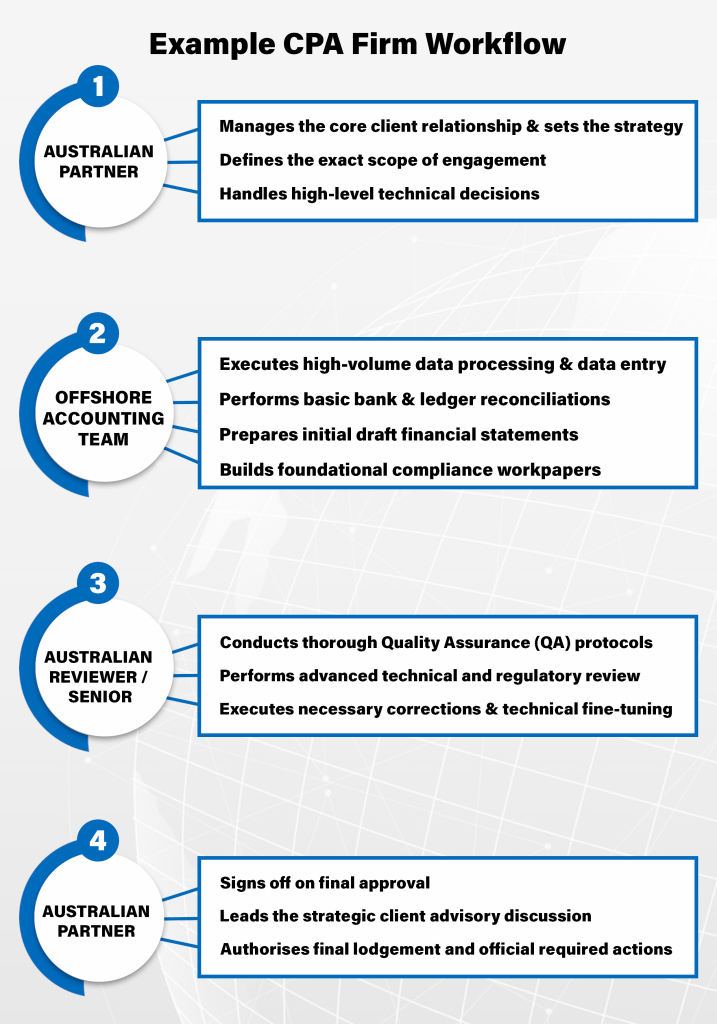
The most resilient and profitable modern architecture is rarely an “either/or” choice; it is a collaborative model that blends local ownership, offshore capacity, and structured review. By establishing a clear division of labour, a business can insulate its local specialists from routine burnout while maintaining absolute domestic accountability.
Under this approach, the offshore team acts as an efficient production engine, while the local team serves as the strategic interface and quality control filter. This structural division is best demonstrated through a standard day-to-day workflow within a growing CPA firm:
Final Verdict
There is no one-size-fits-all option when it comes to offshore accounting vs local accounting for businesses and CPA firms in Australia. In general, offshore accounting appears to be a more viable option for expenses, work routine requirements, and storing data. On the contrary, local accounting is a better option for performing complex compliance functions, providing strategic consulting, working with clients, and completing tasks that require significant judgment. Many companies combine offshore and local accounting in their businesses. Offshore teams can cope with complex processes of a standard nature, while the rest of the tasks are assigned to professionals in Australia, who take care of audit processes and management.
Looking to reduce accounting costs without compromising quality? Aone Outsourcing Solutions helps Australian businesses and CPA firms build scalable offshore accounting teams tailored to their needs. Talk to our experts today to explore the right model for your business.
FAQs
Is offshore accounting cheaper than local accounting?
Yes. Offshore accounting can significantly reduce labour and operating costs, especially for routine, process-driven work.
Is offshore accounting safe for Australian businesses?
Yes, when providers use appropriate access controls, security measures, contracts, and audit trails.
Can Australian CPA firms outsource accounting work offshore?
Yes. CPA firms can outsource suitable preparation and processing tasks while retaining local oversight and professional responsibility.
Which accounting tasks are best suited to offshore teams?
Bookkeeping, reconciliations, accounts payable, payroll processing, workpapers, and other repetitive, standardised tasks are strong candidates.
Is offshore or local accounting better for Australian businesses?
Neither is universally better. Offshore works well for scalable processing, while local teams are valuable for complex, high-judgment and advisory work; a hybrid model often combines both strengths.