
 Australia
 USA
USA Canada
 UK
UK Ireland



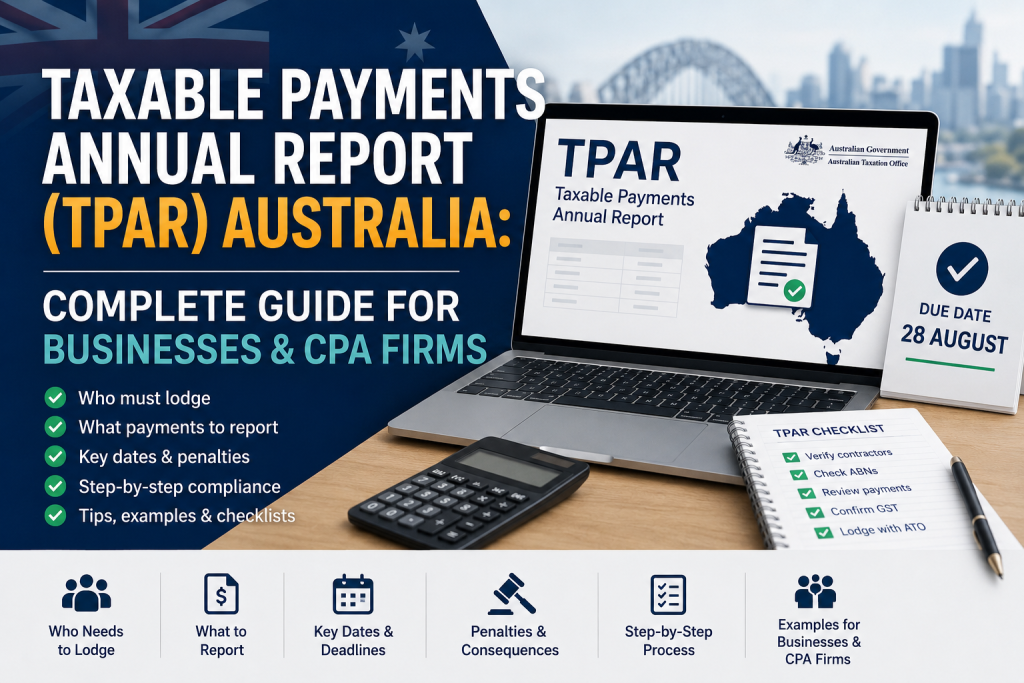
A Taxable Payments Annual Report (TPAR) is an annual ATO lodgment disclosing payments your business made to contractors during the financial year. If you operate in building and construction, cleaning, courier, road freight, IT, or security services and pay contractors, you’re likely required to lodge. The FY2025–26 TPAR is due 28 August 2026, and there’s no grace period built into the process.
TPAR Due Date at a Glance
| Field | Detail |
| TPAR Due Date 2026 | 28-Aug-26 |
| Reporting period | 1 July 2025 – 30 June 2026 |
| Report | Taxable Payments Annual Report (TPAR) |
| Lodged with | Australian Taxation Office (ATO) |
| Who may need to lodge | Businesses that make reportable payments to contractors |
What Is a Taxable Payments Annual Report (TPAR)?
A TPAR is an annual report you lodge with the ATO that discloses the payments your business made to contractors over the financial year — who you paid, how much, and whether GST was included. It doesn’t change your own tax bill. It’s purely disclosure.
The ATO introduced TPAR in 2012 for building and construction, then extended it to cleaning, courier, road freight, IT services, and security services once the data-matching approach proved it worked. The logic is straightforward: contractor income is one of the easiest places for cash-in-hand work and underreported invoices to hide. When your business tells the ATO “we paid this contractor $80,000,” and that contractor’s own return shows $50,000, the gap is visible without anyone opening an audit file.
That’s the real difference between TPAR and your regular BAS or GST reporting. BAS is about your business’s own position — GST collected and paid, PAYG withholding, PAYG instalments. TPAR is about someone else’s income, reported through you. You’re not being taxed on it; you’re the data source that lets the ATO check someone else’s honesty.
When Is the TPAR Due?
The TPAR is generally due 28 August each year. Businesses required to report contractor payments must lodge their Taxable Payments Annual Report with the ATO by the applicable deadline. For the 2025–26 financial year, the standard TPAR due date is 28 August 2026.
What’s Different About TPAR in 2026
Two changes make this year’s TPAR season meaningfully different from previous ones, and both are worth understanding before you treat this as routine paperwork.
Paper lodgement is gone.
From 28 August 2025, the ATO permanently discontinued paper TPAR lodgement. If your business (or your bookkeeper) was still submitting a paper form out of habit, that option no longer exists — lodgment now has to go through Online services for Business, a registered agent’s portal, or compatible accounting software. There are no exceptions carved out for small operators who preferred the paper process.
Contractor data now pre-fills automatically.
From late August 2026, the ATO begins using TPAR submissions to pre-fill income data for contractors in high-risk industries — construction, cleaning, IT services, courier, road freight, and security. In practice, this means a contractor’s own tax return can now show up partially completed based on what businesses reported paying them. If your TPAR entry for a contractor is wrong — a bad ABN, an understated total, a duplicate — that error doesn’t sit quietly in an ATO database. It surfaces in the contractor’s own return, and the mismatch becomes visible to both sides almost immediately.
Put together, these two changes shift TPAR from “an annual disclosure the ATO files away” to something closer to real-time cross-checking. Accuracy has always mattered; in 2026, the gap between getting it right and getting it wrong closes much faster.
Who Needs to Lodge a TPAR?
If your business is in one of the industries below and you paid contractors for services during the year, you almost certainly need to lodge — even if payments were a small part of what you paid contractors overall.
| Industry | Must Lodge? | Exceptions |
| Building & construction | Yes | Businesses with 0% of income from construction services in the year |
| Cleaning services | Yes | One-off or incidental cleaning arrangements, not core business activity |
| Courier services | Yes | Contractors paid solely for goods, not delivery services |
| Road freight | Yes | Businesses where freight is incidental, not a core service line |
| Security, investigation, surveillance | Yes | None material — coverage is broad across this category |
| IT services | Yes | Software or hardware purchases with no service component |
| Mixed businesses | Depends | Required if income from a reportable service exceeds 10% of total GST turnover |
The 10% threshold for mixed businesses is the one that catches people out. A business that’s mostly retail or hospitality but does some contracted cleaning or IT work on the side can still trip the requirement once that income crosses the line — it’s worth checking even if TPAR “doesn’t sound like us.”
What Payments Must Be Reported?
You report payments made to contractors for labour, or for a combination of labour and materials, within a reportable industry. For each contractor, the ATO wants:
- ABN (verified, not just what’s printed on the invoice)
- Name and business address
- Total amount paid for the financial year, including GST
- Total GST included in those payments
What you don’t report: payments for materials-only supply with no labour component, payments to your own employees (that’s Single Touch Payroll’s job), and payments where no ABN was quoted and you withheld tax under the no-ABN withholding rules — those get reported through PAYG withholding, not TPAR. Incidental materials supplied alongside a labour contract (a plumber who supplies pipe as part of the job) are included in the reportable total; a separate, unrelated materials-only invoice from the same supplier isn’t.
TPAR Due Dates in Australia
The Taxable Payments Annual Report (TPAR) is generally due by 28 August each year. Businesses required to report payments made to contractors for eligible services must lodge their TPAR with the ATO by this date, with no extended concession, as there sometimes is for other lodgments through a registered agent. For example, the TPAR covering payments made during the 2025–26 financial year is due 28 August 2026.
| TPAR financial year | TPAR due date |
| 2024–25 | 28-Aug-25 |
| 2025–26 | 28-Aug-26 |
| 2026–27 | 28-Aug-27 |
If 28 August falls on a weekend or public holiday, check the ATO’s current lodgement guidance for the applicable date.
| Milestone | Timing |
| Financial year covered | 1 July – 30 June |
| TPAR due date | 28 August following year-end |
| Nil report | Required if you’re registered for TPAR but had no reportable payments — you still need to tell the ATO, either by lodging a nil report or updating your obligations |
| Amended report | Can be lodged any time you discover an error — the sooner after discovery, the better for minimising any penalty exposure |
| Late lodgement | May attract a failure-to-lodge penalty, calculated in penalty units for every 28 days the report is overdue |
One habit worth building: don’t wait until August to start pulling contractor data. Reconciling a full year of contractor payments in the days before a fixed deadline is where most of the mistakes in the next section come from.
How to Prepare a TPAR, Step by Step
Preparing a TPAR isn’t complicated in principle, but each step has a specific failure mode if it’s rushed. Here’s what actually happens at each stage, and where the process typically breaks down.
1. Collect contractor details
Start by pulling together name, ABN, and business address for every contractor paid during the financial year — not just the ones you remember, but everyone in your accounts payable ledger who was coded as a contractor rather than a supplier of goods. This is also the point to confirm whether each arrangement is genuinely a contractor relationship or should be treated as employment; the classification matters for TPAR and for broader compliance.
2. Verify ABNs
Don’t rely on the ABN printed on an old invoice or entered once at onboarding. Confirm each ABN is currently active and matches the contractor’s registered business name via the ABN Lookup register. ABNs get cancelled, businesses change structure, and a contractor who was a sole trader last year might now invoice through a company — the ABN on file should reflect who you’re actually paying today.
3. Reconcile payments
Match every contractor invoice to an actual bank payment, not just the invoice total. This step is where duplicate and missing entries usually surface — an invoice can be issued, paid, and then re-issued in error, or a payment can be made directly without a matching invoice ever being logged. Reconciling against the bank feed, rather than trusting the invoice register alone, is the single most effective way to catch this before lodgment.
4. Review GST
For every payment, separate the GST component, so your TPAR figures split cleanly into GST-exclusive and GST amounts. This is usually straightforward if GST was coded correctly at the time of entry, and considerably harder if it wasn’t — which is why doing this retrospectively, all at once in August, tends to produce more errors than reviewing it progressively through the year.
5. Export accounting software data
Most cloud accounting platforms — Xero, MYOB, QuickBooks — can generate a TPAR-ready report directly from correctly coded transactions. The export is only as good as the coding behind it, though: contractors need to be consistently tagged as reportable throughout the year for the export to be complete and accurate on the first pass.
6. Validate records
Before lodging, spot-check a sample of contractors — particularly the highest-value ones — against source invoices and bank statements. This is a final sanity check, not a full re-reconciliation, but it’s the step that catches the odd transposed figure or misclassified payment that slipped through earlier stages.
7. Lodge with the ATO
Submit via Online services for Business, through a registered tax or BAS agent, or directly from compatible accounting software. Paper lodgement is no longer available, so confirm your chosen channel is set up and tested well before the 28 August deadline rather than discovering an access issue on the day.
8. Retain documentation
Keep invoices, ABN verification records, and reconciliation working papers for at least five years. This isn’t just good practice — it’s what lets you respond quickly if the ATO queries a figure, or if a contractor disputes what was reported against their own return.
Common TPAR Mistakes That Trigger ATO Issues
| Mistake | Impact | Prevention |
| Missing contractors | Understates total contractor payments; if the contractor’s own return shows income you didn’t report, it’s an immediate mismatch | Reconcile against the full accounts payable ledger, not just a contractor list maintained manually |
| Incorrect ABNs | Report doesn’t match the contractor’s ATO record, which can delay processing or flag the lodgment for review | Verify every ABN against the ABN Lookup register before lodging, not just once when the contractor was onboarded |
| Duplicate payments | Overstates contractor income, which can create discrepancies the contractor then has to explain | Reconcile against bank transactions, not invoice records alone — invoices can be issued twice by mistake |
| Incorrect GST | Misreports the GST component, which affects the contractor’s own BAS reconciliation | Separate GST at the point of data entry, not retrospectively at TPAR time |
| Wrong contractor classification | Can misrepresent whether someone is genuinely a contractor versus an employee under a different label | Review classification annually, particularly for long-term or exclusive contractor relationships |
| Late reporting | Attracts failure-to-lodge penalties calculated per 28-day period overdue | Start data collection well before the deadline rather than the week of |
TPAR vs BAS vs Business Tax Return
These three obligations get confused constantly because they all involve numbers going to the ATO — but they’re answering different questions.
| Feature | TPAR | BAS | Tax Return |
| What it reports | Payments made to contractors | GST, PAYG withholding, PAYG instalments | Total business income and deductions |
| Frequency | Annual | Monthly or quarterly (some annual) | Annual |
| Due date | 28 August | 21st/28th of the month following period end | 31 October (self-lodged) or per agent lodgment program |
| Who it affects | Contractors you paid | Your own GST and withholding position | Your own tax liability |
| Does it change what you owe? | No — purely informational | Yes — determines GST/PAYG payable or refundable | Yes — determines income tax payable |
What Records Should You Keep?
The records that make TPAR straightforward are the same ones a good bookkeeping system should already be producing — the issue is usually that they’re scattered across email, invoices, and bank statements rather than centralised.
- Contractor invoices, itemised where possible (labour vs materials): so the reportable and non-reportable portions of a payment can be separated cleanly if a supplier invoices for both.
- Signed contractor agreements, especially for ongoing arrangements: useful evidence of the nature of the relationship if a contractor’s classification is ever questioned
- Payment records matched to bank transactions: the source of truth when an invoice total and an actual payment don’t line up
- ABN verification records or screenshots from ABN Lookup: dated evidence that the ABN was active and correctly matched at the time of payment
- GST breakdowns for each payment: needed both for your own BAS and to report the correct GST-inclusive and GST components on the TPAR
- A running contractor register updated through the year, not rebuilt in August: ideally a single spreadsheet or software view that’s added to with every new contractor engagement.
- Correspondence around disputed or corrected invoices: helpful context if a figure is later queried by the ATO or by the contractor themselves
- Prior years’ lodged TPARs and any amendments: a quick reference point when a contractor’s history needs to be checked across multiple years
Keep all of the above for at least five years — the standard ATO record-keeping period — since an amended report or a contractor dispute can surface well after the original lodgment.
TPAR Checklist for Australian Businesses
Use this as a working checklist through the lead-up to 28 August, broken into the three stages most businesses go through: getting the data ready, checking it, and lodging it.
Before you start
- Confirm whether your business needs to lodge at all this year, including checking the 10% mixed-income threshold if you’re not in a core reportable industry.
- Pull a full list of contractors paid during the year from your accounts payable ledger, not from memory or a manually maintained list.
- Identify any new contractors added during the year who may not yet have verified details on file.
- Check whether any contractor arrangements changed structure during the year (sole trader to company, for example) and need updated ABN records.
Data collection and reconciliation
- Verify every contractor detail — name, ABN, address — is current and complete.
- Match every invoice to an actual bank payment rather than relying on invoice totals alone.
- Confirm each ABN against the ABN Lookup register and flag any that are inactive or mismatched.
- Separate the GST component of every payment so figures are reported correctly.
- Reconcile any contractors paid through multiple entities or under slightly different business names.
- Flag and resolve any duplicate invoices or payments before they’re included in totals
Before lodging
- Export the TPAR-ready report from your accounting software
- Spot-check a sample of contractors — especially the largest by value — against source invoices and bank records
- Confirm your lodgment channel (Online services for Business, registered agent, or software) is set up and accessible
- Lodge before 28 August — or lodge a nil report if you’re registered but had no reportable payments
- File all supporting documentation — invoices, ABN checks, reconciliations — for at least five years
- Note any figures you’re uncertain about so they can be checked first if an amendment is ever needed
Should You Prepare TPAR In-House or Outsource It?
There’s no single right answer here — it comes down to how many contractors you’re managing and whether you already have someone whose job it is to get this right.
| Business Type | Best Option |
| Sole trader with a handful of contractors | In-house |
| Small business with moderate contractor volume | Hybrid — in-house data collection, professional review before lodging |
| Growing SME with expanding contractor base | Outsource |
| Multi-location business | Outsource |
| CPA or accounting firm managing client TPARs | Outsource compliance support for overflow capacity |
The pattern worth noticing: it’s rarely about business size alone. A sole trader with fifteen long-term subcontractors can outgrow “in-house” faster than a larger business with three stable contractor relationships.
How Outsourced Accounting Helps Businesses Stay TPAR Compliant
The practical benefit of bringing in outsourced support isn’t just “someone else does the paperwork” — it’s the specific things that go wrong when TPAR is handled ad hoc internally:
- Reduced errors — a dedicated process for ABN verification and reconciliation, rather than a rushed August exercise
- BAS agent expertise — correct classification of contractors and payment types from someone who does this across many clients
- Cloud bookkeeping — contractor data captured continuously through the year, not reconstructed at deadline time
- ATO-ready documentation — records kept in a form that holds up if the ATO ever asks questions
- Year-round compliance — TPAR readiness becomes a by-product of ongoing bookkeeping, not a separate annual scramble
- Scalability during EOFY — capacity to handle TPAR alongside BAS, STP finalisation, and other EOFY obligations without one crowding out another
In practice, most businesses that move TPAR to an outsourced provider aren’t doing it because the report itself is difficult — it’s because contractor data has been drifting all year. August is the first time anyone sits down to reconcile it properly. An outsourced bookkeeping arrangement fixes that by making contractor reconciliation part of the monthly routine, so the TPAR itself becomes a short review-and-lodge step rather than a multi-week catch-up exercise.
Real-World Scenarios
Construction company with 120 contractors
Challenge: a mid-sized construction business managing subcontractors across multiple job sites had contractor data spread across site supervisors’ spreadsheets, with no central register.
Approach: consolidated all contractor payments into a single reconciliation process, cross-checked against bank records rather than site-level invoice logs. Outcome: identified several duplicate and missing entries before lodgment — the kind of errors that would otherwise have surfaced as ATO mismatches months later.
Cleaning company expanding into three states
Challenge: rapid expansion meant contractor arrangements varied by state, with inconsistent ABN verification and some contractors paid through informal arrangements.
Approach: standardised contractor onboarding and ABN checks across all three states, with a single national TPAR process rather than three separate ones. Outcome: a consistent, defensible TPAR position across the whole business, rather than three different risk profiles.
CPA firm outsourcing compliance work
Challenge: a CPA firm managing TPAR for a portfolio of construction and cleaning clients found the annual TPAR season was creating a capacity bottleneck every August.
Approach: outsourced the data reconciliation and validation layer for client TPARs, keeping review and lodgment sign-off in-house. Outcome: freed up partner and senior staff time for advisory work, while maintaining direct oversight of the final lodged figures.
Final Thoughts
TPAR isn’t a complicated report once the underlying contractor data is in good shape — the difficulty almost always traces back to how that data was handled during the year, not to the lodgment itself. The businesses that find August straightforward are the ones treating contractor reconciliation as a routine part of bookkeeping, not a once-a-year scramble.
With paper lodgement gone and the ATO now pre-filling contractor income from TPAR data, the cost of a wrong ABN or a missed contractor shows up faster than it used to — and is more visible to the contractor on the other end. That’s less a reason for alarm than a reason to bring forward the parts of this process that are easy to do progressively: verifying ABNs as contractors are onboarded, coding GST correctly at the point of entry, and keeping a running register rather than rebuilding one from scratch.
Whether you handle TPAR in-house, hand it to a registered agent, or bring in outsourced bookkeeping support, the checklist and step-by-step process above should cover what’s needed to lodge an accurate report on time — and to have the records on hand if anything needs to be revisited later.
Frequently Asked Questions
What is TPAR?
A Taxable Payments Annual Report is an annual disclosure to the ATO of payments your business made to contractors, covering who was paid, how much, and any GST included.
Is TPAR mandatory?
Yes, if your business operates in a reportable industry — building and construction, cleaning, courier, road freight, IT services, or security — and pays contractors for services.
When is the TPAR due in Australia?
The TPAR is generally due by 28 August each year, covering payments made to contractors during the previous financial year (1 July–30 June).
Who must lodge a TPAR?
Businesses in the reportable industries above, plus mixed businesses where income from a reportable service exceeds 10% of total GST turnover.
Can I amend a lodged TPAR?
Yes. If you discover an error after lodging, you can submit an amended report. The sooner you correct it after discovery, the better for minimising any potential penalty exposure.
What happens if I lodge late?
Late lodgement can attract a failure-to-lodge penalty, calculated in penalty units for every 28 days the report remains overdue.
Is TPAR part of BAS?
No. TPAR is a separate annual report. BAS covers your own GST, PAYG withholding, and PAYG instalments; TPAR discloses payments made to contractors.
What software supports TPAR?
Most major cloud accounting platforms, including Xero, MYOB, and QuickBooks, can generate TPAR-ready reports directly from transaction data.
Does Xero generate TPAR reports?
Yes — Xero includes TPAR reporting functionality that compiles contractor payment data for lodgment, provided transactions have been correctly coded through the year.
Can outsourced accountants prepare TPAR?
Yes. Outsourced bookkeepers and BAS agents commonly handle TPAR data reconciliation and preparation, either as part of ongoing bookkeeping or as a standalone EOFY service.
What records should I keep for TPAR?
Contractor invoices, ABN verification, payment records matched to bank transactions, and GST breakdowns, retained for at least five years.
Do I need to lodge a nil TPAR if I made no reportable payments?
If you’re registered as needing to lodge but had no reportable payments in the year, you generally still need to notify the ATO — either through a nil report or by updating your obligations.
Does TPAR apply to payments to employees?
No. Payments to employees are reported through Single Touch Payroll, not TPAR. TPAR is specifically for payments to contractors.
Need Help With TPAR Compliance?
If contractor reconciliation, ABN verification, or the August deadline is eating more time than it should, this is exactly the kind of work outsourced support is built for. Aone Outsourcing Solutions can help with:
- Bookkeeping — ongoing contractor and payment data kept audit-ready year-round
- BAS — registered BAS agent support for your regular lodgments
- Payroll — STP-compliant payroll processing alongside contractor payment tracking
- EOFY compliance — TPAR handled alongside your other year-end obligations, not as a separate scramble