
 Australia
 USA
USA Canada
 UK
UK Ireland
Australian CPA firms can grow revenue and margin through 2026–2027 without expanding local headcount by combining five levers: outsourced/global staffing for capacity, a shift from compliance to advisory (CAS) work, value-based pricing, an integrated cloud and AI tech stack, and niche specialisation. Used together as one system, these free up senior time and convert it into higher-margin work rather than more billable hours.
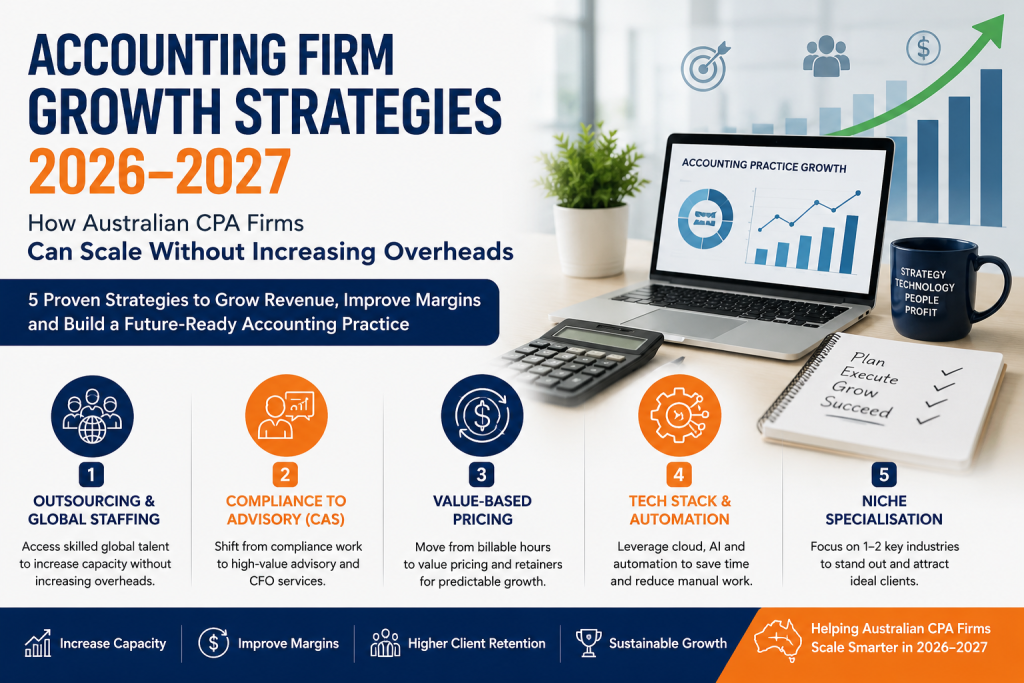
The Five Strategies at a Glance
Before the detail, here’s how the five strategies compare on effort, overhead impact, and how quickly each tends to show results.
| Strategy | Core Action | Overhead Impact | Typical Time to Results |
| 1. Outsourcing & Global Staffing | Add trained capacity via offshore/outsourced roles for process-heavy work | Adds capacity without growing the fixed local cost base | ~1 quarter with a proper ramp-up |
| 2. Compliance → Advisory (CAS) | Redirect freed-up hours into forecasting, CFO support, and tax planning | Same headcount, higher revenue per client | 2–4 quarters |
| 3. Modern Pricing & Billing | Shift from billable hours to value-based or retainer pricing | No overhead change; margin and predictability rise | 2–4 quarters (pilot, then migrate) |
| 4. Tech Stack & Automation | Integrate cloud ledger, AI tools, and practice management software | Cuts manual hours; can reduce future hiring need | Ongoing, compounding over time |
| 5. Niche Specialisation | Concentrate on 1–2 verticals already present in the client base | No overhead change; reduces price competition | 2+ quarters to build reputation |
Every Australian CPA firm knows the feeling: the pipeline is full, tax season is looming, and there simply aren’t enough hours — or hands — to get through it. Client demand for advisory work is rising faster than compliance-only staffing models can absorb, and the accountants available to hire are getting harder to find and more expensive to keep. This is the real growth ceiling facing Australian practices heading into 2026–2027: it isn’t a lack of opportunity, it’s a lack of capacity. The accounting firm growth strategy that works in this environment isn’t “hire more people” — it’s building revenue, margin, and client value without adding proportional overhead. Here are five ways Australian CPA firms are doing exactly that.
The Modern Growth Challenge: Capacity vs Revenue
The maths behind this problem is stark. The Australian Bureau of Statistics estimates the profession will need around 338,000 accountants to meet demand through 2026, which works out to roughly 10,000 new professionals needed every year — a number the current graduate pipeline isn’t close to filling. Chartered Accountants ANZ’s own member survey of 2025 vacancies found fill rates for tax accountants sitting at around 55%, well under the 67% threshold typically used to flag a genuine occupational shortage, with general accountant and internal auditor roles running even lower. At the same time, entries into the Professional Year program — the on-ramp for new accountants — have collapsed from over 7,000 in 2018 to only a few hundred in recent years, while a wave of experienced practitioners is expected to exit the workforce by 2026.
For a firm on the ground, this shows up as a familiar cycle: partners and senior staff doing work that should sit several levels below them, tax season capacity crunches that never quite ease, and client requests for advisory services that go unanswered simply because there’s no one free to take them on. Growth strategy for the next two years has to solve for this capacity constraint first — everything else, from advisory expansion to niche specialisation, depends on freeing up the hours to do it.
Strategy 1 — Expand Capacity Through Strategic Outsourcing & Global Staffing
If there’s one strategy that determines whether the other four are even possible, it’s this one. Local hiring in Australian accounting is now defined by long lead times, rising salary expectations, and a shrinking pool of qualified candidates — a direct consequence of the graduate and Professional Year shortfalls outlined above. Firms that keep trying to solve a capacity problem purely through local headcount are competing for the same shrinking talent pool as every other practice in the market, and paying more for it every year.
Strategic outsourcing and global staffing solve the equation differently: they add trained accounting capacity without adding to the fixed local cost base, and without the multi-month lead time of a local hire. What should stay local and firm-side is anything involving direct client relationships, technical sign-off, and advisory judgement calls — the work that actually needs a partner’s name attached to it.
| Function | Outsource? | Why |
| Bookkeeping & data entry | Yes | Process-heavy, well-documented, low client-facing judgement |
| Payroll processing | Yes | Repeatable, rules-based, easy to standardise |
| BAS / IAS lodgement prep | Yes (prep only) | Standardised preparation work; sign-off stays local |
| Tax return & statutory account prep | Yes (prep only) | Draft prep offshore; technical review stays with a qualified local reviewer |
| Client relationship management | No | Requires direct trust and firm-specific context |
| Advisory & strategy conversations | No | Requires partner-level judgement |
| Technical sign-off & ATO lodgement | No | Regulatory requirement for a locally qualified reviewer |
For Australian firms specifically, three considerations matter more than they do elsewhere: data security (client financial data needs to sit behind the same security and access controls whether it’s processed onshore or offshore), ongoing ATO compliance oversight (outsourced preparation still needs a locally-based, qualified reviewer signing off before anything is lodged), and time zone alignment — Philippines-based teams, in particular, offer a working-day overlap with Australian business hours that many offshore markets don’t.
When evaluating an outsourcing or global staffing partner, look for demonstrated familiarity with Australian software and compliance requirements (Xero, MYOB, BAS/IAS processes), verifiable data security and access controls, and a defined trial or pilot period before any long-term commitment — the goal is to validate the arrangement, not take it on faith.
Solving the local hiring bottleneck without overhead
The practical rollout matters as much as the decision to outsource. Firms that get the most out of this strategy tend to start with role-based outsourcing — a specific function like bookkeeping or payroll — rather than outsourcing an entire department on day one. A structured ramp-up period, with defined quality-control checkpoints at the two-week, one-month, and one-quarter marks, lets a firm validate accuracy and turnaround before scaling the arrangement across a larger share of compliance work.
Strategy 2 — Transition from Compliance to High-Margin Advisory Services
Compliance work — tax returns, BAS lodgements, statutory accounts — is necessary, but it’s also the most commoditised, most price-competitive part of an accounting firm’s offering. Advisory and Client Accounting Services (CAS) work — cash flow forecasting, fractional CFO support, tax planning, and business strategy conversations — commands meaningfully higher fees per hour and builds a stickier, more consultative client relationship. The firms growing fastest right now aren’t necessarily doing more compliance work; they’re doing a higher proportion of advisory work per client.
The direct link back to Strategy 1 is deliberate: the hours freed up by outsourcing compliance-heavy tasks are exactly the hours a firm needs to have advisory conversations in the first place. Without that freed-up capacity, advisory ambitions tend to stay aspirational rather than actual.
Upselling fractional CFO and tax planning services to existing clients
The easiest advisory clients to win are the ones a firm already has. A client is usually advisory-ready when they show one or more of the following signals:
- Consistent revenue growth over the past 12–24 months
- An upcoming business decision on the horizon — financing, acquisition, expansion, or a major hire
- Repeated ad hoc questions that go beyond compliance, especially around cash flow or forecasting
- A recent change in circumstances (new premises, new product line, entry into a new market)
A simple way to open the conversation is to frame it around a decision the client is already facing, rather than pitching a service: “given what’s coming up for you next quarter, would it help to build out a cash flow forecast together?” Commonly bundled advisory offerings include fractional CFO support, rolling cash flow forecasts, and forward tax planning — each of which can be introduced individually rather than as a full advisory retainer from day one.
Strategy 3 — Modernise Pricing & Billing Models
The billable hour has a structural ceiling: revenue can only grow as fast as headcount and hours worked, which is precisely the constraint this whole strategy set is built to escape. Value-based pricing and subscription or retainer models decouple firm revenue from hours logged, instead pricing based on the value and scope of the work delivered.
| Billing Model | How It’s Priced | Revenue Ceiling | Client Predictability |
| Billable hours | Time logged × hourly rate | Capped by hours worked | Low — varies month to month |
| Fixed-fee compliance | Flat fee per defined service | Capped by agreed scope | Medium |
| Value-based pricing | Priced on value/outcome delivered | Uncapped, tied to value created | Medium–high |
| Monthly retainer | Recurring fee bundling compliance + advisory | Uncapped, scalable with scope | High — predictable for both sides |
A compliance-only client billed by the hour has a revenue ceiling set by how many hours their return takes; that same client moved to a monthly advisory retainer — covering ongoing compliance plus forecasting and planning check-ins — typically represents a meaningfully higher and more predictable margin, without a proportional increase in delivery time. The transition doesn’t need to be immediate or firm-wide: introduce value-based or retainer pricing with new clients first, refine the model based on real delivery data, and only then start migrating existing clients across as their engagements come up for renewal.
Moving from billable hours to subscription and value-based pricing
In practice, this looks like scoping a fixed monthly fee that bundles compliance obligations with a defined amount of advisory time, rather than quoting and invoicing every task separately. It gives clients billing predictability and gives the firm a recurring revenue base that’s far easier to forecast than hour-by-hour billing.
Strategy 4 — Optimise Tech Stack & Implement Workflow Automation
Cloud accounting platforms like Xero and QuickBooks Online are now the baseline expectation in the Australian market, not a differentiator — the differentiator is what a firm builds around them. AI-assisted bookkeeping and document processing tools are increasingly handling first-pass data entry and reconciliation, freeing staff for review and exception-handling rather than manual entry. Practice management software ties the workflow together, giving visibility into job status, capacity, and bottlenecks across the team.
The governance angle matters as much as the tools themselves. As AI tools become standard in bookkeeping and document processing, Australian firms carry a specific compliance responsibility around how client financial data is handled, stored, and processed by any AI-enabled tool — client trust and ATO data-handling expectations both depend on getting this right, not just on picking the most feature-rich software.
Integrating cloud accounting, AI tools, and seamless practice management
Before adding any new tool to the stack, audit what’s already in place by asking:
- Does this tool integrate natively with our existing cloud ledger and practice management system, or will it need manual workarounds?
- Who owns the client data once it passes through this tool, and where is it stored?
- Does the vendor publish clear data security and access-control documentation?
- Will this reduce a specific, named bottleneck — or is it a general “nice to have”?
Integration compatibility between the practice management system, the cloud ledger, and any AI or automation add-ons matters far more than any single tool’s individual feature list — a firm with three tools that don’t talk to each other is often worse off than one with two that do.
Strategy 5 — Specialise in High-Value Industry Niches
Generalist firms compete on price because, from a client’s perspective, one generalist accounting service looks much like another. Firms that specialise in a specific vertical — becoming the go-to practice for a particular industry — compete on expertise instead, which supports higher fees, reduces price sensitivity, and drives referrals within that industry’s own network. The niche doesn’t need to be invented from scratch; it’s usually already visible in a firm’s existing client base, where a handful of clients in the same industry point to an underserved specialisation worth building out formally.
| Niche | Why It’s Underserved or Valuable |
| Hospitality | Cash flow volatility and rostering complexity most generalist firms don’t model well |
| Trades & Construction | Progress claims, retention amounts, and project-based accounting need specific expertise |
| E-commerce & SaaS | Subscription revenue recognition and multi-platform reconciliation are easy to get wrong |
| Medical & Allied Health | Trust accounting and practice-specific compliance requirements are highly specialised. |
Becoming the go-to firm for specific verticals
Niching also depends on the capacity freed up by Strategy 1 — a firm can pilot a new vertical without committing to a local hire dedicated to that niche, testing demand and building expertise before scaling the specialisation further.
Signs Your Firm Is Ready — and the KPIs to Track
Before committing fully to any of the five strategies above, a handful of KPIs indicate whether a firm is actually ready to scale, and which strategy to prioritise first:
| KPI | What It Shows | Watch For |
| Revenue per partner / FTE | Whether capacity is being used efficiently | A flat or falling trend signals a capacity, not a demand, problem |
| Realisation rate | The gap between hours billed and hours worked | A widening gap signals pricing or scoping issues |
| Advisory-to-compliance revenue mix | Whether Strategy 2 is actually gaining ground | A stagnant mix means advisory conversations aren’t converting |
| Client retention rate | How sticky the client base is | Advisory relationships retain better than compliance-only ones |
| Capacity utilisation at peak | Whether the firm is over-capacity at tax season | Persistent peak overload is the clearest signal to outsource |
Conclusion
None of these five strategies works particularly well in isolation. Outsourced capacity frees up the hours for advisory conversations; advisory revenue justifies a shift to value-based pricing; the right tech stack makes both scalable; and niche specialisation gives the whole system a defensible position in the market.
Treated together, they form a single growth system rather than a checklist — one built to grow revenue and margin without a matching increase in local overhead. For firms feeling the capacity crunch most acutely heading into the next tax season, the practical starting point is usually the same: talk to a team that can show what outsourced staffing could look like for your firm’s specific bottlenecks, before the next peak period arrives.
FAQs
What is the best growth strategy for an accounting firm in 2026?
There’s no single “best” strategy — the firms growing fastest in 2026 are combining outsourced capacity, advisory service expansion, and modern pricing models, rather than relying on any one lever alone.
How can accounting firms grow without increasing overheads?
By expanding capacity through outsourced or global staffing rather than local hires, then redirecting the freed-up hours toward higher-margin advisory work instead of proportionally more compliance staffing.
How can a small accounting firm scale without hiring more staff locally?
Outsourcing specific functions like bookkeeping, payroll, or compliance preparation adds trained capacity without the lead time, salary inflation, or fixed cost of a local hire.
What is client accounting services (CAS) and why is it growing?
CAS bundles compliance with ongoing advisory support — forecasting, planning, and CFO-style guidance — delivered as a recurring service rather than one-off compliance tasks, and it typically carries higher margins than compliance alone.
Should accounting firms move away from billable hours?
Not necessarily all at once — many firms pilot value-based or retainer pricing with new clients first, then migrate existing clients as engagements renew, rather than replacing billable hours firm-wide immediately.
What functions should an accounting firm outsource first?
Process-heavy, lower-judgement functions with clear documentation — bookkeeping, payroll, and compliance prep — are the easiest to outsource first, while client relationships and technical sign-off stay local.
Is outsourcing accounting work to the Philippines safe for Australian client data?
It can be, provided the arrangement includes the same data security controls, access restrictions, and a locally-based qualified reviewer signing off on any work before it’s lodged with the ATO.
What KPIs should accounting firms track for growth?
Revenue per partner, realisation rate, advisory-to-compliance revenue mix, client retention rate, and capacity utilisation at peak periods are the core five to track.
How is AI changing accounting firm operations in 2026?
AI tools are increasingly handling first-pass bookkeeping, data entry, and document processing, shifting staff time toward review and advisory work — provided firms manage the data-handling and governance side carefully.
What accounting tech stack do Australian firms need in 2026?
A cloud ledger (Xero or QuickBooks Online), AI-assisted bookkeeping and document tools, and practice management software that integrates cleanly across all three — integration compatibility matters more than any single tool’s features.
Should an accounting firm specialise in a niche industry?
Niching reduces price competition and increases referral flow within that industry. Most firms already have the beginnings of a niche visible in their existing client base rather than needing to build one from scratch.
How long does it take to see results from these growth strategies?
Outsourcing capacity gains typically show within one quarter given a proper ramp-up period; advisory revenue and pricing model shifts tend to build over two to four quarters as client conversations and renewals come through.