
 Australia
 USA
USA Canada
 UK
UK Ireland



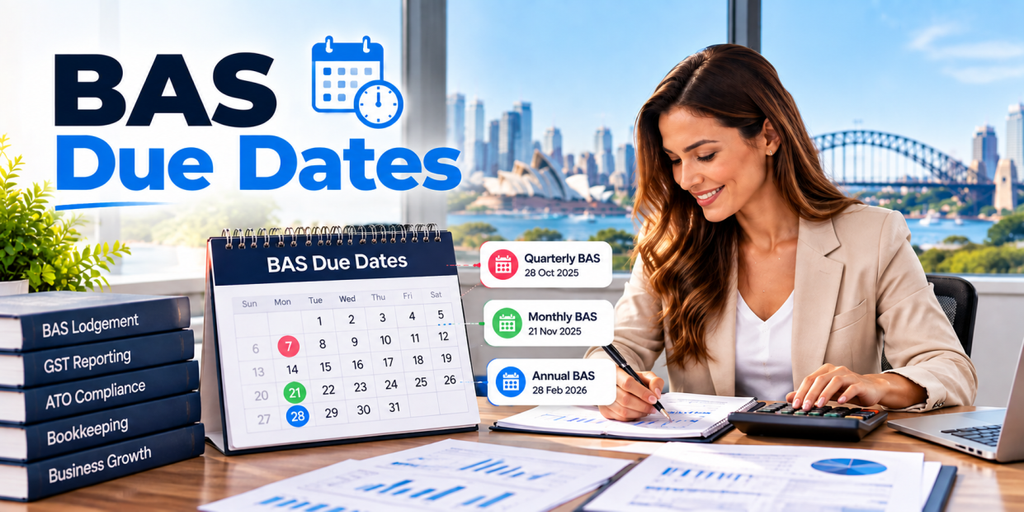
Quarterly BAS for July–September 2026 is due 28 October 2026, or 25 November 2026 via an eligible registered agent. Monthly BAS is due on the 21st of the following month. The December quarter is due 28 February 2027, or Monday 1 March 2027 because 28 February falls on a Sunday, with no standard agent extension. (Source: ATO)
Important: BAS due dates can vary depending on your reporting obligations and circumstances. Confirm the applicable due date through your ATO Online services account or with your registered tax or BAS agent.
This guide covers the 2026–27 BAS due dates, including quarterly, monthly and annual reporting, registered-agent concessions, weekend adjustments, late-lodgement penalties and common BAS mistakes.
BAS Due Dates 2026–2027 at a Glance!
| Reporting period | Standard due date | Eligible registered-agent date |
| Q1: July–September 2026 | 28 October 2026 | 25 November 2026 |
| Q2: October–December 2026 | 1 March 2027 because 28 February 2027 is a Sunday | No standard agent extension |
| Q3: January–March 2027 | 28 April 2027 | 26 May 2027 |
| Q4: April–June 2027 | 28 July 2027 | 25 August 2027 |
Monthly BAS: Generally due on the 21st of the following month, subject to applicable concessions and adjustments when the due date falls on a weekend or public holiday.
Annual BAS: The annual due date depends on your circumstances and reporting arrangement.
What is a Business Activity Statement (BAS)?
A Business Activity Statement (BAS) is an ATO reporting form used by businesses to report and pay certain tax obligations. Depending on your business and registration status, your BAS may include:
Goods and Services Tax: This consumption tax is applied to most of the goods and services in Australia, and businesses collect it on behalf of the government.
Pay-as-you-go (PAYG) instalments: are income tax prepayments that businesses and sole traders make yearly to reduce their end-of-year tax burden.
PAYG withholding tax: Businesses that employ staff must tax from employee wages and remit these amounts to the ATO regularly.
- Other applicable taxes: such as the Luxury Car Tax, Fuel Tax Credits, and Wine Equalisation Tax – These taxes apply to businesses in specific industries and must be reported accurately in BAS submissions.
GST is generally collected by GST-registered businesses on taxable sales and reported through the BAS. PAYG instalments are payments towards an expected income tax liability, while PAYG withholding is the amount withheld from certain payments to employees and other workers.
Submitting your BAS accurately and on time helps you meet your reporting and payment obligations. If you are unsure which obligations apply to your business, a registered tax or BAS agent can help you determine your reporting requirements.
When Is the Next BAS Due?
The next standard quarterly BAS deadline is 28 October 2026 for the July–September 2026 quarter.
If you lodge an eligible quarterly BAS through a registered tax or BAS agent, the applicable agent concession may extend the due date to 25 November 2026.
If you lodge your BAS yourself, check the due date in your ATO Online services account and allow enough time to prepare your GST, PAYG and other required figures.
BAS Lodgement Cycles and Due Dates
Your BAS reporting frequency depends on your GST registration and reporting obligations.
Quarterly BAS
Quarterly reporting is commonly used by businesses with GST turnover below $20 million. Businesses with GST turnover of $20 million or more generally need to report GST monthly, although other rules and elections can apply.
Monthly BAS
Businesses with GST turnover of $20 million or more generally need to lodge monthly BAS. Businesses below this threshold can also choose monthly GST reporting.
Monthly BAS is generally due on the 21st day of the following month.
Annual BAS
Some businesses that meet the relevant ATO requirements may report GST annually. Annual reporting can reduce the frequency of GST reporting for eligible businesses, but the specific due date and requirements depend on the business’s circumstances.
Do not rely solely on a general calendar if your business has unusual reporting arrangements. Check your ATO Online services account or speak with your registered tax or BAS agent.
BAS Due Dates for 2026–27
Quarterly BAS Due Dates 2026–27
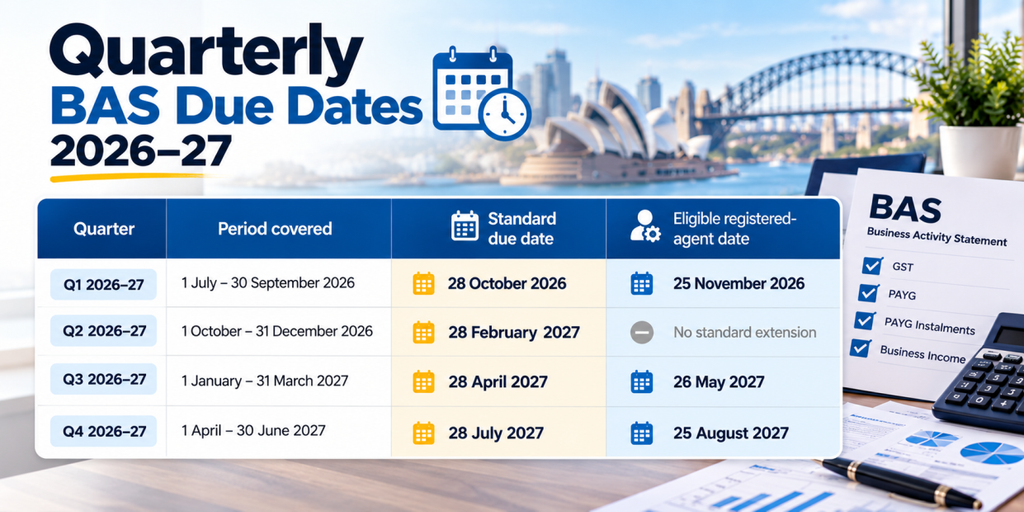
Grab a One Month Free Trial & Be Updated On Latest BAS Due Dates & Submission!
The second quarterly BAS is different from the other quarters because it covers October–December and has a standard due date of 28 February.
Monthly BAS Due Dates 2026–27
For businesses lodging monthly BAS, the standard due date is generally the 21st of the following month.
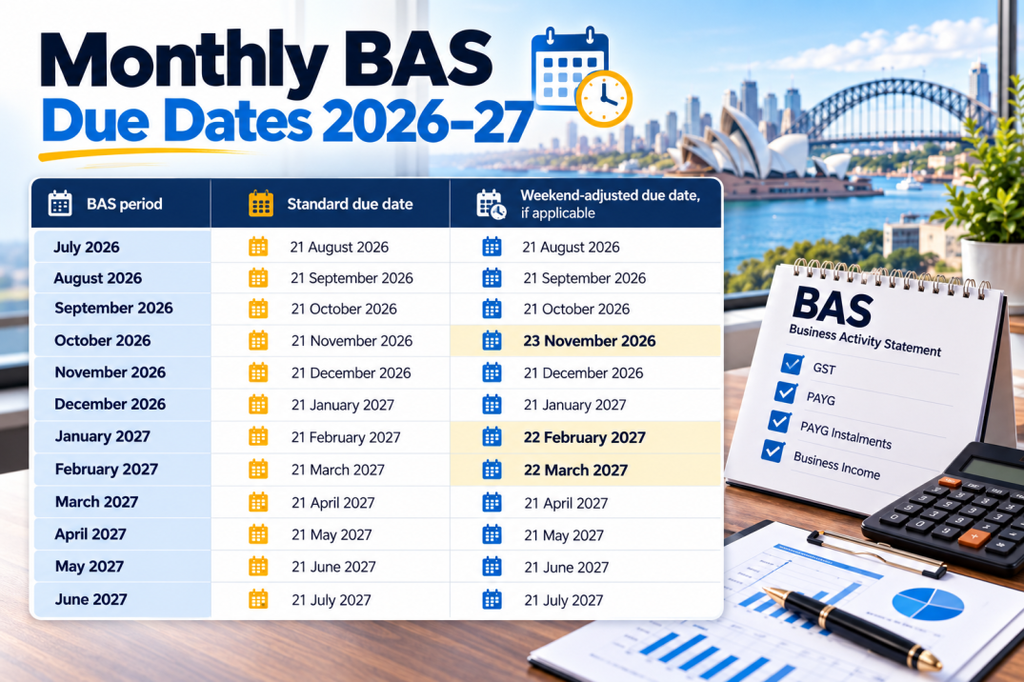
When a due date falls on a weekend or public holiday, the applicable next-business-day rule can affect the actual lodgement and payment date. Always confirm the date in your ATO account, particularly where public holidays apply.
Annual BAS Due Dates
For businesses that report GST annually, the annual GST return and payment are generally due 31 October following the end of the annual tax period. For the 2026–27 financial year, the annual BAS is therefore generally due 31 October 2027.
If you are not required to lodge an income tax return, the annual GST return is generally due 28 February following the end of the annual tax period. For the 2026–27 financial year, this means 28 February 2028.
If you use a registered tax or BAS agent, a different due date may apply under the applicable lodgement program. Confirm the date shown in your ATO Online services account or with your registered agent before relying on a general calendar.
Do BAS Due Dates Change When You Use a Registered Agent?
Eligible businesses that lodge quarterly BAS through a registered tax or BAS agent may receive additional time under the ATO’s agent lodgement program.
For the 2026–27 quarterly cycle, the commonly applicable dates are:
- Q1: 28 October 2026 → 25 November 2026
- Q2: 28 February 2027 → no standard extension
- Q3: 28 April 2027 → 26 May 2027
- Q4: 28 July 2027 → 25 August 2027
The December quarter is an important exception. Businesses should not assume that the usual agent extension applies to the Q2 BAS.
Eligibility for an agent concession depends on the applicable ATO requirements and lodgement arrangements. Check with your registered agent before relying on an extended date.
What Happens If a BAS Due Date Falls on a Weekend or Public Holiday?
If a BAS due date falls on a Saturday, Sunday or applicable public holiday, the due date may move to the next business day.
For example, 21 November 2026 falls on a Saturday. The applicable next-business-day date is therefore Monday, 23 November 2026.
This rule can affect monthly BAS and other ATO reporting obligations. Always check the applicable date rather than assuming that the 21st or 28th will always be the final lodgement day.
How Do I Know Which BAS Reporting Cycle Applies to My Business?
Your BAS reporting cycle depends on factors including your GST registration, GST turnover and other tax obligations.
GST Turnover
Businesses with GST turnover of $20 million or more generally need to report GST monthly. Businesses below $20 million can generally report quarterly, although monthly reporting may also be available by choice.
For GST registration, the threshold is generally $75,000, or $150,000 for not-for-profit organisations. Businesses that reach the applicable threshold generally need to register for GST, while businesses below the threshold can generally choose to register voluntarily.
PAYG Withholding
Your BAS obligations may also include PAYG withholding if you employ staff or otherwise have withholding obligations.
The frequency of your PAYG withholding reporting can differ from your GST reporting arrangements, so businesses should check their specific ATO obligations rather than assuming that all tax obligations follow the same cycle.
What Changed for BAS in 2026–27?
The basic quarterly BAS calendar continues to use the standard dates of 28 October, 28 February, 28 April and 28 July.
However, businesses should pay attention to updated figures and obligations that apply from 1 July 2026.
Updated Penalty Unit
From 1 July 2026, the Commonwealth penalty unit amount is $364.
This affects the monetary amount associated with penalties calculated using penalty units.
Updated PAYG Instalment Adjustment
For the 2026–27 income year, the ATO has published a 5% GDP adjustment factor for working out certain quarterly GST and PAYG instalment amounts.
The applicable treatment can depend on your circumstances, so check your BAS or ATO correspondence when calculating your instalment.
How to Lodge and Pay Your BAS
You can generally lodge your BAS using several methods, depending on your circumstances.
ATO Online Services
Businesses can use the ATO’s online services to manage, lodge and pay activity statements.
Accounting Software
Compatible accounting software can help businesses record transactions, reconcile accounts and prepare information needed for BAS reporting.
Registered BAS or Tax Agent
A registered BAS or tax agent can prepare and lodge BAS on your behalf and help you manage your reporting obligations.
Paper Lodgement
Paper lodgement may be available in some circumstances, although online lodgement is widely used for BAS reporting.
Regardless of the method you choose, make sure your records are reconciled and the BAS is lodged by the applicable due date.
Common BAS Mistakes That Can Lead to Problems
Even businesses with established accounting processes can make BAS errors. Common problems include:
Misclassifying GST Transactions
Not every sale or purchase is treated the same way for GST purposes. Incorrectly classifying taxable, GST-free or input-taxed transactions can result in inaccurate BAS reporting.
Omitting PAYG Withholding
If your business has PAYG withholding obligations, make sure the relevant amounts are correctly recorded and reported.
Lodging on Time but Paying Late
Lodgement and payment are separate obligations. Lodging your BAS on time does not necessarily prevent interest from applying to an unpaid tax liability.
The ATO may charge a general interest charge (GIC) on certain unpaid amounts.
Missing an Agent Lodgement Date
Do not assume that simply appointing an agent automatically changes every BAS due date. Your agent should confirm whether the applicable concession applies to your activity statement.
Failing to Lodge a Nil BAS
If you are required to lodge a BAS, you generally still need to lodge it even when there is nothing to report.
A nil BAS can be lodged when the relevant reporting period has no amounts to report.
What Is the BAS Late-Lodgement Penalty in 2026–27?
The ATO can apply a Failure to Lodge (FTL) penalty when a required document is not lodged on time.
The base penalty is generally one penalty unit for each 28-day period or part of 28 days that the document remains overdue, up to five penalty units.
From 1 July 2026, one penalty unit is $364.
BAS Failure to Lodge Penalty 2026–27
| Delay | Penalty units | Amount at $364 per unit |
| 1–28 days late | 1 | $364 |
| 29–56 days late | 2 | $728 |
| 57–84 days late | 3 | $1,092 |
| 85–112 days late | 4 | $1,456 |
| 113+ days late | 5 | $1,820 |
Different penalty multipliers can apply to certain entities, including businesses that fall within specified turnover or withholding categories.
The ATO can also consider remission of penalties in appropriate circumstances. Do not assume that a penalty will automatically be waived.
What If You Cannot Pay Your BAS?
If you cannot pay your BAS liability in full by the due date, you should generally still lodge the BAS on time.
Lodging on time establishes the correct liability and can help you avoid additional consequences associated with failing to lodge.
If you cannot pay the amount in full, check whether you are eligible for an ATO payment arrangement or contact your registered tax or BAS agent for assistance.
Do not delay lodgement simply because you cannot immediately pay the amount owing.
General Interest Charge on Late BAS Payments
The ATO may apply General Interest Charge (GIC) when certain tax liabilities are paid late.
GIC is separate from a Failure to Lodge penalty. This means that a business can potentially face both a late-lodgement penalty and interest on an unpaid amount.
From 1 July 2025, GIC is no longer deductible for income tax purposes.
How Aone BAS Services Can Help
Managing BAS involves more than remembering quarterly deadlines. Accurate transaction coding, account reconciliation and timely preparation are important for reliable BAS reporting.
Aone Outsourcing can support businesses with:
- BAS preparation support
- GST and transaction reconciliation
- PAYG reporting support
- Accounting data preparation
- BAS-ready bookkeeping
- Monthly and quarterly accounting support
- Cloud accounting workflows
- Ongoing financial record maintenance
Our outsourcing model provides accounting support without requiring businesses to build every accounting function internally.
If you already work with a registered tax or BAS agent, Aone can also provide back-office accounting support while your appointed professional retains responsibility for review, professional judgement and lodgement where applicable.
How to Check Your BAS Due Date
Your actual BAS due date can depend on your reporting cycle, lodgement method and individual ATO arrangements.
Before lodging, check:
- Your ATO Online services account.
- The activity statement issued for the relevant period.
- Your registered tax or BAS agent, if applicable.
- Your accounting software’s BAS and tax calendar.
- The ATO’s current BAS due-date guidance.
Do not rely on an old BAS calendar if your reporting arrangements have changed.
BAS Due Date Checklist
Use this checklist before each BAS deadline:
- Reconcile bank and credit-card accounts.
- Review GST-coded transactions.
- Check GST collected and GST paid.
- Review PAYG withholding amounts.
- Check PAYG instalment amounts, where applicable.
- Confirm the reporting period.
- Check the exact ATO due date.
- Review the BAS before submission.
- Lodge by the applicable deadline.
- Arrange payment or a payment plan if required.
- Keep supporting records.
Final Takeaway
The first quarterly BAS deadline for the 2026–27 financial year is 28 October 2026, covering July–September 2026. Other standard quarterly dates are 28 February 2027 (1 March 2027 because 28 February 2027 is a Sunday), 28 April 2027 and 28 July 2027.
Monthly BAS is generally due on the 21st of the following month, while eligible businesses using registered agents may receive additional time for certain quarterly lodgements.
Because BAS obligations can vary by business, reporting cycle and circumstances, use the ATO’s current information or speak with a registered tax or BAS agent when you need to confirm a specific due date.
Frequently Asked Questions
1. What is a BAS and who needs to lodge it?
A Business Activity Statement is an ATO form used to report and pay certain business tax obligations, including GST, PAYG instalments and PAYG withholding. Businesses registered for GST generally need to lodge BAS according to their assigned reporting cycle.
2. When is BAS due in 2026–27?
Quarterly BAS is generally due on 28 October 2026, 28 February 2027 (1 March 2027 because 28 February 2027 is a Sunday), 28 April 2027 and 28 July 2027. Eligible businesses lodging through a registered agent may receive additional time for certain quarters.
3. When is the next BAS due?
The next standard quarterly BAS due date is 28 October 2026 for the July–September 2026 quarter.
Eligible businesses lodging through a registered tax or BAS agent may have a later due date, subject to the applicable agent lodgement program.
4. When is monthly BAS due?
Monthly BAS is generally due on the 21st day of the following month. If the date falls on a weekend or public holiday, the applicable next-business-day rule may change the actual due date.
5. What happens if I miss the BAS due date?
The ATO may apply a Failure to Lodge penalty when a required BAS is lodged late. General Interest Charge may also apply to certain unpaid tax liabilities. The amount of any FTL penalty depends on how late the document is lodged and the applicable penalty-unit value and multiplier.
6. What happens if a BAS due date falls on a weekend?
If the applicable BAS due date falls on a weekend or public holiday, the due date may move to the next business day. For example, 21 November 2026 falls on a Saturday, so the applicable date is Monday, 23 November 2026.
7. Can I get extra time to lodge my BAS?
Eligible businesses lodging through a registered tax or BAS agent may receive additional time under the agent lodgement program. The concession does not apply in exactly the same way to every BAS period, so confirm your applicable date with your agent.
8. Is there an extension for the December quarter BAS?
The December quarter has a specific due date of 28 February and should not be treated as having the same standard agent extension as the other quarterly BAS periods.
9. Can I lodge BAS myself without a tax agent?
Yes. Businesses can lodge their BAS themselves using the applicable ATO online services or compatible software. A registered BAS or tax agent can provide professional assistance with preparation and lodgement.
10. Do I need to lodge a BAS if I had no income?
If you are required to lodge a BAS, you generally still need to lodge it even if there is nothing to report for the period. This is commonly referred to as a nil BAS.
11. What should I include in my BAS?
Depending on your obligations, your BAS may include GST on sales, GST on purchases, PAYG instalments, PAYG withholding and other applicable tax obligations.
12. What is the penalty for late BAS lodgement in 2026–27?
From 1 July 2026, the penalty unit is $364. The standard FTL penalty is generally one penalty unit for every 28 days or part of a 28-day period, up to five units. This means the standard maximum is $1,820 before considering any applicable multiplier.
13. What is the difference between BAS and a tax return?
A BAS is used during the year to report obligations such as GST and PAYG amounts. An income tax return is used to report income and deductions and determine the income tax position for the relevant income year.
14. Do sole traders need to lodge a BAS?
A sole trader generally needs to lodge a BAS if registered for GST or otherwise required by the ATO to lodge an activity statement. GST registration thresholds and reporting obligations should be checked against the business’s individual circumstances.
15. What is the difference between BAS and IAS?
A BAS can be used to report GST and other obligations, while an Instalment Activity Statement (IAS) is generally used for certain PAYG obligations where a BAS is not required for GST reporting. The form you receive depends on your tax obligations and registration status.