
 Australia
 USA
USA Canada
 UK
UK Ireland




Accounting is no longer a backward-looking administrative chore. With the Australian Taxation Office (ATO) deploying automated data-matching algorithms and real-time reporting protocols, financial management has become an active operational driver. From intelligent cloud infrastructure and machine learning reconciliations to strict digital compliance, Australian businesses need leaner, more resilient finance functions.
Finance professionals are no longer hired just to key in receipts or lodge quarterly activity statements. Today, businesses rely on their finance teams for predictive cash-flow forecasting, data security, and strategic advisory.
In this blog, we’ll explore the top business accounting trends that are shaping the future of finance in Australia. Whether you are a small business owner or managing a growing accounting firm, staying ahead of these trends can help you save time, reduce costs, and make good financial choices. We’ll also show you how Aone Outsourcing Solutions can help you embrace these changes with expert support and future-ready accounting systems.
2026–27 Accounting Trends at a Glance
| Trend | Core Shift | Strategic Impact for AU Businesses |
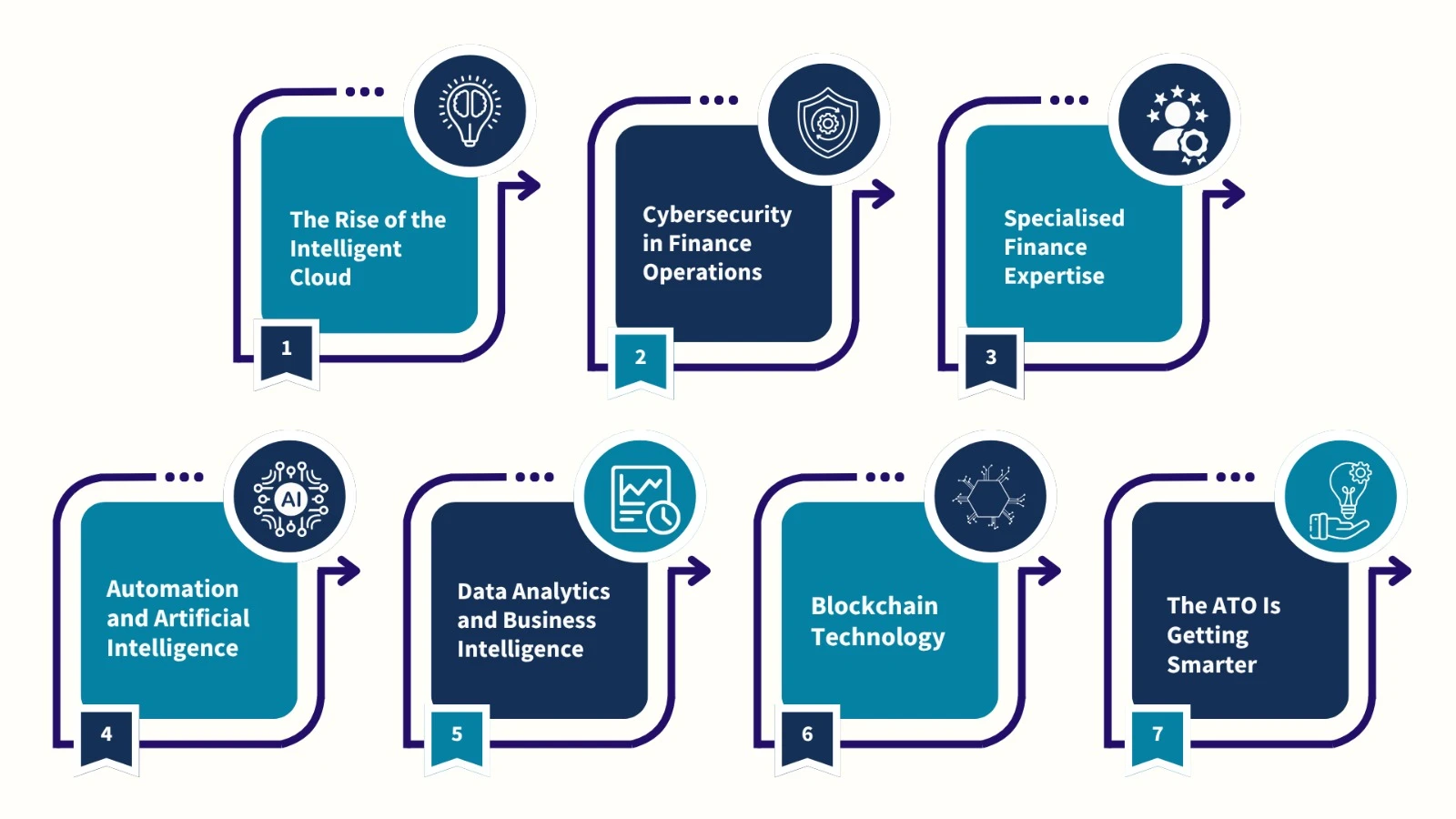
| 1. Intelligent Cloud | Deep API integration & machine learning reconciliations | Instant financial visibility without month-end processing bottlenecks. |
| 2. Financial Cybersecurity | ACSC Essential Eight alignment & strict client data controls | Protects sensitive payroll, TFN, and banking records from ransomware and phishing. |
| 3. Specialised Resourcing | On-demand FP&A, audit-prep, and technical compliance | Solves local talent shortages by deploying fractional, skilled accounting teams. |
| 4. AI & Workflow Automation | Automated invoice capture, OCR extraction, and rule engines | Cuts manual processing hours by over 60% and eliminates human entry error. |
| 5. Predictive Analytics | Dynamic rolling forecasts and working capital dashboards | Replaces static historical P&Ls with forward-looking cash-flow management. |
| 6. Digital Ledger Integrity | Smart-contract workflows and tamper-proof verification | Speeds up cross-border trade settlements and multi-entity reconciliations. |
| 7. ATO Digital Compliance | Automated STP Phase 2 validation & B2G e-invoicing alignment | Eliminates data mismatches that trigger audits and late lodgement penalties. |
1. The Rise of the Intelligent Cloud
Cloud-based accounting is changing how businesses function and make decisions, not just storing data online. Australian businesses are using intelligent cloud platforms which integrate AI and machine learning with cloud functionalities. Apart from this, automating tasks, these cutting-edge systems offer real-time insights, predictive analytics, and robust collaboration tools that help finance teams and business owners operate more productively and successfully.
Cloud accounting eliminates the overhead of on-premise servers and software licences while enabling flexible, subscription-based scalability. It fundamentally improves operational agility: management teams can review real-time dashboards, evaluate performance across business units, and make strategic decisions without waiting weeks for month-end books to close.
At Aone Outsourcing Solutions, our accountants are certified in multiple cloud platforms and help clients set up, manage, and optimise these systems. Whether it’s real-time reporting, AI-powered dashboards, or integrating payroll and BAS tracking, we make cloud adoption smooth and results-driven.
2. Cybersecurity in Finance Operations
Financial ledgers hold a company’s most sensitive assets: payroll files, Tax File Numbers (TFNs), bank details, and customer billing histories. Cyber threats—including business email compromise (BEC) and targeted ransomware—continue to pose severe financial and operational risks. Data from the Australian Cyber Security Centre (ACSC) indicates that small and medium businesses face an average cost exceeding $40,000 per reported cyber incident, making financial data governance a non-negotiable priority.
Australian organisations must maintain strict compliance with the Privacy Act 1988 and implement operational safeguards aligned with the ACSC Essential Eight framework. For businesses dealing with international clients or cross-border vendor data, systems must also satisfy overseas standards like GDPR or CCPA where applicable.
At Aone Outsourcing Solutions, security is baked into our workflow. We enforce enterprise-grade data protection, multi-factor authentication (MFA), encrypted client portals, and regular internal compliance audits to ensure your sensitive financial data remains secure at all times.
3. Specialised Finance Expertise
As business regulations grow more intricate, standard bookkeeping is no longer enough on its own. Australian businesses frequently require specialized technical support—such as statutory audit preparation, R&D tax incentive tracking, international tax compliance, and forward-looking financial planning and analysis (FP&A). However, hiring full-time, in-house specialists for every niche area is cost-prohibitive and difficult amid local talent shortages.
At this point outsourcing to highly-competent professionals comes to the rescue. Finance partners needed by businesses include experience in technical accounting, regulatory compliance (such as with IFRS or US GAAP), and such tools as financial planning and analysis (FP&A), budgeting, and risk management.
Aone Outsourcing Solutions unites a group of financial professionals that possess vast experience in many spheres, such as healthcare, construction, real estate, and e-commerce. We provide access to specialised expertise in the areas of compliance, tax, audit preparation, ESG reporting and so much more. Have international tax issues or are you struggling to have better financial projections? Aone can be your solution because they possess the skills and knowledge but are not attached to the overhead costs.
4. Automation and Artificial Intelligence
Eliminating manual data entry is now an operational baseline. Modern finance teams use intelligent optical character recognition (OCR) and rule-based workflows—via platforms like Dext, Hubdoc, and native cloud AI tools—to automatically capture supplier invoices, match purchase orders, and reconcile standard bank transactions.
Such technologies as Robotic Process Automation (RPA) and Machine Learning (ML) are actively introduced to identify mistakes, patterns, and predictions. NLP is also used to retrieve valuable information out of contracts, email, and receipts. Even chatbots, with the powerful tools of AI, seem to work on answering accounting questions or other types of client onboarding.
At Aone Outsourcing Solutions, we combine smart automation tools with seasoned professional oversight. We automate data extraction and high-volume matching while applying human review for quality control—giving you faster turnaround times and dependable, accurate ledgers.
5. Data Analytics and Business Intelligence
These days, simply having financial data isn’t enough you need to understand what it means. That’s why data analytics and business intelligence tools are becoming essential in accounting. In 2025, forward-thinking businesses are using these tools to uncover patterns, spot risks, manage cash flow, and guide strategic decisions.
With the right analytics, companies can track KPIs in real time, build dashboards, and forecast future trends. This kind of insight helps businesses plan ahead, control spending, improve profit margins, and even secure investor confidence. For example, analytics can show which product lines are underperforming, how late payments are affecting cash flow, or what financial risks lie ahead.
Aone Outsourcing Solutions helps clients move beyond basic reporting by setting up powerful financial dashboards and KPI trackers tailored to their industry. We transform numbers into meaningful insights—helping you not just manage your books, but make better decisions with them.
6. Blockchain Technology
Blockchain is relatively new but is already causing ripples in the accounting sector. It perfectly fits the industry where audit trails and trust are paramount because of its capacity to generate tamper-proof, transparent, decentralised financial records. Blockchain has the potential to minimize cheating, speed up settlements, and make reconciliation a much easier task, especially within the realms of cross-border payments and asset tracking.
Though the journey to full adoption remains in the beginning stages, more outsourcing firms and accounting software providers are considering how to include blockchain and enhance their security and audit-readiness.
At Aone we are keeping up with these innovations by observing how technologies such as blockchain can improve client trust and data integrity. Our clients become one of the first to enjoy the benefits of safer, smarter financial systems.
7. The ATO Is Getting Smarter
The Australian Taxation Office is undergoing a digital transformation, and businesses that don’t keep pace are at risk of penalties, audits, and delayed returns. From Single Touch Payroll (STP) Phase 2 and e-invoicing mandates to real-time data matching, the ATO now expects businesses to operate with a higher level of transparency and reporting accuracy. Compliance is no longer just about lodging your BAS or annual tax return—it’s about maintaining consistent, audit-ready records throughout the year.
Key compliance priorities for 2026–27:
- STP Phase 2 Reporting: Disaggregated income streams, paid leave, overtime, and allowances must be classified accurately with zero room for manual payroll errors.
- Super Guarantee (SG) Verification: Automated matching between payroll submissions and clearing house receipts allows the ATO to spot unpaid or late super contributions rapidly.
- E-Invoicing Standards: While business-to-business (B2B) e-invoicing remains voluntary, Commonwealth government agencies mandate Peppol-compliant e-invoicing for public procurement (B2G). Suppliers in government supply chains must ensure their invoicing software is Peppol-ready.
Aone Outsourcing Solutions helps businesses meet these heightened standards by providing compliance-ready bookkeeping and tax services. Their offshore team stays up to date with every change in ATO regulations, STP, BAS deadlines, and GST updates. With Aone, Australian businesses no longer need to fear ATO scrutiny—they’re prepared for it.
How Aone Outsourcing Solutions Helps You Stay Ahead to Be Future-Ready
The future of business accounting is fast, digital, and data-driven—and to stay competitive, your finance operations need to be just as agile. At Aone Outsourcing Solutions, we help Australian businesses move beyond traditional accounting models and embrace smarter, future-ready solutions that drive long-term success.
1. Built for the Future of Accounting
We integrate the latest accounting trends—cloud platforms, automation, real-time reporting, and AI-powered insights—into your everyday operations. This means you’re not just keeping up with change, you’re staying ahead of it.
2. Cloud-First, Always Connected
Our team is fully trained in Xero, MYOB, QuickBooks, and other cloud-based platforms. We streamline your workflows, automate routine tasks, and enable 24/7 access to your financials—so your team and ours can collaborate seamlessly, anytime, from anywhere.
3. Smarter Insights, Better Decisions
Custom management dashboards give you clear visibility into debtor days, cash runways, and operating margins. This empowers you to make proactive, data-backed decisions, not just react to problems after they occur.
4. Secure, Compliant, and Audit-Ready
As regulations tighten and cybersecurity threats grow, we stay ahead of both. Aone uses enterprise-grade data protection, encrypted portals, multi-factor authentication, and regular audits to keep your financial data safe and compliant, always.
5. Scalable Support That Grows With You
Whether you need a single bookkeeper or a full-service virtual finance team, Aone scales with your needs. As your business grows, we plug in the right skills and services—from payroll and BAS to CFO-level support—without increasing your overhead.
7. Industry-Specific Solutions
Reduce domestic wage and recruitment overhead by up to 50% without compromising work quality or turnaround times. Transparent pricing, zero hidden fees, and long-term ROI make outsourcing with Aone a smart financial move.
8. Cost Savings Without Compromise
Our offshore model saves businesses up to 50% on finance team costs, while delivering the same (or higher) quality of service you’d expect in-house. Transparent pricing, zero hidden fees, and long-term ROI make outsourcing with Aone a smart financial move.
Aone isn’t just a service provider—we’re your long-term partner in building a smarter, more resilient, and future-ready finance function.
Wrapping Up…
Accounting in Australia is no longer just about staying compliant; it’s about staying competitive. The trends we’re seeing in 2025—from intelligent cloud platforms and AI automation to advanced cybersecurity and data analytics—are not just buzzwords; they’re a reality.
The above-reported trends, such as cloud platforms, automation, improved security, and analytics, have enabled companies in Australia to become more efficient, reduce expenses, and maintain control. Early adopters will be in a better position to grow, scale, and to become competitive with the changes taking place in a dynamic environment.
Aone Outsourcing Solutions will assist you to be the change. With the help of smart tools, skilled professionals, and customised support, we can modernise your finance processes, meet deadlines, and focus more on growth, all without stretching your internal resources.
Do you want to work smart and stay ahead?
Let Aone accompany you in developing a future-proof financial system. Sign up for free and try it now.
FAQs
- What are the primary accounting trends for Australian businesses in 2026–27?
The major shifts center on intelligent cloud accounting, automated invoice and payroll processing, advanced data-matching compliance by the ATO, and stronger cybersecurity standards around financial ledgers.
- Is e-invoicing mandatory for all Australian businesses?
No. Business-to-business (B2B) e-invoicing is currently voluntary across the private sector. However, e-invoicing via the Peppol framework is mandatory for Commonwealth government agencies receiving invoices (B2G), making it a key requirement for businesses tendering for government contracts.
- How does the ATO cross-check business tax and payroll records?
The ATO matches business-reported figures against external data feeds, including STP Phase 2 payroll reporting, SuperStream data from superannuation clearing houses, bank interest records, and TPRS data from industries like construction and cleaning.
- Why are Australian firms shifting to outsourced accounting models?
Outsourcing helps businesses bypass domestic talent shortages and high wage overheads. It provides immediate access to trained specialists for cloud management, compliance, and reporting at a fraction of the cost of full-time internal hires.