
 Australia
 USA
USA Canada
 UK
UK Ireland
The SMSF tax return due date depends on how your fund lodges: 31 October 2026 for self-preparing funds and for newly registered funds lodging their first annual return, 28 February 2027 for most existing self-preparers and new funds using a registered tax agent, and generally 15 May 2027 for established funds lodging through a tax agent (funds with income over $2 million usually move forward to 31 March 2027). Missing your SMSF lodgement due date can trigger failure-to-lodge penalties and put your fund’s complying status at risk.
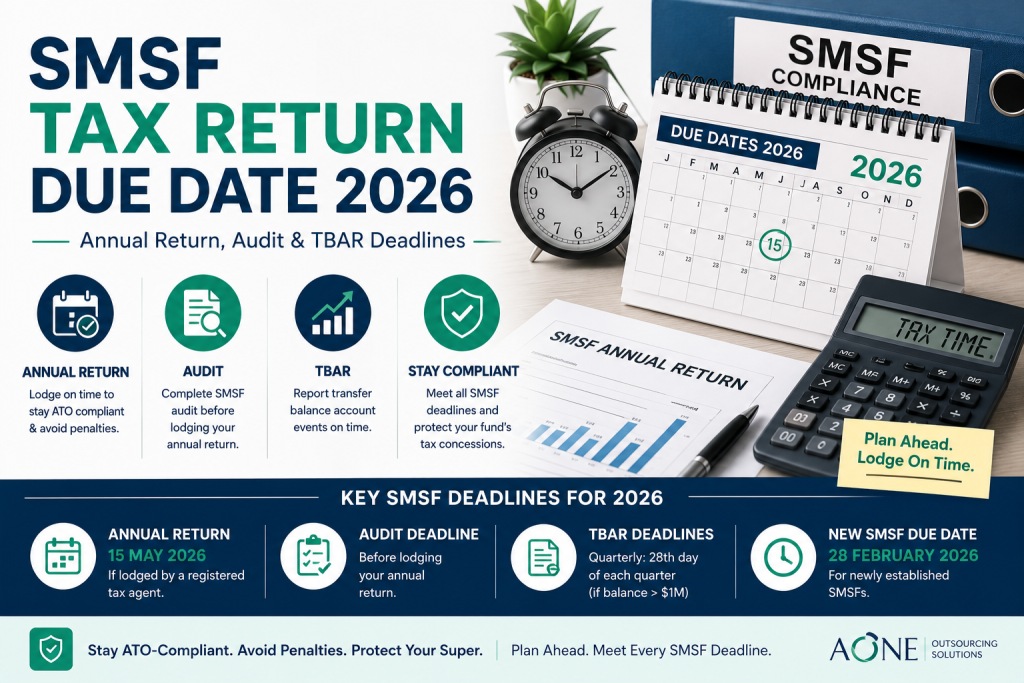
Important SMSF Due Dates & Reporting Requirements
One essential part of SMSF management includes completing annual returns while handling contributions and pension payments and complying with lodgement requirements. Here is the comprehensive list of SMSF due dates:
| Fund category | Due date | Notes |
| New SMSF — first return, self-prepared | 31-Oct-26 | Applies to funds registered in 2025–26 lodging their own SAR |
| New SMSF — first return, tax agent client | 28-Feb-27 | *Some new funds are still assigned 31 Oct 2026 at registration review — check the registration letter |
| Existing SMSF — self-preparer | 28-Feb-27 | Standard date for ongoing self-lodging funds, no overdue prior-year returns |
| Existing SMSF — overdue prior-year SAR | 31-Oct-26 | Loses the later self-preparer date |
| Existing SMSF — agent-lodged (standard) | 15-May-27 | Varies by tax agent’s lodgment program placement |
| Existing SMSF — agent-lodged, income over $2M | 31-Mar-27 | Usually brought forward under the lodgment program |
1. SMSF Annual Return (SAR) Lodgement Due Dates
The SMSF Annual Return (SAR) demands reporting of financial data combined with income statements and deductions alongside regulatory requirements of the fund.
Annual Return Lodgment Due Date for New SMSFs: New SMSF organisations must lodge their first Annual Return on February 28th of the subsequent financial year when the fund becomes established during that year.
Annual Return Lodgment Due Date for Existing SMSFs: If tax professionals file the documents, SMSF trustees must submit their annual returns on 15 May. However, the deadline shifts to 31 October when the fund submits its returns independently.
- How to Lodge SMSF Annual Returns: There are three options to lodge SMSF annual returns that include using the ATO’s online services, a registered tax agent,or an eligible paper form.
What Happens if You Miss a Due Date?
A late SMSF annual return attracts a Failure to Lodge penalty of $330 per 28-day period overdue, capped at $1,650. Your fund’s status can also change to “regulation details removed” on Super Fund Lookup, blocking rollovers and employer contributions until resolved.
2. SMSF Audit Deadline
Every Single-Member Superannuation Fund (SMSF) must undergo an audit before submitting its annual return.
Audit Completion Deadline: SMSF audits must be completed before the self-managed super fund’s annual return needs to be submitted.
Trustee Responsibility: Trustees are responsible for delivering financial records to their auditing service before the submission deadline.
- Penalty for Non-Compliance: A delayed audit can lead to a postponed SAR submission, resulting in potential administrative fines.
The ATO requires trustees to appoint an approved SMSF auditor at least 45 days before the fund’s annual return is due — the audit needs to start well ahead of your lodgment date, not the week before.
3. Superannuation Guarantee (SG) Contribution Deadlines
Independent contractors making superannuation guarantee (SG) contributions to SMSFs for employee members must meet specific SG deadline requirements.
Quarterly Due Dates:
28 January (for the October – December quarter)
28 April (for the January – March quarter)
28 July (for April – June quarter)
28 October (for the July – September quarter)
Late Contributions: Late submissions cause financial penalties and compel organisations to file Superannuation Guarantee Charge (SGC) statements.
4. Minimum Pension Payment Due Date
SMSFs need to withdraw their minimum pension payments before the financial year’s 30 June date when they provide retirement income streams (pensions) to their members.
Pension income taxation at superannuation tax rates will be triggered if an SMSF fails to meet its required withdrawal amount.
Pension Minimum Withdrawal Deadline
If your SMSF pays a retirement-phase pension, the fund must withdraw at least the minimum pension amount by 30 June each year. Falling short affects the fund’s exempt current pension income (ECPI) claim for that year.
5. Transfer Balance Account Report (TBAR) Due Dates
SMSFs must use the Transfer Balance Account Report (TBAR) to report all events which impact members’ transfer balance caps.
- Quarterly Reporting: Since 1 January 2026, the $1 million threshold no longer applies. Every SMSF now reports quarterly whenever a reportable event occurs (a pension starting, a commutation, a reversionary death benefit, etc.), regardless of member balance. No event in a quarter means no TBAR is required for that quarter.
| Quarter | TBAR due date |
| 1 Oct–31 Dec | 28-Jan |
| 1 Jan–31 Mar | 28-Apr |
| 1 Apr–30 Jun | 28-Jul |
| 1 Jul–30 Sep | 28-Oct |
The general transfer balance cap was indexed to $2 million from 1 July 2025.
- Annual Reporting: SMSFs must file their annual reporting with their annual tax return if they possess amounts less than $1 million.
- Significance: Failure to report transfer balance information at the right time creates an increased risk for unnecessary transfer balance tax payments.
6. Tax Lodgement Dates & PAYG Instalments
Where an SMSF has taxable income for which Pay-As-You-Go (PAYG) instalments are due or for which it is registered for GST, lodgement due dates apply:
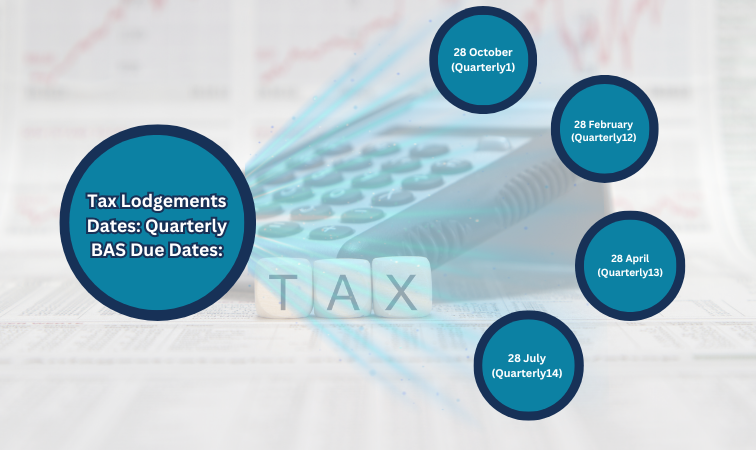
Tax Lodgements Dates: Quarterly BAS Due Dates:
28 October (Q1)
28 February (Q2)
28 April (Q3)
28 July (Q4)
PAYG Instalments: Due quarterly according to ATO schedule.
Tax Lodgement Due Date for SMSFs: The normal due date for lodging SMSF tax returns is 15 May if lodged by a registered tax agent. But if the SMSF is newly registered, the due date could be sooner (28 February).
Delay in Lodging: A delay in lodgement can lead to penalties and loss of concession tax treatment.
Under the incoming Payday Super reform, employers must pay super contributions within 7 business days of each payday from 1 July 2026, rather than quarterly.
7. Tax Agent Concessions for Lodgement Extension
If the SMSF has a registered tax agent, there may be lodgement extensions:
15 May Extension: Most SMSFs that lodge with a tax agent have until 15 May of the next financial year.
- New Funds: New SMSFs can have a different due date, typically 28 February.
New in 2026: Division 296 Tax
Division 296 passed Parliament in March 2026 and commenced 1 July 2026 — a personal tax (not a fund-level tax) on members with a Total Superannuation Balance above $3 million, calculated on realised earnings. First assessments relate to 2026–27 and issue after 30 June 2027.
What are the Best Ways to Practice SMSF Compliance?
To guarantee compliance with every due date, SMSF trustees should:
Maintain Detailed Financial Records: Monitor all contributions, investments, expenses, and tax documents to be able to report accurately.
Engage a Registered SMSF Auditor Early: Hiring an auditor ahead of time avoids last-minute rushes and guarantees compliance with ATO rules.
Use a Tax Agent for Lodgement: Professional tax agents can assist with lodgement responsibilities, understand intricate tax requirements, and obtain deadline extensions.
Automate Contributions & Pension Payments: Direct deposits or reminders can avoid missed tax lodgement deadlines and non-compliance problems.
Stay Updated on Regulatory Changes: The ATO regularly updates SMSF rules, so trustees should frequently check ATO guidance or seek the advice of a professional.
Utilise an SMSF Compliance Calendar: Monitoring due dates in a calendar can avoid oversights and provide timely lodgement of necessary reports.
Periodic Review of Fund Investment Strategy: Trustees must make sure that their fund’s investment strategy is compatible with ATO compliance requirements and risk tolerance.
How Aone Outsourcing Solutions Can Assist
SMSF management is difficult and time-consuming. Aone Outsourcing Solutions provides specialised SMSF administration and compliance services to make sure your fund complies with all legislation. Our services are as follows:
SMSF Annual Return Preparation & Lodgement
Independent SMSF Audit Coordination
Super Contribution & Pension Payment Tracking
ATO Compliance & Regulatory Updates
BAS & PAYG Lodgements
By partnering with Aone Outsourcing Solutions, SMSF trustees can build their superannuation reserves while we resolve compliance issues and administrative matters. Call us today to learn how we can help you with your SMSF management requirements!
Conclusion
Keeping track of SMSF due dates — annual returns, audits, TBAR, pensions, and contributions — is key to staying compliant and avoiding penalties. A simple compliance calendar and early planning go a long way. If you’d rather leave it to the experts, Aone Outsourcing Solutions can manage it all for you — get in touch today.
FAQ
What happens if I miss my SMSF lodgement due date?
Missing your due date triggers a Failure to Lodge penalty of $330 for every 28 days the return is overdue, up to a maximum of $1,650. Beyond the fine, the ATO can change your fund’s status to “regulation details removed” on Super Fund Lookup. This blocks employer contributions and rollovers into your fund until the lodgement is brought up to date, so the practical impact often outweighs the penalty itself. If you’re at risk of missing a deadline, engaging a tax agent before the due date can sometimes secure you a later lodgement date under their program.
Can I lodge my SMSF’s annual return myself without a tax agent?
Yes. Self-preparing trustees can lodge directly through the ATO’s online services or via an eligible paper form. The trade-off is timing: self-lodged returns are generally due earlier (31 October for new funds, or 28 February for most existing self-preparers) than agent-lodged returns, which can extend out to 15 May. Self-lodging also means you carry full responsibility for accuracy and for coordinating your audit before you lodge.
Does every SMSF now need to lodge TBAR quarterly?
As of 1 January 2026, yes — the previous $1 million balance threshold has been removed. Every SMSF must now report quarterly whenever a reportable event occurs, such as a pension starting, a commutation, or a reversionary death benefit. If no event occurs in a given quarter, no TBAR is required for that quarter. This is a shift from the old system, where only members with balances over $1 million reported quarterly, and everyone else reported annually with their tax return.
Does the audit need to be finished before the annual return is due, or can it happen at the same time?
The audit must be completed before lodgement, not alongside it. The ATO expects trustees to appoint an approved SMSF auditor at least 45 days before the annual return is due, giving the auditor genuine lead time rather than a last-minute scramble. A delayed audit directly delays your SAR lodgement and can expose the fund to the same late-lodgement penalties as missing the deadline outright.